Public framework sheet
GODREAMET Framework Sheet
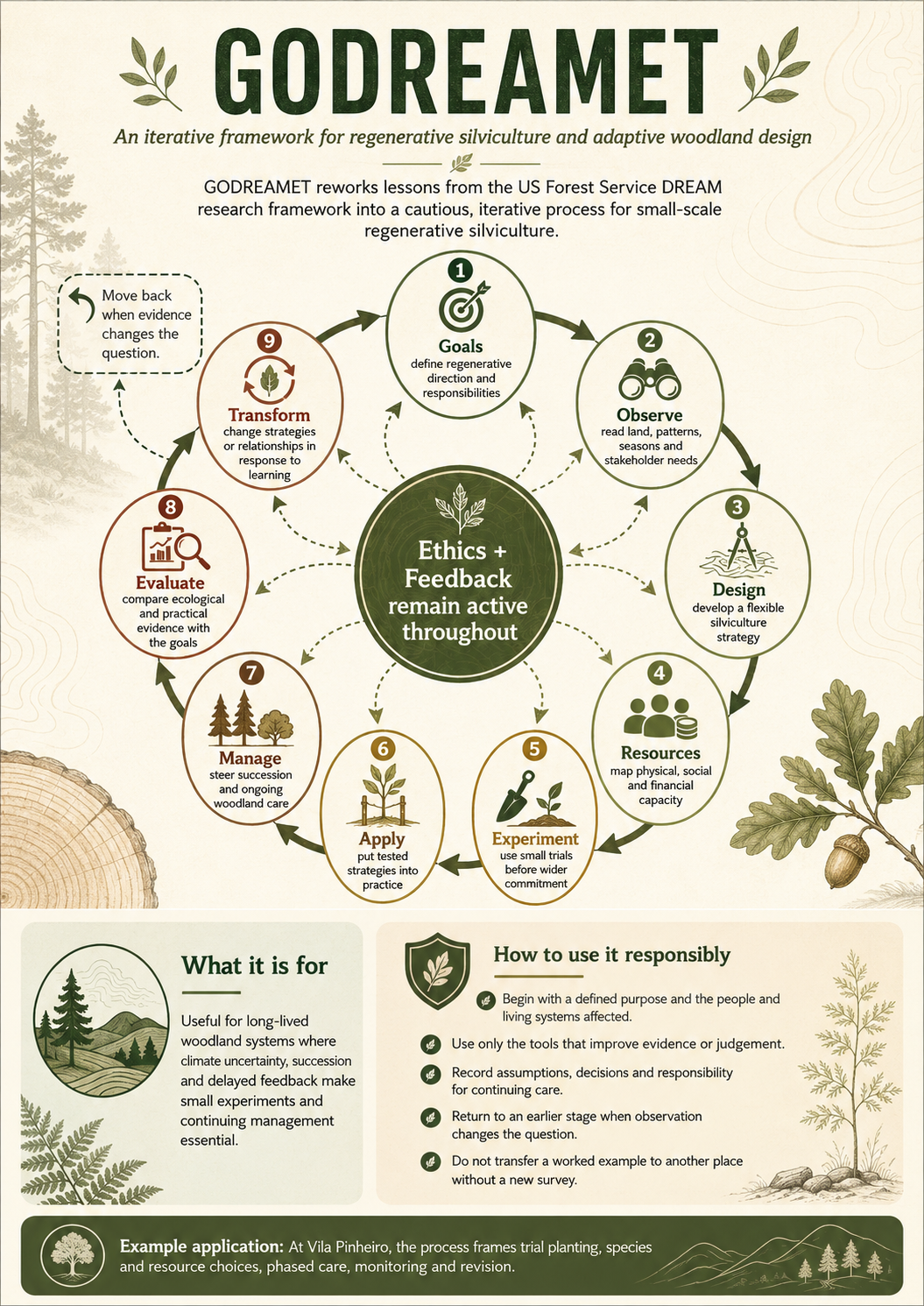
GODREAMET reworks lessons from the US Forest Service DREAM research framework into a cautious, iterative process for small-scale regenerative silviculture.
What the framework is for
Useful for long-lived woodland systems where climate uncertainty, succession and delayed feedback make small experiments and continuing management essential.
Stages and movement
- GoalsDefine the regenerative direction and responsibilities.
- ObserveRead land, patterns, seasons and stakeholder needs.
- DesignDevelop a flexible silviculture strategy.
- ResourcesMap physical, social and financial capacity.
- ExperimentUse small trials before wider commitment.
- ApplyPut tested strategies into practice.
- ManageSteer succession and ongoing woodland care.
- EvaluateCompare ecological and practical evidence with the goals.
- TransformChange strategies or relationships in response to learning.
Ethics and feedback remain active throughout. Move back when evidence changes the question.
A concise application
At Vila Pinheiro the process frames trial planting, species and resource choices, phased care, monitoring and revision. It remains an evolving design in progress, not proof of universal outcomes.
How to use it responsibly
- Begin with a defined purpose and the people and living systems affected.
- Use only the tools that improve evidence or judgement.
- Record assumptions, decisions and responsibility for continuing care.
- Return to an earlier stage when observation changes the question.
- Do not transfer a worked example to another place without a new survey.
Authorship and lineage
DREAM means Desired REgeneration through Assisted Migration and is a US Forest Service research framework. Mark D’Cruz created the GODREAMET adaptation for Design 8; the Academy does not imply US Forest Service endorsement.
Sources and provenance
- US Forest Service, Desired REgeneration through Assisted Migration (DREAM).
- Mark D’Cruz, Design 8 within the Diploma journey.