Prioritisation method
Action Priority Matrix
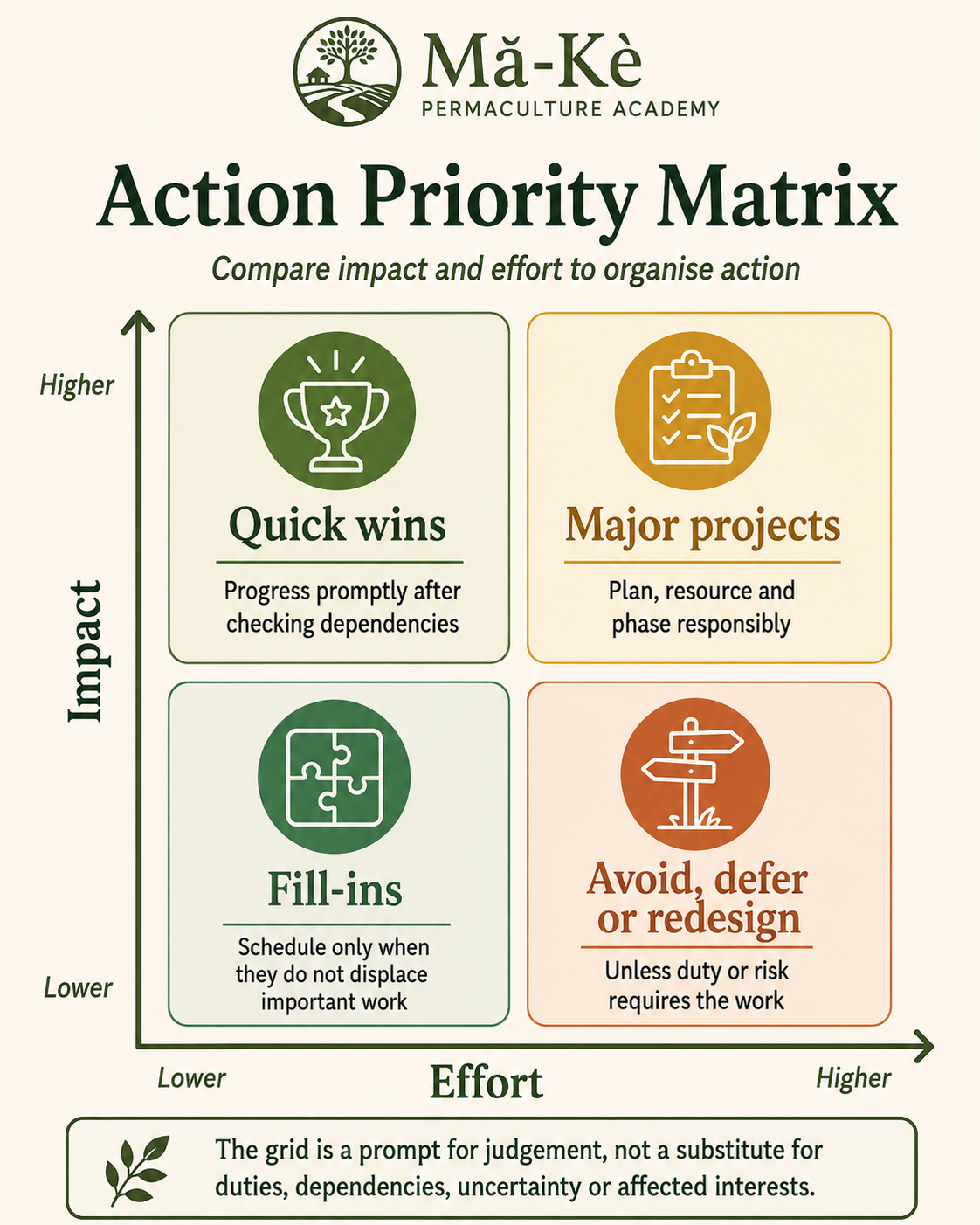
Compare impact and effort to organise action, while keeping duties, dependencies, uncertainty and affected interests outside the oversimplified grid.
What the tool is
An Action Priority Matrix places candidate actions on two axes: expected impact and effort. It can expose quick wins, major projects, lower-value fill-ins and tasks to avoid, defer or redesign. The originator is not reliably established, so this page makes no invention attribution.
The method at a glance
High impact, lower effort
Quick wins: progress promptly after checking dependencies.
High impact, higher effort
Major projects: plan, resource and phase responsibly.
Lower impact, lower effort
Fill-ins: schedule only when they do not displace important work.
Lower impact, higher effort
Avoid, defer or redesign: unless duty or risk requires the work.
This accessible HTML diagram is a teaching aid. Its labels and explanatory text, rather than colour or position alone, carry the meaning.
When to use it
Use the matrix after goals and candidate actions are clear, but before committing scarce time or money. It is best for a bounded portfolio of comparable actions, not for deciding whether to meet legal, safety or ethical obligations.
How to use it
- Define impact in relation to the stated purpose and affected interests.
- Define effort broadly, including money, labour, skill, risk, maintenance and opportunity cost.
- Estimate with ranges where knowledge is weak.
- Place actions provisionally, then discuss dependencies and sequencing.
- Separate mandatory work from discretionary prioritisation.
- Record the decision, owner and review trigger.
From Mark’s Diploma practice
Design 03 uses an Action Priority Matrix to organise whole-site tasks. The source shows specific actions placed by impact and effort. It demonstrates how Mark used the method at that stage of the project. It does not establish that every priority remained fixed or that placement alone justified implementation.
Limitations and cautions
- Impact and effort are estimates, often with different units and time horizons.
- Dependencies can make an apparent quick win impossible or irresponsible.
- Small maintenance tasks may protect high-value systems despite appearing low impact.
- Urgency, reversibility, equity and risk may need separate criteria.
- Avoiding a task is not acceptable when the task is a duty or controls serious harm.
Authorship and provenance
Mark’s Design 03 provides a traceable application. The wider matrix has no securely verified single originator in the sources used here, so the Academy claims neither invention nor exclusive terminology.
Diploma source locators
- Design 03, printed page 22, PDF page 29: Action Priority Matrix with project tasks.
References
- MindTools, “The Action Priority Matrix”, method overview and origin caveat.