Participation and responsibility
Stakeholder Analysis
Identify who affects or is affected by a design, then make interests, influence, responsibilities and representation choices visible.
What the tool is
A stakeholder is a person, group or institution that can affect a decision or may experience its consequences. Stakeholder analysis helps a designer plan engagement, expose power differences and clarify responsibility. It is not a licence to reduce people to boxes.
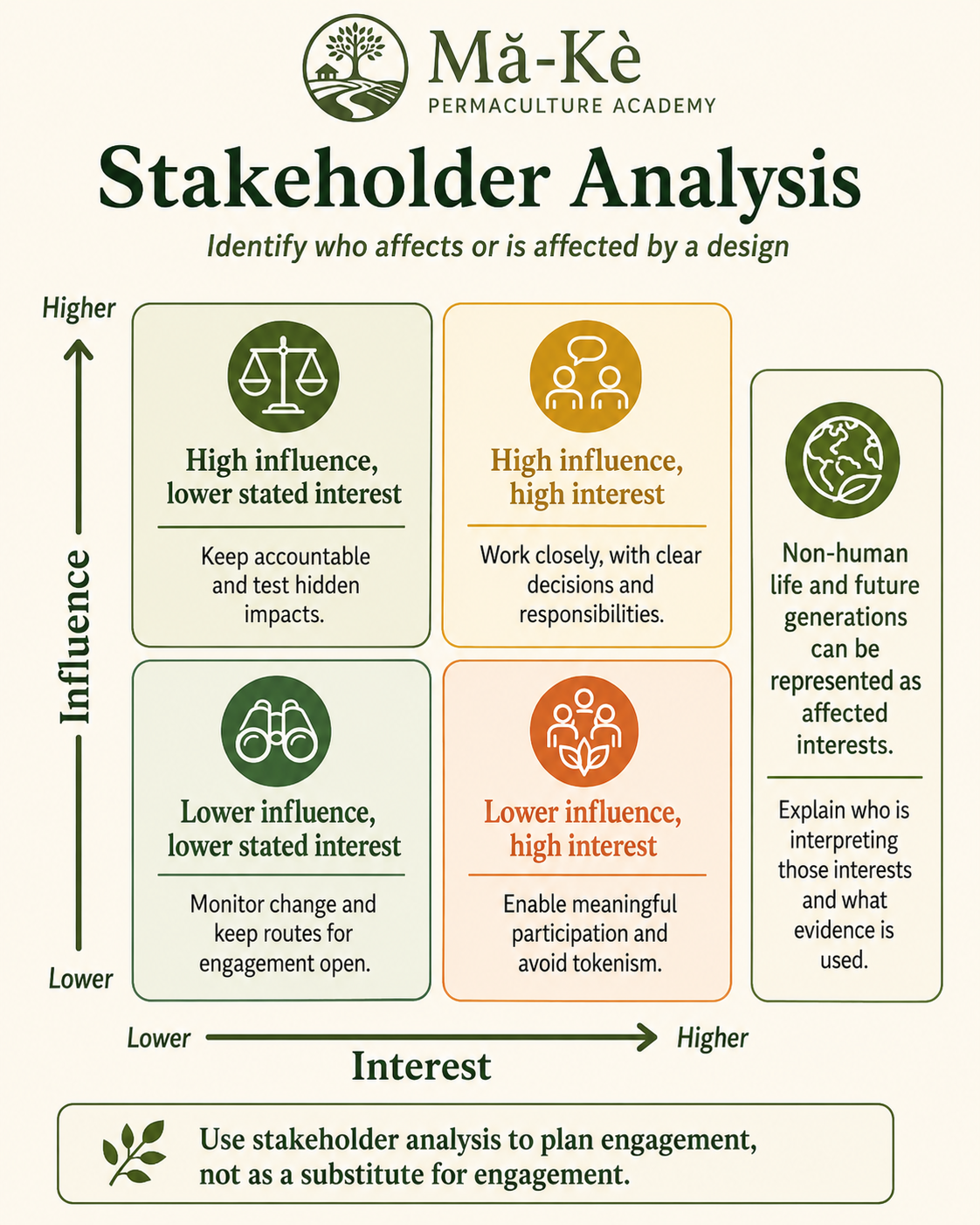
Non-human life and future generations can be represented as affected interests. They do not attend meetings, so the designer must explain who is interpreting those interests, what evidence is used and where uncertainty remains.
The method at a glance
High influence, high interest
Work closely, with clear decisions and responsibilities.
High influence, lower stated interest
Keep accountable and test hidden impacts.
Lower influence, high interest
Enable meaningful participation and avoid tokenism.
Lower influence, lower stated interest
Monitor change and keep routes for engagement open.
This accessible HTML diagram is a teaching aid. Its labels and explanatory text, rather than colour or position alone, carry the meaning.
When to use it
Begin early, before goals and participation structures harden. Revisit the analysis when ownership, funding, implementation or maintenance changes. Use it for engagement planning, not as a substitute for engagement.
How to use it
- Define the decision and who may be affected.
- Identify people and institutions through more than one route so the loudest group does not define the list.
- Record interests, knowledge, influence, rights, responsibilities and possible barriers to participation.
- Choose an engagement approach appropriate to the impact and authority involved.
- Document representation choices for non-human life and future generations.
- Review omissions, conflicts and changes throughout implementation.
From Mark’s Diploma practice
Design 06 names Stakeholder Analysis and Client Interviews in its summary. The source also identifies primary stakeholders and discusses engagement with future caretakers. A formal stakeholder matrix was not located in the controlled PDF. The matrix on this page is therefore a bounded teaching reconstruction informed by the documented participants, not a reproduction of a Diploma artefact.
Limitations and cautions
- Influence can be mistaken for legitimacy, and low power can be mistaken for low importance.
- Categories change over time and across decisions.
- Consultation does not equal consent, shared authority or accountability.
- Privacy and safeguarding may limit what should be recorded.
- Representation of ecosystems or future people is a methodological choice, not their direct testimony.
Authorship and provenance
Stakeholder analysis is an established field with many methods. Mark’s Design 06 supports his use of stakeholder thinking and interviews. This page distinguishes that evidence from the Academy’s teaching reconstruction.
Diploma source locators
- Design 06, design summary, PDF page 3: Stakeholder Analysis and Client Interviews named.
- Design 06, PDF page 20: stakeholder engagement and future caretakers.
- Design 06, PDF page 25: primary stakeholders and budget context.