Practical field tool
DAFOR: A Practical Abundance Scale
DAFOR is a quick ecological field scale for comparing relative abundance within a defined survey area.
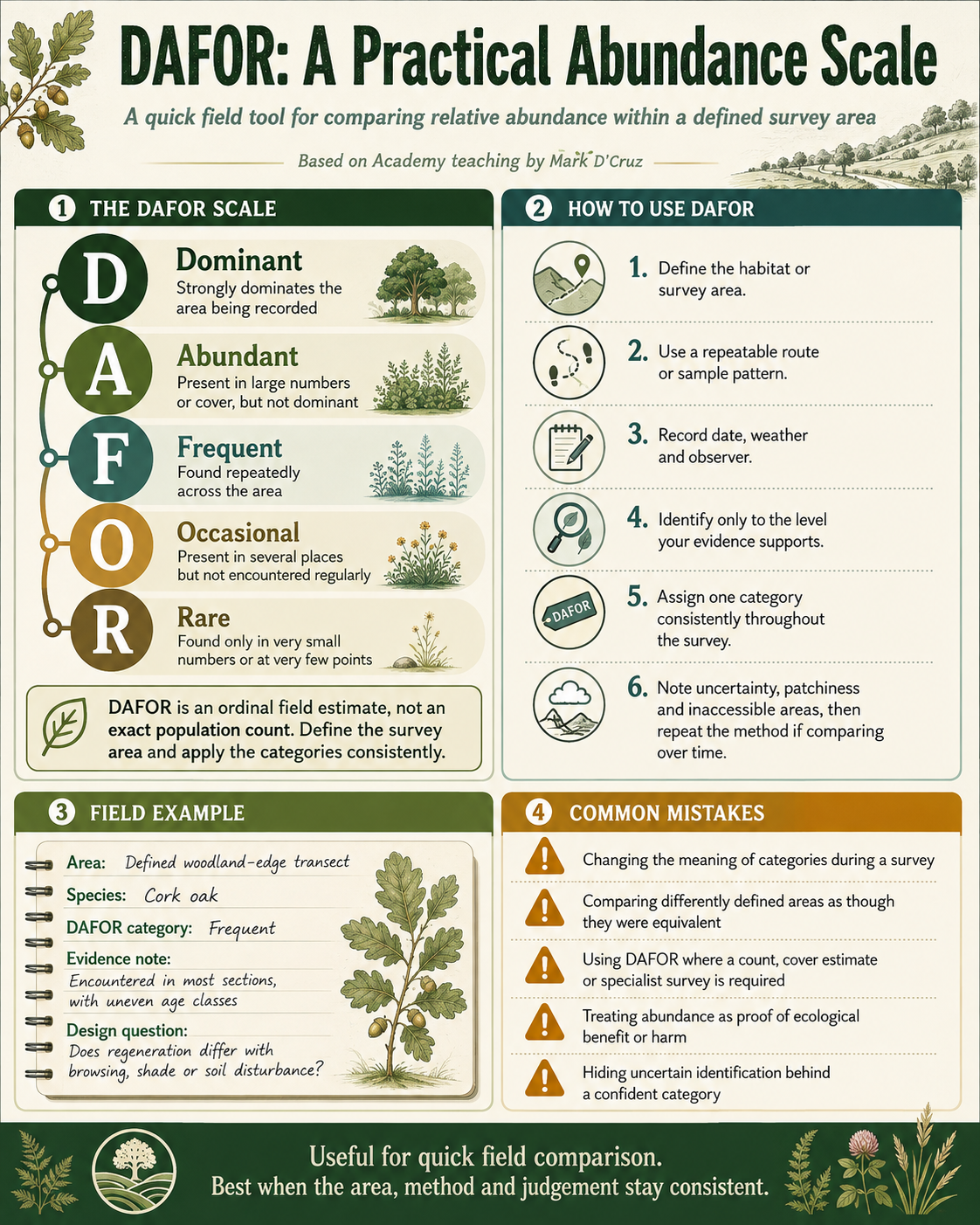
What DAFOR means
- Dominant
- The species strongly dominates the area being recorded.
- Abundant
- Present in large numbers or cover, but not dominant.
- Frequent
- Found repeatedly across the area.
- Occasional
- Present in several places but not encountered regularly.
- Rare
- Found only in very small numbers or at very few points.
DAFOR is an ordinal field estimate. Define the survey area and apply the categories consistently; it is not an exact population count.
A first-use method
- Define the habitat or survey area before assigning categories.
- Choose a repeatable route or sample pattern and record date, weather and observer.
- Identify species only to the level your evidence supports.
- Assign one DAFOR category using the same judgement throughout the survey.
- Record uncertainty, patchiness and any part of the area that was inaccessible.
- Repeat with the same method when comparison over time matters.
Field-recording example
| Record | Example |
|---|---|
| Area | Defined woodland-edge transect |
| Species | Cork oak |
| DAFOR category | Frequent |
| Evidence note | Encountered in most sections, with uneven age classes |
| Design question | Does regeneration differ with browsing, shade or soil disturbance? |
Common mistakes and limits
- Changing the meaning of categories during a survey.
- Comparing differently sized or defined areas as though they were equivalent.
- Using DAFOR where a count, cover estimate or specialist survey is required.
- Treating abundance as proof of ecological benefit or harm.
- Hiding uncertain identification behind a confident category.
At Vila Pinheiro, Mark used DAFOR conventionally for flora and experimented with adapting the scale to compare renewable-energy resource availability. That second use is an Academy interpretation, not the standard ecological method.
Printable DAFOR field sheet
Purpose and defined area: _______________________________________
Date, method, weather and observer: _____________________________
| Species or feature | D/A/F/O/R | Location and evidence note | Confidence or follow-up |
|---|---|---|---|
Sources and provenance
- The Heritage Council, Best Practice Guidance for Habitat Survey and Mapping.
- Mark D’Cruz, Design 7 DAFOR flora appendix within the Diploma journey.