Practical field tool
PASTE: A First Site Inventory
PASTE helps a designer notice what is already present, who or what interacts with it and what needs closer observation.
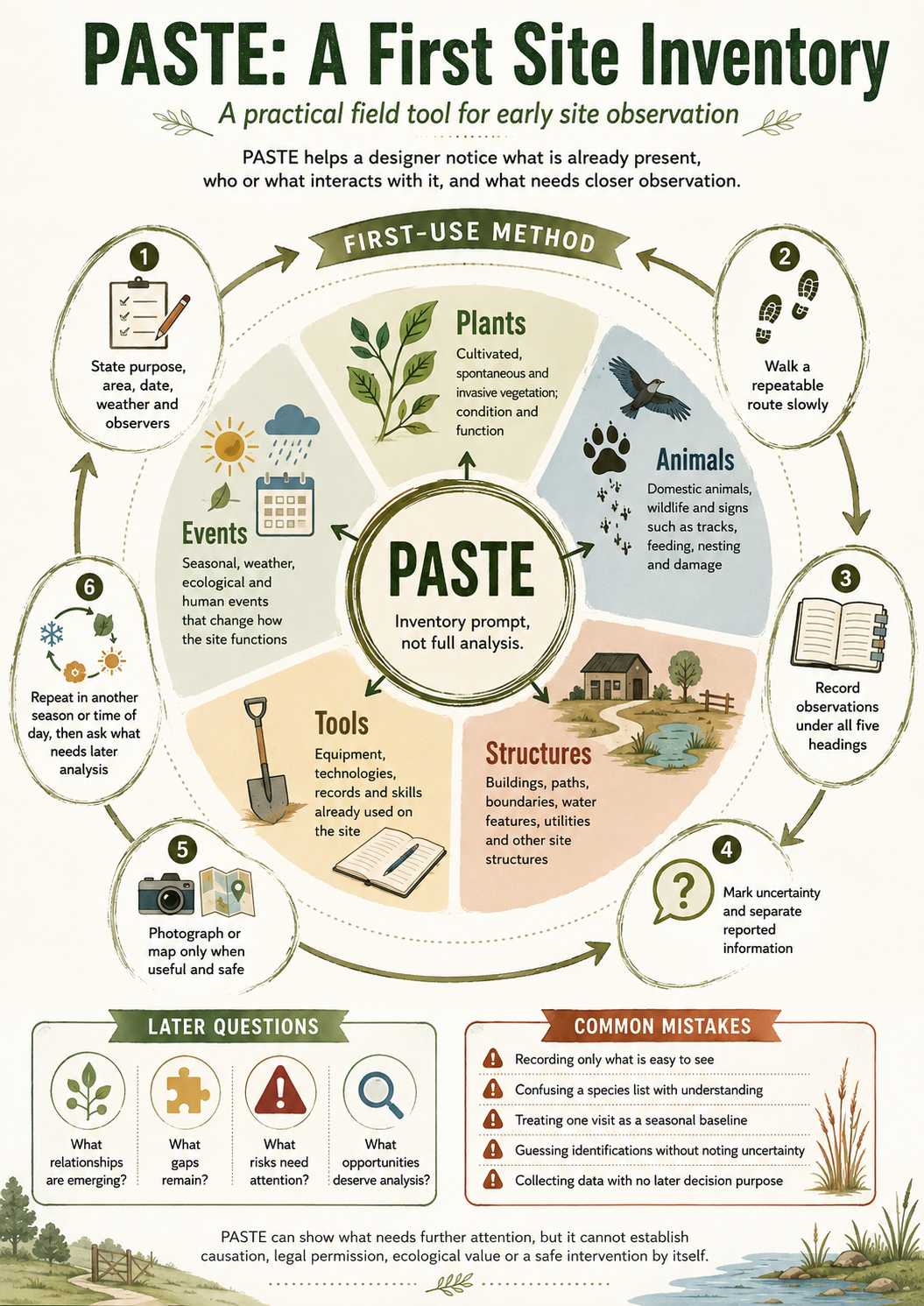
What PASTE means
- Plants
- Existing cultivated, spontaneous and invasive vegetation, including condition and function.
- Animals
- Domestic animals, wildlife and signs such as tracks, feeding, nesting and damage.
- Structures
- Buildings, paths, boundaries, water features, utilities and other built or natural structures.
- Tools
- Equipment, technologies, records and skills already used to care for or understand the site.
- Events
- Seasonal, weather, ecological and human events that change how the site functions.
PASTE is an inventory prompt. It does not complete species identification, risk assessment or design analysis on its own.
A first-use method
- State the purpose, area, date, weather and observers.
- Walk a repeatable route slowly and record direct observations under all five headings.
- Photograph or map only where it improves the record and is safe to share.
- Mark uncertain identifications and reported information separately.
- Repeat in another season or time of day where change matters.
- Ask what relationships, gaps, risks and opportunities require later analysis.
Field-recording example
| Category | Observation | Evidence status | Later question |
|---|---|---|---|
| Plants | Dense evergreen seedlings beneath mature trees | Observed and photographed | Which species, and what does their distribution suggest? |
| Animals | Browsing on young shoots | Observed; animal not identified | When does browsing occur and how severe is it? |
| Structures | Compacted track sheds water downslope | Observed during rain | Where does the flow go and who or what is affected? |
| Tools | Hand tools and a water tank are available | Confirmed with carer | What capacity and maintenance limits apply? |
| Events | Summer access and irrigation demand increase | Reported; needs seasonal record | What baseline should be recorded? |
Common mistakes and limits
- Recording only what is easy to see.
- Confusing a species list with an understanding of relationships.
- Treating one visit as a seasonal baseline.
- Guessing an identification without marking uncertainty.
- Collecting information with no later decision purpose.
PASTE can show what needs further attention. It cannot establish causation, legal permission, ecological value or a safe intervention by itself.
Printable PASTE field sheet
Purpose and area: ______________________________________________
Date, time, weather and observers: ______________________________
Plants
Observation, location, condition, confidence
Animals
Sighting or sign, behaviour, timing, confidence
Structures
Feature, condition, flow, responsibility
Tools
Equipment, skill, record, availability, limit
Events
Seasonal, weather, ecological or human change
Questions for later analysis
Relationships, gaps, risks and next observations
Sources and provenance
- Mark D’Cruz, Design 6 PASTE appendix and field records within the Diploma journey. The wider origin of this permaculture use of PASTE has not been verified, so the Academy makes no invention claim.