Analysis method
SWOC and SWOT Analysis
Use strengths, weaknesses, opportunities and challenges or threats to widen enquiry without mistaking a four-box prompt for a complete design.
What the tool is
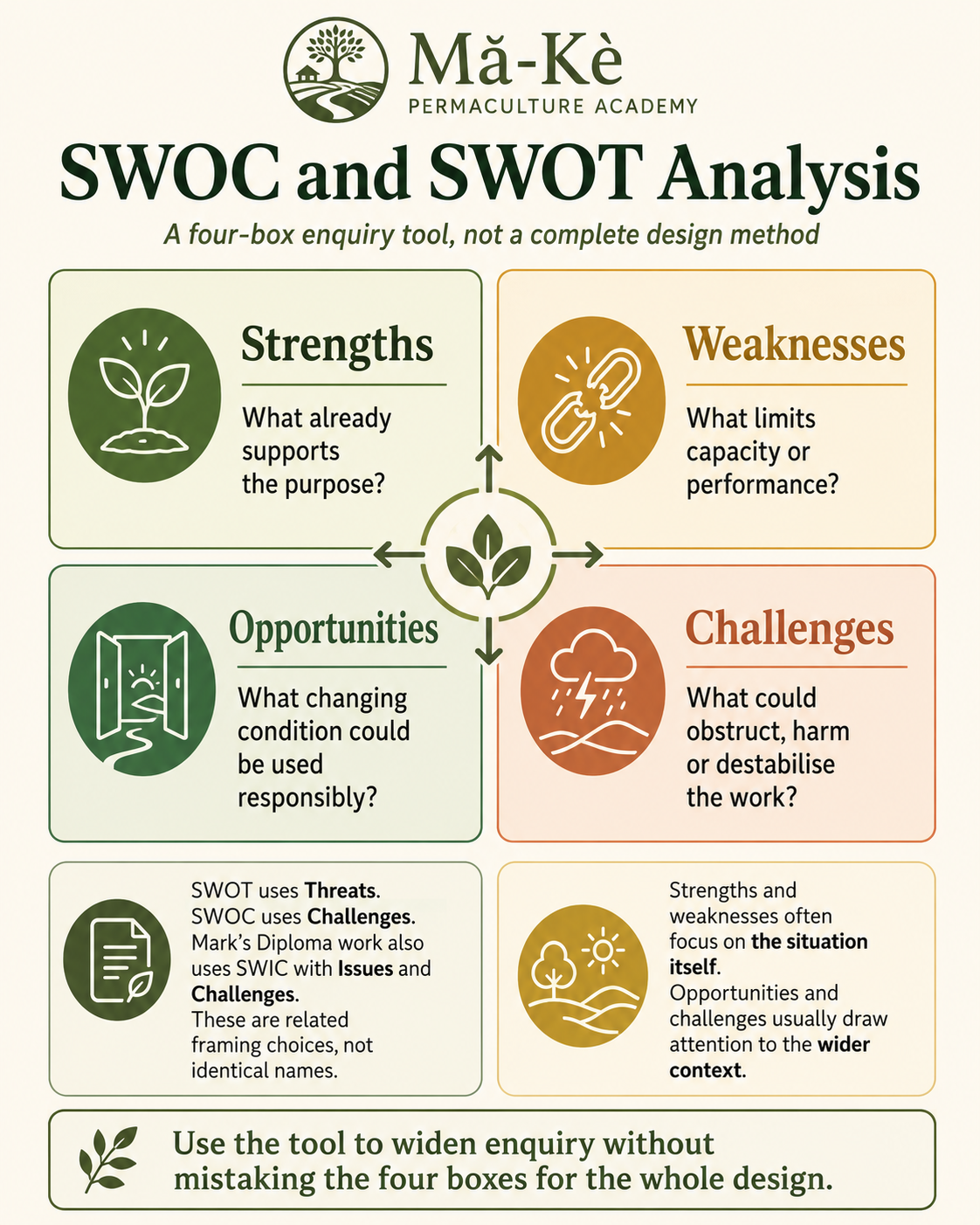
SWOT asks about strengths, weaknesses, opportunities and threats. SWOC keeps the same first three prompts and uses challenges for the fourth. Mark’s Diploma work also uses SWIC, with issues and challenges. These are related framing choices, not interchangeable historical names.
Strengths and weaknesses usually focus attention on conditions within the situation or the designer’s influence. Opportunities and threats or challenges usually invite attention to the wider context. In living systems that boundary is porous, so the value lies in explaining the placement, not policing the box.
The method at a glance
Strengths
What already supports the purpose?
Weaknesses
What limits capacity or performance?
Opportunities
What changing condition could be used responsibly?
Challenges
What could obstruct, harm or destabilise the work?
This accessible HTML diagram is a teaching aid. Its labels and explanatory text, rather than colour or position alone, carry the meaning.
When to use it
Use SWOC or SWOT after enough survey work exists to ground the discussion and before selecting a preferred response. It is useful for bringing several perspectives into one view, testing an early proposal and exposing assumptions that need evidence.
How to use it
- State the decision, boundary, time horizon and participants.
- Record evidence before interpretation. Mark unknowns rather than filling every box.
- Generate observations under all four headings, allowing an item to appear in more than one box when the reason differs.
- Ask which entries are supported, which are reported and which remain assumptions.
- Look for relationships. A strength may create a weakness; an opportunity may introduce a challenge.
- Convert the most material findings into questions, design criteria or further research.
From Mark’s Diploma practice
In Design 03, Mark used SWOC while developing a whole-site homestead design. The analysis identified existing knowledge and land resources alongside time, finance, climate and maintenance constraints. The useful result was not the quadrant itself. It was the way those observations informed later design priorities.
Limitations and cautions
- A brief workshop can reward confidence, familiarity and group hierarchy rather than evidence.
- Generic phrases such as “climate change” or “community support” are not useful until their relevance and scale are explained.
- The four boxes do not rank importance, resolve conflicts or establish causation.
- Calling the final quadrant challenges may encourage constructive framing, but must not soften credible hazards.
The precise institutional origin of the SWOT label was disputed for decades. Recent historical research traces its development through earlier SOFT analysis and avoids the unsupported folklore often repeated online.
Authorship and provenance
Mark used SWIC in Design 01, SWOC in Designs 02 and 03, and SWOC again in the evaluation of Design 06. These records demonstrate use in his Diploma practice, not invention of the method.
Diploma source locators
- Design 01, printed pages 8 to 9, PDF pages 12 to 13: SWIC within the Design Web.
- Design 02, printed page 7, PDF page 12: SWOC and resource analysis.
- Design 03, printed pages 12 to 13, PDF pages 19 to 20: SWOC analysis and quadrant.
- Design 06, Evaluation: SWOC Analysis, PDF page 52.
References
- Puyt, Lie and Wilderom, “The origins of SWOT analysis”, Long Range Planning, 56(3), 2023.
- Permaculture Association, “Analysing”, overview of analysis tools used in permaculture design.