Parallel-thinking method
Six Thinking Hats
Separate six modes of attention so a person or group can examine information, feeling, risk, value, possibility and process without turning every difference into an argument.
What the tool is
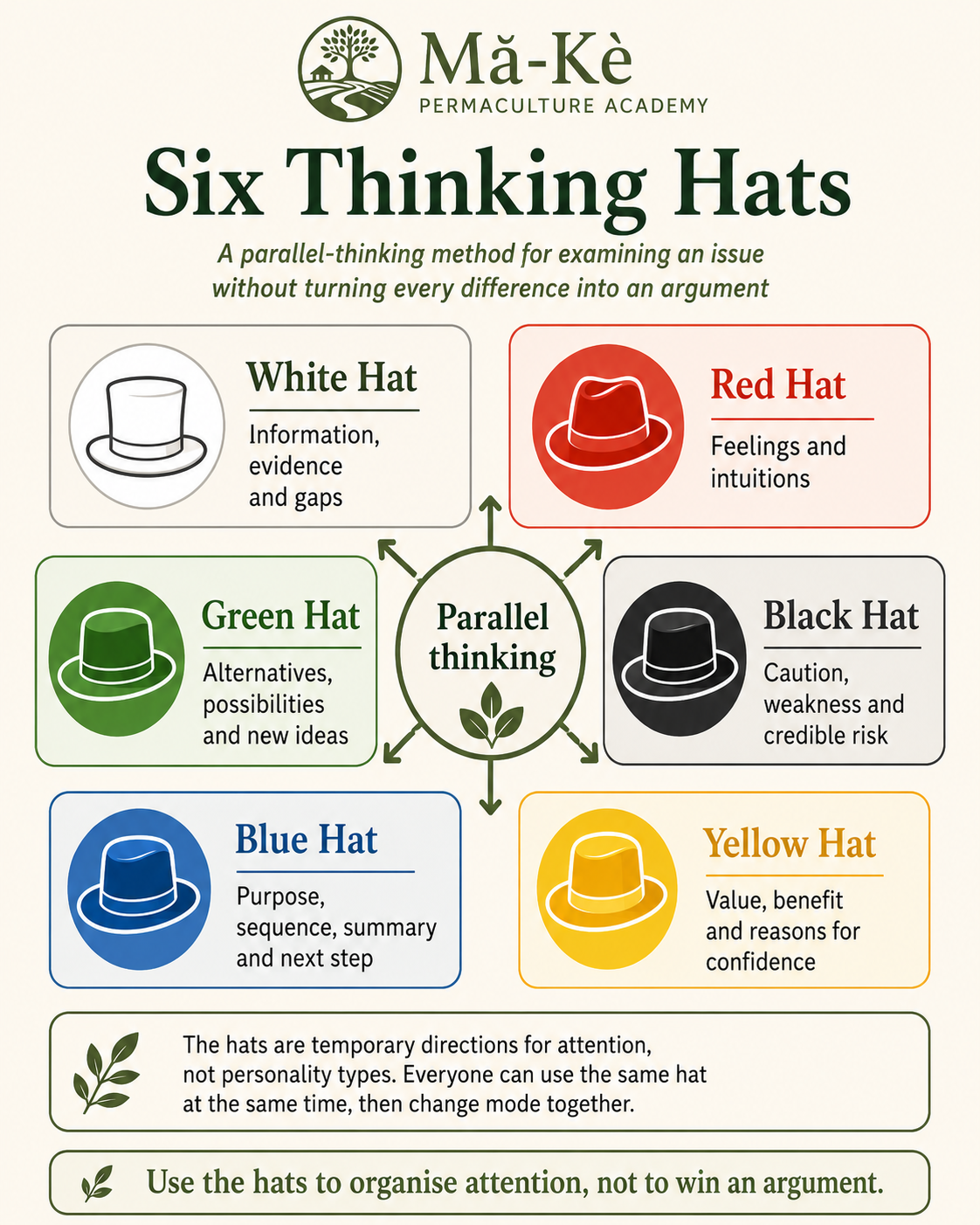
Edward de Bono created Six Thinking Hats as a parallel-thinking method. The hats are temporary directions for attention, not personality types. Everyone can use the same hat at the same time, then change mode together.
The method at a glance
White
Information, evidence and gaps.
Red
Feelings and intuitions, stated without forced justification.
Black
Caution, weakness and credible risk.
Yellow
Value, benefit and reasons for confidence.
Green
Alternatives, possibilities and new ideas.
Blue
Purpose, sequence, summary and next step.
This accessible HTML diagram is a teaching aid. Its labels and explanatory text, rather than colour or position alone, carry the meaning.
When to use it
Use the method when a discussion is stuck in advocacy, when one mode such as risk or enthusiasm dominates, or when a complex proposal needs a deliberate sequence. It can be used individually, but its parallel structure is especially useful in groups.
How to use it
- Use the blue hat to state the purpose, decision boundary and sequence.
- Begin with white-hat information, including what is not known.
- Invite a short red-hat round so feelings are visible without being treated as facts.
- Use yellow and black deliberately. Neither optimism nor caution is the final decision.
- Use green to generate alternatives, including smaller and reversible options.
- Return to blue to summarise evidence, disagreements, owners and the next review.
A sequence is a facilitation choice, not a fixed rule. Change it to suit the purpose and explain why.
From Mark’s Diploma practice
In Design 01, Mark used the hats to examine how permaculture could be integrated with The Mă-Kè Bonsai Way. The process helped separate evidence about the existing philosophy, concern about overclaiming, enthusiasm for regenerative practice and possibilities for teaching. The Diploma record supports this application, not a claim that the method validated the resulting philosophy.
Limitations and cautions
- The colour metaphor does not replace specialist knowledge, consent or evidence.
- A facilitator can steer the outcome through timing, wording or selective summaries.
- Red-hat contributions are feelings, not diagnoses or proof.
- Black-hat caution must not be used to silence difficult stakeholders, and yellow-hat value must not become promotional spin.
- Accessibility may require names and text labels rather than colour alone.
Authorship and provenance
The method is Edward de Bono’s. Mark’s contribution here is a bounded account of how he applied it in his Diploma design and how he teaches its use in evidence-aware design.
Diploma source locators
- Design 01, printed pages 12 to 14, PDF pages 16 to 18: integration of permaculture and The Mă-Kè Bonsai Way.
- Design 01, design summary, PDF page 5: Six Thinking Hats named among the design tools used.
References
- de Bono, Six Thinking Hats official resource.
- Edward de Bono, Six Thinking Hats, Penguin, 2016 edition.