Decision prompt
PMI and PNI Decision Analysis
Examine pluses, minuses and interesting points before choosing, while keeping the local PNI variant distinct from de Bono’s documented PMI method.
What the tool is
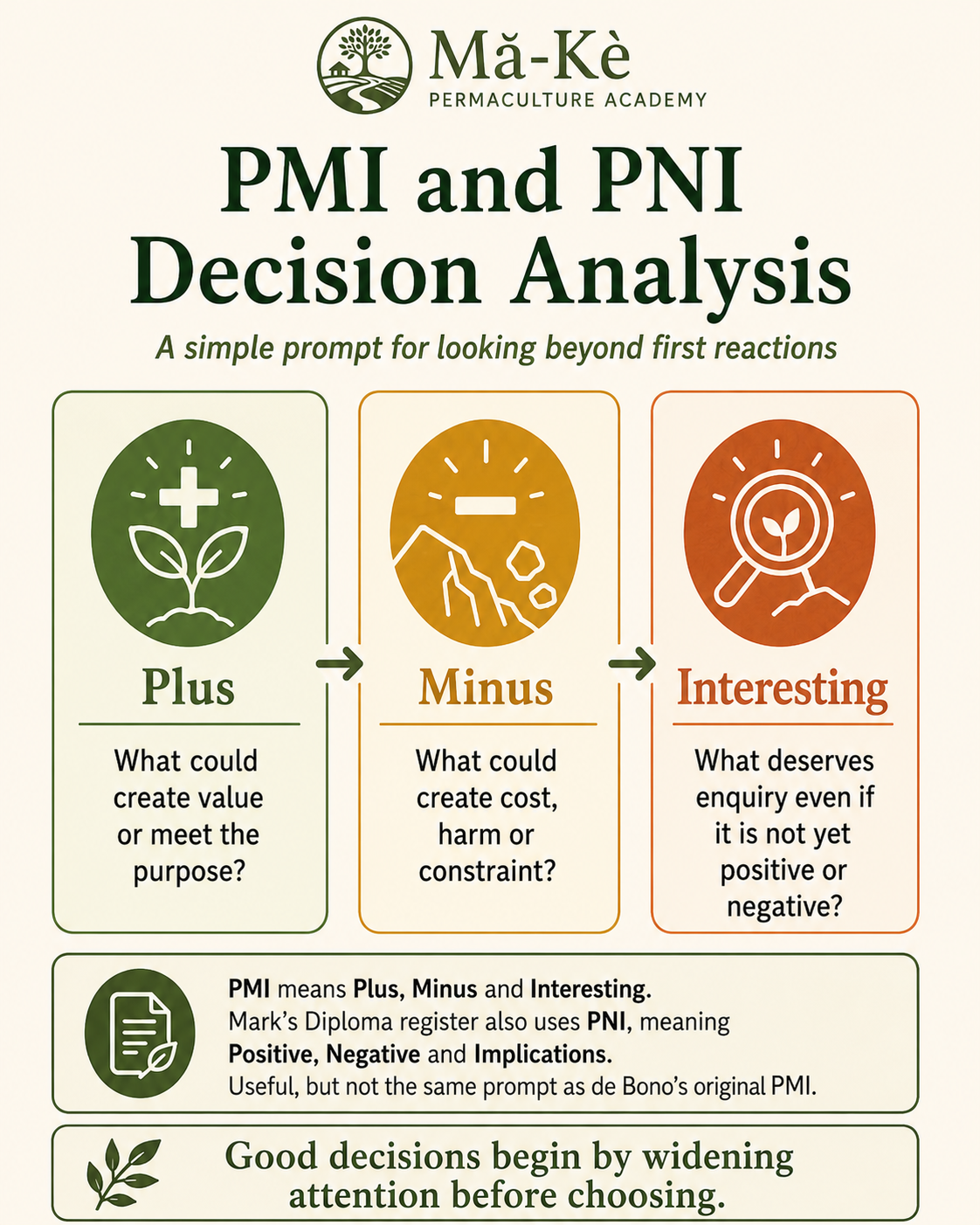
PMI means Plus, Minus and Interesting. Edward de Bono presented it as a deliberate attention-directing tool: first look beyond an initial reaction, then identify favourable points, unfavourable points and matters that are interesting or require enquiry.
Mark’s Diploma register also uses PNI, meaning Positive, Negative and Implications. That wording is a local variant in the record. Implications can be valuable, but it is not the same prompt as Interesting and should not be presented as de Bono’s original label.
The method at a glance
Plus
What could create value or meet the purpose?
Minus
What could create cost, harm or constraint?
Interesting
What deserves enquiry even if it is not yet positive or negative?
This accessible HTML diagram is a teaching aid. Its labels and explanatory text, rather than colour or position alone, carry the meaning.
When to use it
Use PMI when a proposal attracts an immediate yes or no, when several options need an initial screen, or when a group needs to widen attention before applying decision criteria. Use PNI only when implications are genuinely the intended third enquiry, and label the variant.
How to use it
- Write one precise proposal or option.
- Set a short, equal period for each heading.
- Record points without debating them during collection.
- Add evidence, affected interests and uncertainty to material points.
- Identify consequences that depend on conditions or time.
- Move the result into an appropriate decision process. PMI supplies considerations; it does not choose for you.
From Mark’s Diploma practice
Design 04 contains a PMI evaluation of energy proposals. The analysis begins on printed page 14 and continues through printed page 16, PDF pages 19 to 21. It distinguishes benefits, drawbacks and points needing attention before reflection. Design 05 names PMI in its summary, but a complete PMI application was not located in the controlled source copy, so this page does not invent one.
Limitations and cautions
- A long list can create the appearance of rigour without weighting impact or evidence.
- More pluses than minuses does not mean the proposal is better.
- Legal duties, life safety and ecological thresholds cannot be traded away by a simple count.
- Framing one preferred proposal may conceal better alternatives.
- PNI should not be used as a vague synonym for PMI.
Authorship and provenance
PMI is attributed to Edward de Bono. Mark’s Diploma work supplies the bounded case example and documents the local PNI wording in the research register.
Diploma source locators
- Design 04, printed pages 14 to 16, PDF pages 19 to 21: PMI evaluation of energy proposals.
- Design 05, design summary, PDF page 3: PMI named among the methods used; no full application located.
- Design 01, PDF page 30: PMI reflection on the development of The Mă-Kè Bonsai Way.
References
- de Bono, PMI lesson plan, defining Plus, Minus and Interesting.