Relationship analysis
Input-Output Analysis
Trace what an element needs, what it produces and where those flows create useful connections, hidden work, waste or risk.
What the tool is
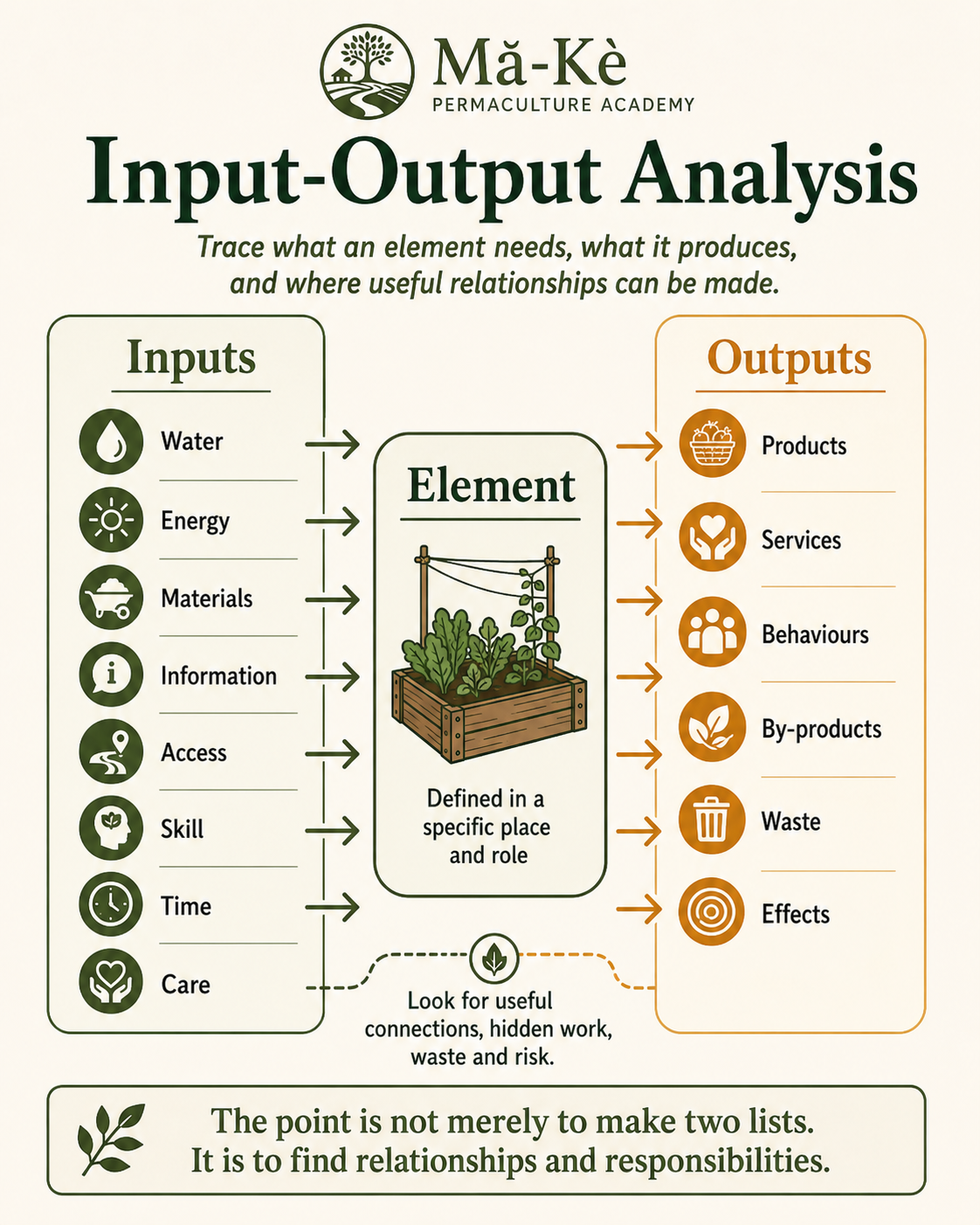
Input-output analysis treats an element as part of a network. Inputs are resources, conditions, labour, information and care the element requires. Outputs include products, services, behaviours, by-products, wastes and effects. The purpose is not merely to make two lists. It is to find relationships and responsibilities.
The method at a glance
Inputs
Water, energy, materials, information, access, skill, time and care.
Element
Defined in a specific place and role.
Outputs
Products, services, behaviour, waste, risk and change over time.
This accessible HTML diagram is a teaching aid. Its labels and explanatory text, rather than colour or position alone, carry the meaning.
When to use it
Use it when selecting or locating elements, comparing alternatives, designing maintenance, identifying dependencies or connecting one element’s useful output with another’s real need. Repeat it when scale, season or management changes.
How to use it
- Define the element, place, scale, season and intended function.
- List material inputs, including labour, knowledge, permission and maintenance.
- List intended and unintended outputs.
- Mark quantity, timing, quality and uncertainty where these affect design.
- Look for connections, conflicts, single points of failure and exported burdens.
- Test the promising relationships with the people responsible for them.
From Mark’s Diploma practice
Design 03 applies input-output analysis during whole-site design. The Diploma figure and accompanying text consider elements as flows rather than isolated features. Design 02 also records the method in course design, where learner time, teaching material, feedback and learning outcomes become part of the analysis.
Limitations and cautions
- Lists can hide quantity, quality, timing and distance.
- A nominally useful output is not a yield unless another element can use it safely and at the right time.
- People, care and knowledge are often omitted because they are less visible than materials.
- The method does not on its own establish ecological impact, life-cycle cost or consent.
Authorship and provenance
Input-output and needs-and-yields thinking are established within permaculture design practice. Mark’s Diploma records show his use in Designs 02 and 03. This page claims application and teaching synthesis, not invention.
Diploma source locators
- Design 02, design summary, PDF page 6, and printed page 7, PDF page 12: method and resource analysis.
- Design 03, printed pages 14 to 15, PDF pages 21 to 22: Input-Output Analysis text and figure.