Cornerstone Guide 8 of 12
Needs and Yields Analysis
Design relationships between elements rather than collecting components: understand what each element requires, what it contributes and how useful connections can reduce waste, dependency and risk.
What you will learn
- How to distinguish needs, inputs, behaviours, products and wider yields.
- How to analyse one element without treating it as isolated.
- How to connect outputs to the needs of other elements.
- How multiple functions and functional redundancy improve resilience.
- How to identify burdens, hazards, seasonal limits and management needs.
Why analyse needs and yields?
An element cannot be judged by its headline product alone. A hen may yield eggs, manure, scratching, heat, feathers, behaviour, educational value and eventually meat, depending on context. It also needs food, water, shelter, health care, protection, space, social conditions and regular human attention. If only the attractive outputs are counted, the design becomes wishful accounting.
Needs and yields analysis asks whether the system can meet an element’s needs and whether its outputs can be used safely and effectively. It therefore supports the principle Integrate rather than segregate and the long-standing permaculture aim of making each element useful to several functions while ensuring important functions are supported by more than one element.
A clear vocabulary
| Term | Meaning | Example for a fruit tree |
|---|---|---|
| Need | A condition or resource required for health or function. | Water, suitable soil, light, root space, pollination and care. |
| Input | A resource or action supplied to meet a need. | Irrigation, mulch, pruning, compost or a pollinator habitat. |
| Behaviour | What the element does through time, including inconvenient effects. | Casts shade, drops leaves, expands roots, hosts organisms and changes seasonally. |
| Product | A direct, recognisable output. | Fruit, prunings, seed or propagation material. |
| Yield | Any useful contribution recognised and used by the wider system. | Food, shade, beauty, habitat, learning, microclimate or carbon storage. |
| Unwanted output or hazard | An effect that becomes costly or damaging in the wrong relationship. | Disease reservoir, obstructed access, excessive shade or combustible litter. |
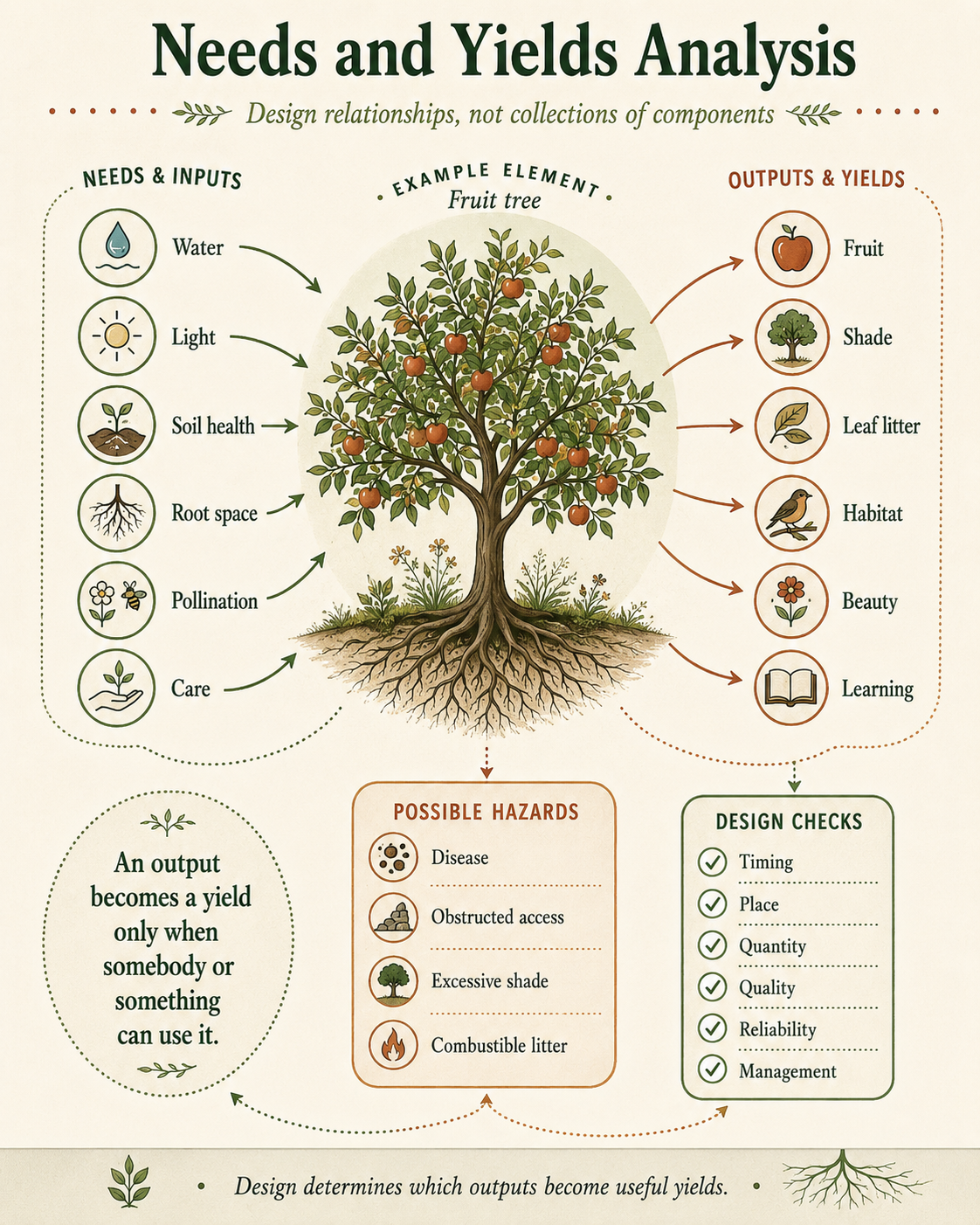
Fruit-tree analysis: complete text equivalent
The example element is a fruit tree.
Needs and inputs
- Water.
- Light.
- Soil health.
- Root space.
- Pollination.
- Care.
Outputs and potential yields
- Fruit.
- Shade.
- Leaf litter.
- Habitat.
- Beauty.
- Learning.
An output becomes a yield only when somebody or something can use it.
Possible hazards
- Disease.
- Obstructed access.
- Excessive shade.
- Combustible litter.
Design checks
- Timing.
- Place.
- Quantity.
- Quality.
- Reliability.
- Management.
Design determines which outputs become useful yields.
Analyse the element in context
Begin with the element’s nature, not with the designer’s intention for it. Describe how it behaves across seasons and stages of development. A young tree, mature tree and declining tree have different needs and effects. A pond in winter storm conditions behaves differently from the same pond during summer drought.
- Name the element precisely enough to analyse it.
- List essential needs and the conditions under which those needs change.
- List products, services, behaviours and less visible contributions.
- List possible burdens, hazards and management demands.
- Identify timing, quantity, quality and location for each major flow.
- Ask which other elements can meet its needs or use its outputs.
- Check whether the proposed relationship is observed, established knowledge or an experiment.
Connect outputs to needs
The central design move is to connect a useful output from one element with a genuine need elsewhere. Kitchen scraps may feed a compost system; mature compost may support a garden; garden residues may return as mulch; harvested water may support newly planted trees. The connection still requires infrastructure, timing and management. A theoretical loop is not closed merely because arrows fit neatly on paper.
| Output or resource | Possible recipient | Design conditions to check |
|---|---|---|
| Roof runoff | Tank, rain garden, pond or infiltration area. | Rainfall intensity, roof material, first flush, capacity, overflow, elevation and legal constraints. |
| Leaf litter and prunings | Mulch, compost, habitat pile or biochar process. | Contamination, fire risk, decomposition rate, transport and labour. |
| Animal manure | Compost, orchard or pasture fertility. | Pathogens, nutrient loading, withdrawal periods, collection and storage. |
| Shade | People, animals, water or shade-tolerant plants. | Season, orientation, density, fire access and future canopy size. |
| Learning and observation | Course, journal, management decision or community event. | Evidence quality, consent, accessibility and honest reporting. |
Timing, place and scale determine usefulness
A match must be practical in time, place, quantity and quality. Ten tonnes of wet biomass are not automatically a yield when the compost area can handle one tonne. Summer shade may be valuable while winter shade is unwelcome. Water at the bottom of a slope cannot serve an uphill tank without energy. Needs and yields analysis should therefore include logistics, not simply nouns.
- Timing: When is the need present and when is the output available?
- Location: How far must the resource move, and by whom or what?
- Quantity: Is there too little, enough or more than the recipient can use?
- Quality: Is the output safe and suitable for the proposed use?
- Reliability: Is it continuous, seasonal, variable or experimental?
- Management: What labour, storage, maintenance or decision makes the connection work?
Multiple functions and redundancy
Efficiency and resilience are related but not identical. Asking one element to perform several compatible functions can reduce wasted space or effort. Depending on one element for an essential function can create fragility. Good design therefore seeks both functional stacking and appropriate redundancy.
| Design test | Meaning | Example |
|---|---|---|
| Each element supports several functions | An element makes more than one useful contribution without compromising its health. | A hedge moderates wind, provides habitat, produces biomass and defines access. |
| Each essential function has several supports | Failure of one element does not collapse a critical function. | Animal water may have mains supply, stored rainwater and an emergency reserve. |
| Relationships remain manageable | The benefit exceeds the labour, cost, risk and complexity of maintaining the connection. | Compost is sited where inputs arrive and finished material can be distributed efficiently. |
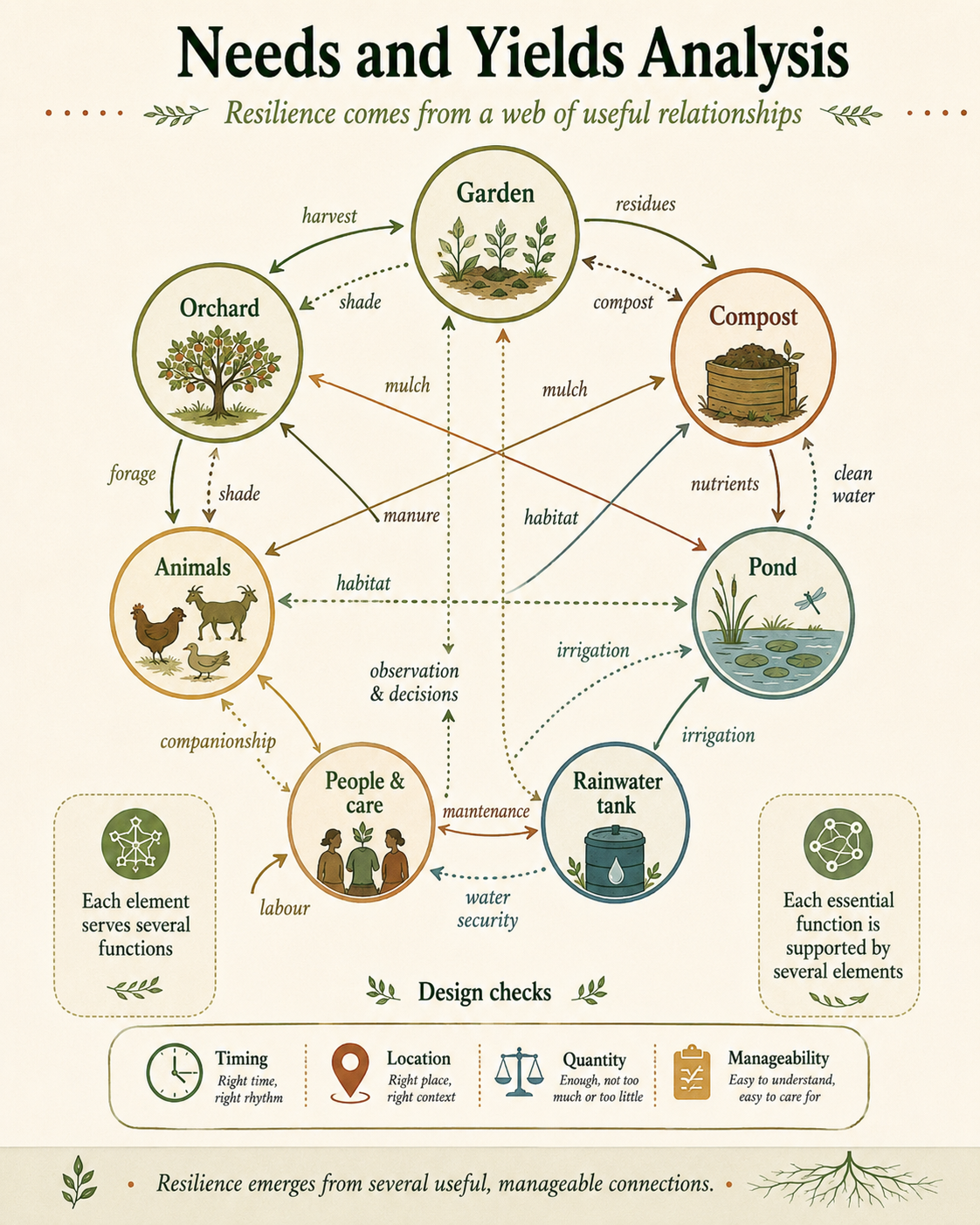
Relationship and resilience web: complete text equivalent
The web connects seven elements: garden, compost, pond, rainwater tank, people and care, animals, and orchard.
The illustrated connections include harvest, residues, compost, mulch, nutrients, forage, manure, shade, habitat, irrigation, clean water, water security, maintenance, labour, companionship, and observation and decisions.
Two design principles
- Each element should serve several functions.
- Each essential function should be supported by several elements.
Four design checks
- Timing: the right time and rhythm.
- Location: the right place and context.
- Quantity: enough but not too much or too little.
- Manageability: easy to understand and care for.
Resilience emerges from several useful, manageable connections rather than one supposedly perfect chain.
Include people, knowledge and care
Human labour is often the invisible input in ecological diagrams. Feeding, checking, recording, repairing, harvesting, teaching and deciding are real system functions. The people involved also have needs for safety, rest, clarity, fairness, learning and meaningful yields. A design that depends on heroic daily effort is not resilient simply because its nutrient arrows form a circle.
Knowledge can also be a yield. Observation records, mistakes, seasonal comparisons and learner feedback may improve future decisions. Yet educational value should not be claimed at the expense of animal welfare, privacy, safety or truthful reporting.
Worked example: proposed animal integration at Vila Pinheiro
The Vila Pinheiro animal-husbandry design explores possible relationships among woodland, pasture, animals, food systems and people. Goats might browse brambles and produce manure; poultry might contribute eggs, scratching and fertility; trees might provide shade, forage and shelter. Each attractive yield introduces needs and risks that must be designed first.
| Element | Principal needs | Possible yields | Questions before integration |
|---|---|---|---|
| Goats | Secure fencing, suitable forage, clean water, shelter, companionship, health care and daily oversight. | Browsing, manure, appropriate products, learning and vegetation management. | Is forage adequate year-round? Which plants are toxic? Can browsing damage regeneration or increase erosion? |
| Poultry | Predator protection, feed, water, housing, health care, dust bathing and managed access. | Eggs, manure, scratching, pest predation, feathers and observation. | Where is manure useful? When does scratching help, and when does it damage mulch or seedlings? |
| Woodland | Regeneration, soil cover, fire management, biodiversity and controlled disturbance. | Shade, habitat, forage, biomass, microclimate and learning. | What stocking level and timing support rather than suppress succession? |
| People | Safety, manageable routines, knowledge, rest, access and economic realism. | Food, companionship, learning, livelihood and connection with land. | Who provides care every day, including illness, travel and emergencies? |
These are design propositions, not reported outcomes. The analysis is valuable because it exposes the conditions that must be met before animals can be treated as regenerative partners.
Practical activity
Complete a needs and yields analysis
Analyse one proposed element and test whether it belongs in the design.
- Choose one element and state its intended role.
- List its needs, inputs, products, behaviours, wider yields and hazards.
- Add timing, quantity, quality, location and management requirements.
- Find at least three possible connections between its outputs and other elements’ needs.
- Find at least two ways the wider system could meet its essential needs.
- Identify one connection that is established, one that needs observation and one that should be tested cautiously.
- Decide whether to include, modify, relocate, delay or reject the element.
Record: Document rejected elements and reasons as carefully as accepted ones. Avoiding a burdensome element can be an excellent design yield.
Printable HTML worksheet
Needs and yields analysis worksheet
Print this page or complete the fields in your own design record. The headings remain available as text and do not depend on the diagrams.
| Analysis field | Notes |
|---|---|
| Element and intended role | |
| Essential needs | |
| Inputs supplied by people or infrastructure | |
| Products and direct outputs | |
| Behaviours through time | |
| Wider ecological or social yields | |
| Unwanted outputs, hazards or burdens | |
| Timing, quantity, quality and location | |
| Possible connections | |
| Redundant support for essential functions | |
| Evidence, assumptions and experiments | |
| Decision and next review date |
Common mistakes
- Counting desirable products while ignoring daily care, infrastructure and risk.
- Calling every output a yield even when it has no safe or practical use.
- Drawing connections without testing timing, distance, quantity or quality.
- Pursuing maximum integration until the system becomes difficult to understand or manage.
- Depending on a single element for water, fertility, income or another essential function.
- Presenting a proposed loop as though it has already worked in practice.
Key takeaways
- Every element has needs, behaviours, outputs and possible hazards as well as attractive products.
- A useful yield depends on a recipient, timing, place, quantity, quality and management.
- Good connections reduce waste and dependency while increasing mutual support.
- Stack compatible functions, but provide redundant support for essential functions.
- Include people, labour, care, knowledge and uncertainty in the analysis.
Sources and attribution
Needs-and-yields and functional-analysis concepts are inherited permaculture teaching tools. The terminology, questions, worksheet and Vila Pinheiro synthesis in this guide are Mark D’Cruz’s teaching interpretation and application.
- Bill Mollison, Permaculture: A Designers’ Manual, Tagari Publications, 1988.
- David Holmgren, Permaculture: Principles and Pathways Beyond Sustainability, Holmgren Design Services, 2002; revised edition, Melliodora Publishing, 2017.
- Looby Macnamara, People & Permaculture: Caring and Designing for Ourselves, Each Other and the Planet, Permanent Publications, second edition, 2019.
- Mark D’Cruz, Design 5: Water Self-sufficiency; Design 7: Ayurvedic Food Forest; Design 8: Regenerative Silviculture; Design 9: Regenerative Animal Ecosystem; Design 10: Action Learning Pathway, Diploma in Applied Permaculture Design, 2025.