Cornerstone Guide 9 of 12
The Design Web
A non-linear framework for permaculture design: twelve connected anchor points support reflection, integration and action without pretending that people and living systems unfold in tidy lines.
What you will learn
- Why the Design Web is a framework rather than a fixed sequence.
- The purpose of its twelve connected anchor points.
- How to enter, move around and return to the Web.
- When the Web may be more useful than a staged design process.
- How Mark used it to design and reflect on his Diploma Action Learning Pathway.
What is the Design Web?
The Design Web is a flexible, holistic and dynamic design framework created by permaculture teacher and author Looby Macnamara. It was developed particularly to support people-based design, but it can be applied to places, projects, processes, pathways and organisations.
Unlike a staged process that suggests a normal progression, the Web presents connected anchor points. A designer may begin where energy, urgency or clarity already exists, move to another anchor point that opens useful enquiry, return to earlier thinking and continue until the design has enough integration and momentum to live in practice.
Non-linear does not mean vague. The Web still asks the designer to examine purpose, resources, constraints, patterns, principles, ideas, needs, action, learning and continuation. Its discipline lies in making relationships visible while refusing to pretend that human and living systems unfold in tidy lines.
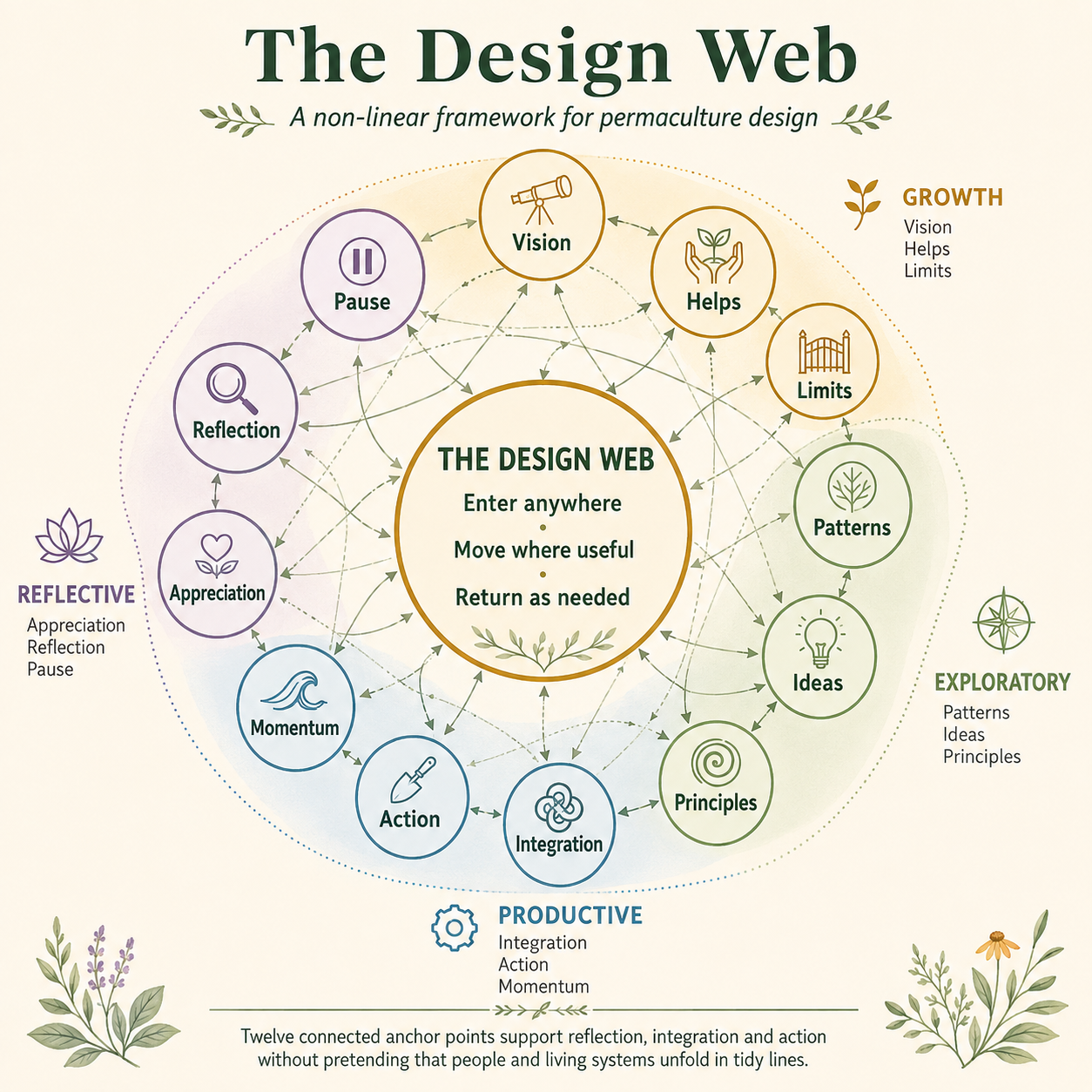
Design Web infographic: complete text equivalent
The Design Web is a non-linear permaculture design framework created by Looby Macnamara.
Its working instruction is to enter anywhere, move where useful and return as needed.
Growth
- Vision.
- Helps.
- Limits.
Exploratory
- Patterns.
- Ideas.
- Principles.
Productive
- Integration.
- Action.
- Momentum.
Reflective
- Appreciation.
- Reflection.
- Pause.
The connecting lines represent possible movement among anchor points rather than a prescribed sequence. The designer may revisit earlier thinking as evidence, understanding, circumstances and the living system change.
The twelve connected anchor points support reflection, integration and action without pretending that people and living systems unfold in tidy lines.
The twelve anchor points
| Anchor point | Purpose | Prompt |
|---|---|---|
| Vision | Clarifies the desired future, qualities and direction that orient the design. | What are we moving towards, and how should it feel when it is working? |
| Helps | Recognises resources, allies, skills, conditions and existing strengths. | What already supports the journey? |
| Limits | Names constraints, blocks, risks and factors that define the design space. | What may prevent movement, and which limits must be accepted or redesigned? |
| Patterns | Examines recurring behaviours, relationships, rhythms and structures. | What keeps happening, and what does that reveal? |
| Ideas | Generates possibilities without committing too early. | What becomes possible if judgement is briefly suspended? |
| Principles | Uses ethics and design principles to question, create and choose. | Which principle offers a useful lens now? |
| Integration | Brings needs, ideas, relationships and realities into a coherent whole. | How can the parts support one another and the wider purpose? |
| Action | Turns intention into specific, appropriately scaled commitments. | What will happen next, by whom and with what resources? |
| Momentum | Sustains movement, energy and continuity beyond the first action. | What rhythm, support or feedback will keep the design alive? |
| Appreciation | Recognises strengths, progress, gifts and what deserves care. | What is already valuable, and what have we received? |
| Reflection | Interprets experience, feedback and learning. | What changed, what did we learn and how did the process change us? |
| Pause | Creates space for rest, sensing, emergence and deliberate non-action. | What becomes visible when we stop pushing? |
The Design Web’s four phases
Looby Macnamara groups the twelve anchor points into four named phases. The phases help organise the Web without turning it into a one-way sequence. Each anchor point remains connected with the others, and a designer may move between phases or return to an earlier enquiry as the design develops.
| Macnamara phase | Anchor points | Design work |
|---|---|---|
| Growth | Vision, Helps, Limits | Establish direction, recognise capacity and face the realities shaping the design. |
| Exploratory | Patterns, Ideas, Principles | Recognise what is happening, generate possibilities and use principles to question or choose. |
| Productive | Integration, Action, Momentum | Bring the design together, commit to movement and establish continuity. |
| Reflective | Appreciation, Reflection, Pause | Value what exists, interpret experience and create space for learning and emergence. |
How to enter and move around the Web
Choose an entry point that has energy or necessity. A strong dream may invite Vision. A stalled project may begin with Limits or Momentum. A team carrying disappointment may need Appreciation, Reflection or Pause before generating more actions. A land design rich in observations may enter through Patterns or Principles.
- Name the subject and choose a boundary that is useful for now.
- Select the anchor point with the greatest energy, urgency or uncertainty.
- Record observations, questions, drawings or evidence without forcing premature closure.
- Notice which other anchor point the enquiry naturally touches.
- Move across the Web and allow earlier notes to be changed by later insight.
- Integrate the work into decisions and actions appropriate to the available capacity.
- Build momentum, reflection and pause into the design rather than adding them after exhaustion.
The Web and staged frameworks
The Design Web and staged frameworks solve different problems. SADIMET offers recognisable stages for moving from survey through analysis, design, implementation, maintenance, evaluation and tweaking. The Design Web is more exploratory and relational. Neither is automatically superior. The design subject, the designer and the available evidence should influence the choice.
| Design condition | A staged framework may help when… | The Design Web may help when… |
|---|---|---|
| Process clarity | A team needs shared stages, deliverables or governance. | The subject is emerging and the useful starting point is uncertain. |
| Human complexity | People-based factors are limited or already well understood. | Beliefs, emotions, relationships, learning or well-being are central. |
| Evidence and implementation | Survey and implementation stages must be explicit and auditable. | Reflection, creativity and integration need equal visibility. |
| Designer preference | A clear progression supports confidence and accountability. | Non-linear exploration improves insight and engagement. |
| Combination | A framework can contain reflective or creative tools. | The Web can host technical surveys, analyses and action plans where needed. |
Hybrid use should remain legible. If a SADIMET stage uses the Web as an exploratory tool, record that relationship. Avoid blending frameworks so thoroughly that nobody can tell which decisions, evidence or responsibilities belong where. Guide 4 explains how to choose and adapt frameworks responsibly.
Worked example: Mark D’Cruz’s Action Learning Pathway
Mark selected the Design Web with his Diploma tutor, Dr Tom Henfrey, during his 2023 induction. The Action Learning Pathway was begun early and presented as Design 10, allowing it to gather and integrate learning from the other nine designs. Its subject was not merely a project schedule. It was Mark’s evolution as a designer, land steward, educator and practitioner.
The final presentation explored limits such as time, finance, physical capacity, regulation, language and the interdependence of several ambitious systems. It recognised helps including family, tutors, established bonsai knowledge, design tools, digital capability and Vila Pinheiro itself. Patterns linked bonsai, permaculture, learning, seasonal rhythms and the recurring temptation to take on too much.
Integration connected the ten designs across land, water, energy, food, trees, animals, education and livelihood. Action and momentum focused on turning aspirations into manageable commitments. Appreciation, reflection and pause made the pathway more than a productivity plan: they allowed the designer to recognise learning, limits and the need for rest.
Mini example: a stalled kitchen garden
| Entry point | What the designer discovers | Possible movement |
|---|---|---|
| Limits | Summer watering and daily attention exceed available capacity. | Move to Patterns and Helps. |
| Patterns | Beds are planted enthusiastically in spring, then neglected during peak heat. | Move to Principles and Ideas. |
| Helps | Roof water, shaded edges, existing herbs and a neighbour’s experience are available. | Move to Integration. |
| Principles | Use small and slow solutions; catch and store energy; obtain a yield. | Reduce area and prioritise reliable crops. |
| Integration | A smaller shaded garden, storage and drip irrigation better match capacity. | Move to Action and Momentum. |
| Pause and Reflection | Review after the summer before expanding. | Return to Vision with evidence. |
Using each anchor point well
- Vision should orient decisions, not become an excuse for ignoring present limits.
- Helps include existing strengths and relationships, not only money or equipment.
- Limits can define a more elegant design; they are not evidence of personal failure.
- Patterns should be supported by observation rather than invented from one incident.
- Principles should open questions and expose trade-offs.
- Ideas benefit from abundance before selection, followed by disciplined integration.
- Action should be specific and appropriately small, with responsibility and timing visible.
- Momentum requires rhythms, support and feedback, not constant acceleration.
- Appreciation, Reflection and Pause are productive design work, not decorative soft endings.
Practical activity
Begin a Design Web
Use the Web to explore a live design subject without forcing a linear route.
- Write a clear design subject in the centre of a page.
- Place the twelve anchor points around it, leaving generous space.
- Choose one entry point and work there for ten minutes.
- Follow two or three connections that arise naturally.
- Use a different colour for evidence, assumptions, ideas and decisions.
- Circle any tension between anchor points, such as Vision and Limits or Action and Pause.
- Choose one next action and one date for Reflection.
Record: Return to the same Web rather than making a fresh clean copy each time. Layers, corrections and crossed connections show the design thinking becoming more honest.
Common mistakes
- Redrawing the Web as a one-way sequence and losing its central advantage.
- Visiting every anchor point once merely to prove completion.
- Using Vision and Ideas enthusiastically while avoiding Limits, Integration or Action.
- Treating Momentum as relentless activity instead of sustainable continuation.
- Leaving Appreciation, Reflection and Pause until the designer is exhausted.
- Using the framework without crediting Looby Macnamara.
- Claiming the framework itself when the original contribution is an application or adaptation.
Key takeaways
- The Design Web is a connected, non-linear framework created by Looby Macnamara.
- Its anchor points can be entered and revisited in response to the design’s energy and needs.
- Flexibility does not remove discipline; evidence, integration, action and learning still matter.
- The Web is particularly valuable where people, relationships, behaviour, well-being or emergence are central.
- Mark’s Action Learning Pathway demonstrates an application of the Web across ten interconnected designs.
Sources and attribution
The Design Web, its name, four phases and twelve anchor points are attributed to Looby Macnamara. The practical prompts and explanatory synthesis are Mă-Kè Permaculture Academy teaching material. The Action Learning Pathway example is Mark D’Cruz’s application.
- Looby Macnamara, People & Permaculture: Caring and Designing for Ourselves, Each Other and the Planet (authorised free edition PDF), Permanent Publications, second edition, 2019.
- Looby Macnamara, “Action learning pathway designs”.
- Cultural Emergence, “The Design Web”.
- Looby Macnamara, Design Adventures, Cultural Emergence, 2026.
- Mark D’Cruz, Design 10: Action Learning Pathway, Diploma in Applied Permaculture Design, 2025.
- Mark D’Cruz, Design 1: The Mă-Kè Bonsai Way; Designs 3–9: Vila Pinheiro systems; supporting Diploma portfolio, 2023–2025.