Cornerstone Guide 3 of 12
SADIMET: A Practical Permaculture Design Process
SADIMET gives a permaculture project a memorable sequence: Survey, Analyse, Design, Implement, Maintain, Evaluate and Tweak.
I value it because it connects imagination with disciplined action. It encourages us to observe before deciding, but it does not leave us observing forever. It takes a design beyond the drawing into implementation, care, evaluation and change.
SADIMET is not a recipe and living projects do not move through it in a perfectly straight line. It is a structure for thinking, recording, acting and learning.
In brief
| Stage | Central question | Useful output |
|---|---|---|
| Survey | What is here, who is involved and what is known? | Evidence and a defined brief |
| Analyse | What patterns, needs, limits and possibilities matter? | Findings and criteria |
| Design | Which relationships and choices best meet the brief? | A justified design |
| Implement | How will we turn the design into responsible action? | A staged implementation record |
| Maintain | What care will keep it functioning? | A realistic maintenance plan |
| Evaluate | What happened compared with what we intended? | Findings grounded in observation |
| Tweak | What should change in response? | An adaptation and a new review point |
SADIMET provides the framework. The tools used within it should fit the project, place, people, scale and questions involved.
SADIMET evidence-and-action pathway
Goals orient the work before seven ordered stages. Feedback can return the project to an earlier stage; monitoring connects implementation, maintenance and evaluation; ethics remain visible throughout.
- Goals Name the need and direction without fixing the solution.
- 1. Survey Evidence and a defined brief.
- 2. Analyse Findings and criteria.
- 3. Design A justified proposal.
- 4. Implement A staged action record.
- 5. Maintain A realistic care plan.
- 6. Evaluate Findings grounded in observation.
- 7. Tweak An adaptation and new review point.
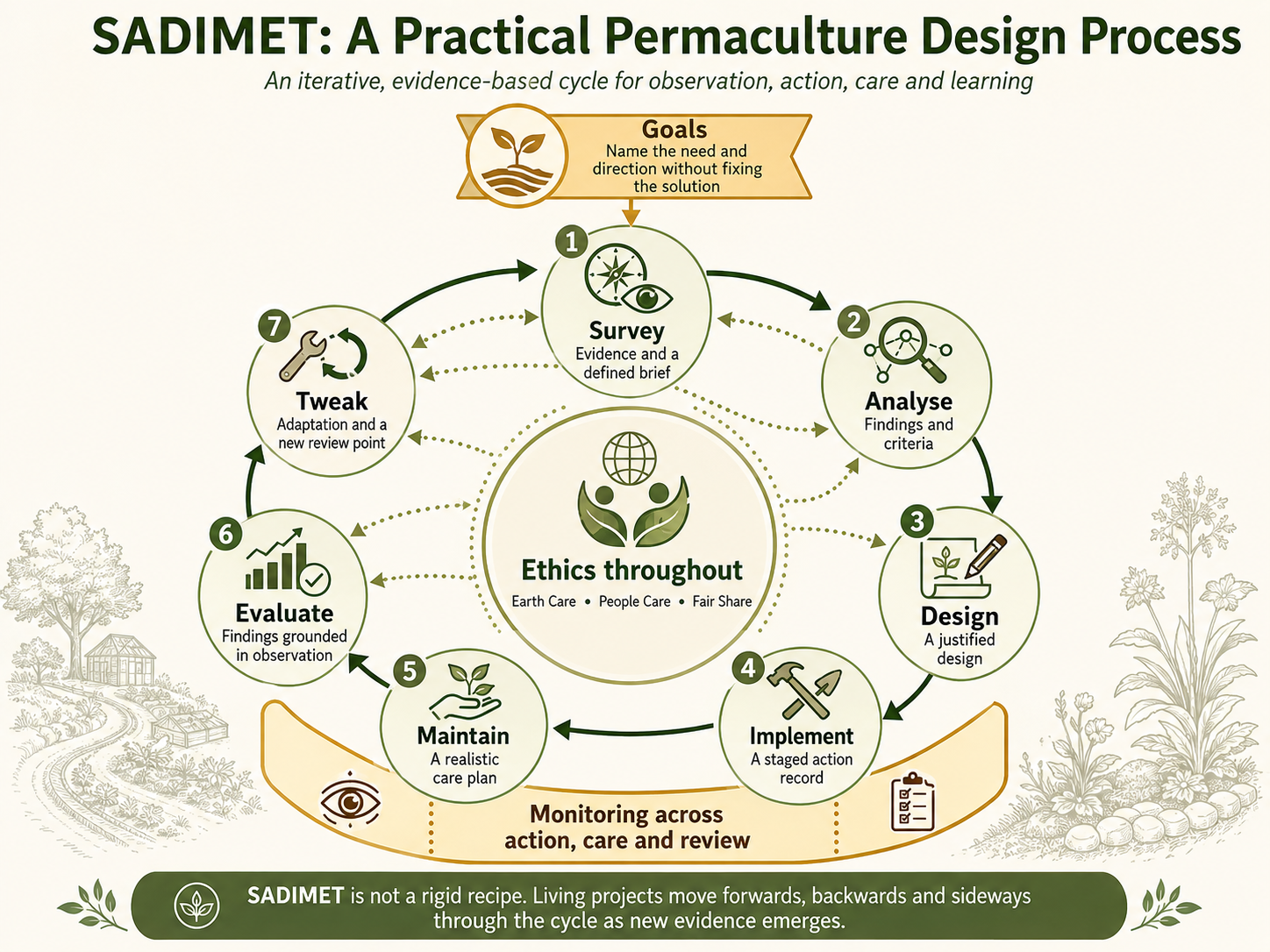
Before SADIMET: begin with purpose and goals
A design process needs direction. GoSADIMET was already in circulation before my Diploma work. Jennifer English Morgan’s dated 13 February 2018 article, in the section “Activity Worksheet: Emergent Design with GOBRADIMET”, records GOBRADIMET and GOSADIMET as related formulations used by multiple designers. This establishes prior use, not a single inventor.
My Design 03 records my selection and use of GoSADIMET on PDF page 9 and explains my interpretation in Annexure I on PDF pages 39 to 40. I did not invent it. For me, a goal should express the need and direction without deciding the solution too early.
Build a large pond.
Improve reliable and responsible water availability while protecting people, soil, habitat and downstream flows.
The second leaves room for observation and analysis to change the answer. The goal itself may need to change if the project reveals that we are solving the wrong problem.
Chris Evans’s one-page 2017 Design Frameworks and Methods lists SADIMET as Survey, Analysis, Design, Implement, Maintain, Evaluate and Tweak. I use that direct source for Maintain as the M. Monitoring across implementation, maintenance and evaluation is my interpretation in this guide, not an alternative expansion of the inherited acronym.
1. Survey
Purpose
Build a trustworthy picture of the place or situation before selecting an answer.
What to do
- agree the purpose, scope, participants and important boundaries;
- observe patterns across relevant times and seasons;
- collect maps, measurements, photographs, records and local knowledge;
- listen to the people who use or care for the place;
- identify safety, ecological, cultural and practical requirements;
- separate observations from assumptions and unanswered questions.
Useful output
A survey record, design brief, evidence register, participant map and list of important unknowns.
Question before moving on
Do we know enough to analyse responsibly, and can any remaining uncertainty be explored through further observation or a modest trial?
Survey is not a hunt for facts that support the solution we already want.
2. Analyse
Purpose
Turn information into an understanding of patterns, relationships, causes, needs, limits and possibilities.
What to do
- distinguish symptoms from underlying needs;
- examine flows of water, energy, materials, nutrients, money, labour and information;
- consider sectors, zones, access, microclimates and relative location where useful;
- explore needs and yields without assuming every possible connection is beneficial;
- identify leverage points, bottlenecks, dependencies and risks;
- agree criteria against which possible designs can be compared;
- examine the situation through permaculture ethics and principles.
Useful output
An analysis summary, pattern and relationship maps, priorities and clear design questions.
Question before moving on
Can we explain how our conclusions arose, and have we considered more than one interpretation?
Analysis is where information becomes judgement. A precise-looking map or spreadsheet can still contain uncertain assumptions.
3. Design
Purpose
Develop and compare possible ways of meeting the need, then connect the selected relationships into a coherent proposal.
What to do
- generate more than one credible option;
- begin with patterns and relationships before fixing details;
- use ethics and principles to question the options;
- compare cost, risk, benefit, maintenance and available capacity;
- seek feedback from the people affected and from relevant expertise;
- record important assumptions and reasons for rejecting alternatives;
- decide what will be observed after implementation.
Useful output
A design appropriate to the project, including drawings or diagrams, decisions, responsibilities, estimated resources, sequencing and a plan for feedback.
Question before moving on
Does the design meet the purpose responsibly, and can another person understand why its main decisions were made?
A beautiful drawing is not automatically a good design. The relationships and reasoning must be clear enough to use and question.
4. Implement
Purpose
Turn the design into careful, observable action.
What to do
- confirm responsibilities, skills, resources and any permissions;
- stage the work so early experience can inform later commitments;
- protect existing soil, water, habitat and useful functions during the work;
- record departures from the design and why they occurred;
- test systems before depending upon them;
- give the people caring for the system understandable information.
Useful output
An implementation plan, record of completed work, changes, tests, handover information and unresolved matters.
Question before moving on
What was actually implemented, what changed and what still requires attention?
When reality contradicts the drawing, pause and learn. Quietly pretending the drawing was right destroys valuable evidence.
5. Maintain
Purpose
Provide the continuing care, resources and responsibility needed for the design to remain useful.
What to do
- define routine and seasonal tasks;
- name the people responsible and make realistic backup arrangements;
- budget time, materials and replacement costs;
- make inspection and care practical and accessible;
- record faults, repairs and recurring burdens;
- reconsider a design whose maintenance demands are unreasonable.
Useful output
A maintenance schedule, responsibility record and provision for the resources required.
Question before moving on
Can the people responsible genuinely maintain this design with the time, skills and resources available?
Maintenance is not the unglamorous work that begins after design. It is part of the design.
6. Evaluate
Purpose
Compare what is happening with the purpose, expectations, starting conditions and ethical responsibilities.
What to do
- collect the observations or measurements chosen during design;
- compare what happened with what was expected;
- listen to users, maintainers and others affected;
- look for unintended effects and displaced burdens;
- distinguish what was produced from the longer-term outcome;
- state what the evidence supports and what remains uncertain.
Useful output
An evaluation record explaining what appears to work, what does not, what remains unclear and what decision follows.
Question before moving on
What have we genuinely learnt, and what would be an overstatement?
A photograph proves that a feature exists. It does not, by itself, prove that the feature saved water, increased biodiversity or improved wellbeing. This boundary strengthens rather than diminishes our work.
7. Tweak
Purpose
Adapt the design in response to experience, new evidence and changing conditions.
What to do
- identify the smallest useful change likely to address the finding;
- return to the relevant earlier stage rather than patching blindly;
- update drawings, instructions and responsibilities;
- explain the change to the people affected;
- record the reason and choose a new review point;
- remove an intervention if that is the wiser course.
Useful output
A clear record of the finding, change, revised design and next review.
Question before continuing
What have we learnt, what should change and which part of the process should we revisit?
Tweaking is not random improvisation. It is adaptation with memory.
A simple example: designing a herb bed
A small herb bed can demonstrate the whole process.
- Goal: Make frequently used culinary and medicinal herbs convenient to harvest while creating a manageable and water-conscious growing area.
- Survey: Observe kitchen use, sunlight, shade, paths, water access, existing plants, soil and the time available for care.
- Analyse: Compare possible locations, identify which herbs are actually used and consider heat, water demand, access and companion relationships.
- Design: Choose a suitable location and arrange plants, paths, irrigation, mulch and harvesting access. Keep the first version modest.
- Implement: Prepare the bed, plant it and record any changes made because the soil, materials or plants differed from the plan.
- Maintain: Water, mulch, prune, harvest and replace plants according to season and actual use.
- Evaluate: Notice which plants thrive, which are used, where water is wasted and whether the bed remains convenient.
- Tweak: Move, replace or divide plants, change watering or reshape access in response to what was learnt.
The project is small, but the quality of thinking is no less real. SADIMET scales by changing the depth and tools, not by abandoning the process.
Monitoring belongs across the cycle
Monitoring means making purposeful observations over time. It may begin during implementation, guide maintenance and provide evidence for evaluation.
Useful monitoring identifies:
- the question being explored;
- the sign, indicator or observation;
- the starting point, where one is available;
- the method, timing and person responsible;
- where the result will be recorded;
- what result would prompt review.
Collecting information without a decision purpose creates work rather than learning. Evaluating without observation encourages a good story to outrun the evidence.
From Vila Pinheiro: water as a connected design
My water design at Vila Pinheiro brought together a requirements analysis, proposed system components and a maintenance plan. The work considered roof catchment, tanks, swales, storm-water flows, a pond, irrigation, the existing well, household needs, growing areas and future animal systems.
These were not seven sealed boxes. Survey exposed gaps. Analysis altered priorities. Design created further questions. Maintenance requirements changed how some components were viewed. The work moved forwards, backwards and sideways through the process.
Some elements have been implemented, others remain proposals or evolving trials, and some figures require renewed checking against present conditions. This does not make the design meaningless. It makes Evaluate and Tweak necessary.
The value of a design record is that it allows us to see what we thought, what we did, what changed and why. Without that record, learning becomes folklore.
Ethics throughout the process
In my water self-sufficiency design, I documented PERMA-SADIMET as my particular adaptation of SADIMET, making permaculture ethics and principles visible at every stage.
It asks whether Survey listened, whether Analysis faced limits, whether Design compared consequences, whether Implementation acted carefully, whether Maintenance transferred hidden burdens, whether Evaluation was honest and whether Tweak responded to harm and learning.
Design 05 documents my framing on PDF pages 3 and 5 and in Appendix 1 on PDF pages 37 to 38. This supports authorship of the particular synthesis recorded there. It does not establish universal uniqueness or priority across the wider field, and I do not use the Diploma assessment as independent corroboration of that wider claim.
SADIMET, GoSADIMET and PERMA-SADIMET
- SADIMET is a mnemonic used in permaculture education: Survey, Analyse, Design, Implement, Maintain, Evaluate and Tweak.
- GoSADIMET is an existing adaptation that predates my Diploma. I used and interpreted it in my own design work; I did not invent it.
- PERMA-SADIMET is my particular documented adaptation for applying permaculture ethics and relevant principles throughout SADIMET. It builds on SADIMET rather than replacing it.
- Observation is central to Survey and continues throughout design.
- Monitoring crosses Implementation, Maintenance and Evaluation. The M in SADIMET remains Maintain.
Permaculture education also contains related variants, including SADIMETS with Share added. The available sources do not establish one adequately evidenced inventor or a direct line from ADDIE. I therefore make neither claim.
A starter SADIMET record
For a small project, keep one concise entry for each heading:
- Goal: need, affected people, limits and desired change.
- Survey: observations, sources, participants and unknowns.
- Analyse: patterns, causes, possibilities, risks and criteria.
- Design: options, selected relationships and reasons.
- Implement: stages, responsibilities, safeguards and changes.
- Maintain: tasks, timing, resources and ownership.
- Evaluate: observations, results, uncertainty and conclusions.
- Tweak: change, reason, updated records and next review.
Give important decisions a date and an owner. Link supporting drawings, photographs and records so that the process remains traceable.
Download status: the accessible standalone starter record is still in production. The complete prompts are available in HTML above; no incomplete download is linked.
Frameworks do not replace competence
SADIMET helps us identify dependencies, questions and responsibilities. It does not make one designer competent in every technical field. Watercourses, drinking water, structures, sanitation, electricity, fire and protected habitats may require specialist knowledge and permission.
The framework helps us know when such knowledge belongs in the design.
Continue learning
Use What Is Permaculture Design? to revisit the wider discipline and Permaculture Ethics in Practice to deepen the ethical questions running through every stage.
This guide and its starter record remain freely useful without enrolment.
References
- Permaculture Association, “SADIMET Design Process”.
- Chris Evans, Design Frameworks and Methods, one-page framework sheet, 2017: SADIMET column.
- Permaculture Association, Small is Beautiful: A Research Handbook for Permaculture, version 1.5, July 2014, PDF pages 8 to 10. This is contextual rather than the primary locator for Maintain.
- Jennifer English Morgan, “A Design Cycle Application: GOBRADIMET”, 13 February 2018, section “Activity Worksheet: Emergent Design with GOBRADIMET”. This records prior related use but does not establish a single inventor.
- Mark D’Cruz, GoSADIMET Design Framework for the Real World, Design 03 Annexure I, PDF pages 39 to 40, 2025.
- Mark D’Cruz, Vila Pinheiro: A Sustainable Homestead, Design 03, PDF page 9.
- Mark D’Cruz, Vila Pinheiro Water Self-sufficiency Design, Design 05, PDF pages 3 and 5, and Appendix 1, PDF pages 37 to 38, 2024 to 2025.
- Mark D’Cruz, “PERMA-SADIMET Framework: Empowering Regeneration”, public account of the framework.