Cornerstone Guide 4 of 12
Choosing a Permaculture Design Framework
Permaculture does not merely give designers a fixed process. It gives us the ethics, principles, tools and flexibility to select, adapt or construct a process appropriate to the problem.
In brief
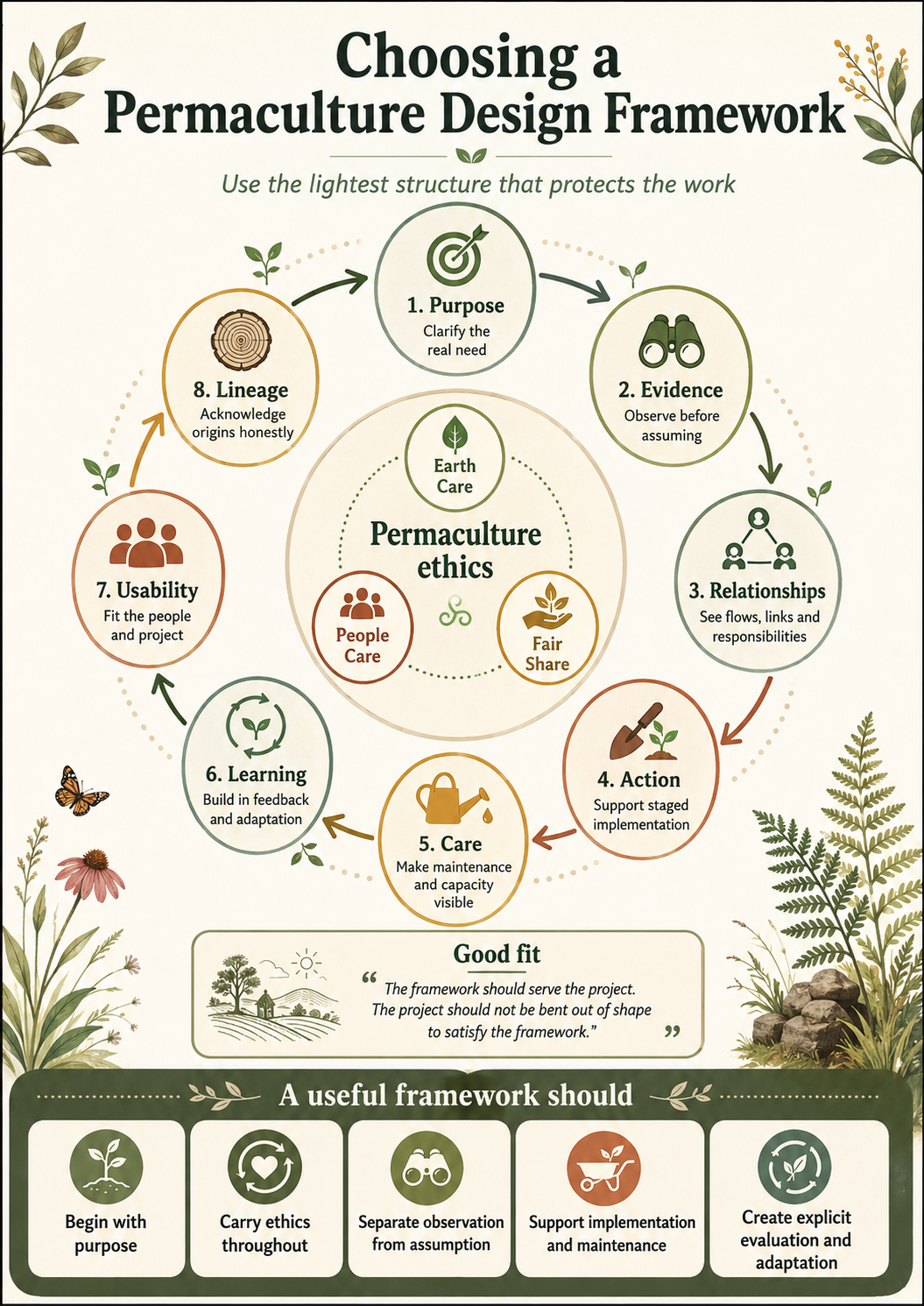
A useful permaculture design framework should:
- begin with a clear purpose or design brief;
- keep Earth Care, People Care and Fair Share present throughout;
- separate observation from assumption;
- reveal relationships, flows, limits and consequences;
- connect decisions to evidence;
- support implementation, maintenance and monitoring;
- create explicit opportunities to evaluate and adapt;
- remain appropriate to the scale, people, place and nature of the project.
Permaculture does not require every problem to be forced through an inherited framework. It should also give a practitioner the design literacy to construct or adapt a process, framework or workflow when the situation genuinely requires one. What remains constant is the ethical responsibility carried into that work.
The best framework is not the one with the most memorable acronym. It is the one that helps people make responsible decisions in the situation before them.
Framework, process, methodology and tool
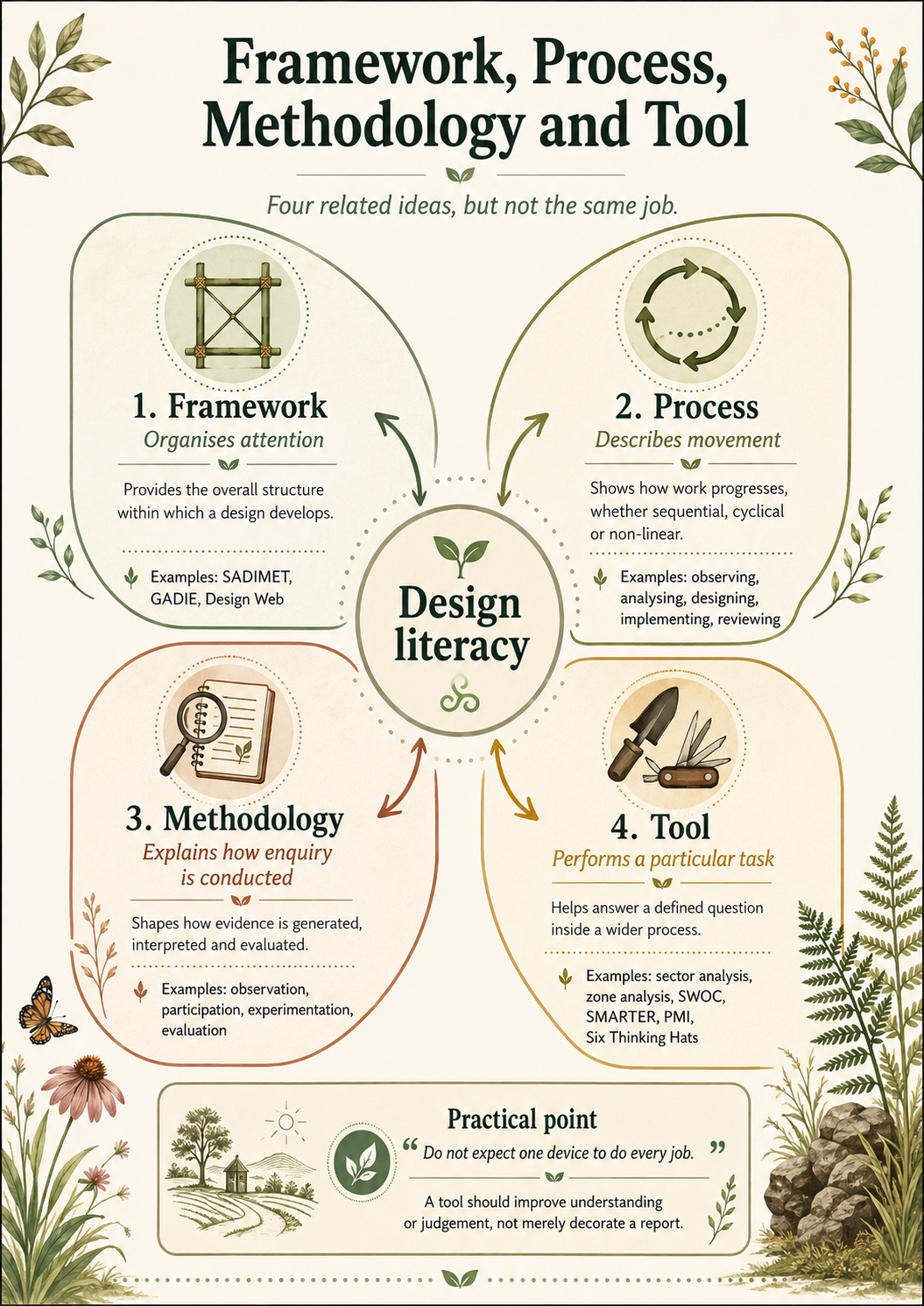
These terms overlap, but they are not identical.
A framework organises attention
A framework provides the overall structure within which a design develops. It identifies important areas of enquiry or stages of work and shows how they relate. SADIMET, GADIE and the Design Web organise a design journey in different ways.
A process describes movement
A process describes what happens as the work progresses. It may be sequential, cyclical or deliberately non-linear. Surveying, analysing, designing, implementing and reviewing form a process even when the designer moves backwards and forwards between them.
A methodology explains how enquiry is conducted
A methodology is the considered approach used to generate and interpret knowledge. It includes choices about evidence, participation, observation, experimentation and evaluation. Two designers might use the same framework but adopt different methodologies because their contexts and questions differ.
A tool performs a particular task
A tool helps answer a defined question. Sector analysis, zone analysis, SWOC analysis, input-output analysis, SMARTER goals, PMI and Six Thinking Hats are tools. They can be used within several frameworks. A tool should earn its place by improving understanding or judgement, not by decorating a report.
The distinctions need not become an exercise in terminology. Their practical purpose is to stop a designer expecting one device to do every job.
What makes a framework suitable for permaculture?
Ethics are carried through the whole design
Ethics should not appear only in an introductory paragraph. A framework suitable for permaculture must help the designer examine who and what may benefit, who carries the work or risk, what limits apply and how the design affects living systems.
Ethics influence the brief, evidence collected, options rejected, resources used, scale of intervention, maintenance burden and distribution of surplus. They do not hand us a perfect answer. They make responsibilities and trade-offs visible.
Observation comes before confident intervention
A design framework should create time for direct observation, listening and evidence gathering. Premature solutions are seductive because they feel productive. They are also a reliable way to solve the wrong problem efficiently.
Observation may include site visits, conversations, seasonal records, maps, photographs, measurements, resource inventories and the knowledge of people who already interact with the system. The strength of an intervention should reflect the strength of the available evidence.
Relationships matter more than isolated objects
Permaculture design is not a shopping list of desirable elements. A pond, greenhouse, orchard, solar array or compost system is not automatically appropriate because it is considered sustainable in isolation.
A framework should help the designer ask what need an element serves, what inputs it requires, what useful outputs it provides, who will maintain it and what happens when it fails or conditions change. Good design emerges through connections, placement, timing and responsibility.
Feedback is designed in
Living projects change. A framework should identify how effects will be observed, what will be recorded, who will review the evidence and what would justify a change of course.
Feedback is not an admission that the original design was poor. It is part of responsible design. Evaluation without the possibility of adaptation becomes theatre.
The framework suits the project
Land, organisations, education, livelihoods and personal development present different design conditions. A linear framework may be useful when responsibilities and deliverables must be communicated clearly. A web-like framework may be more suitable when the work is exploratory or personal. A specialised adaptation may be justified when an inherited framework repeatedly leaves important questions unaddressed.
The framework should serve the project. The project should not be bent out of shape to satisfy the framework.
Inherited frameworks and responsible adaptation
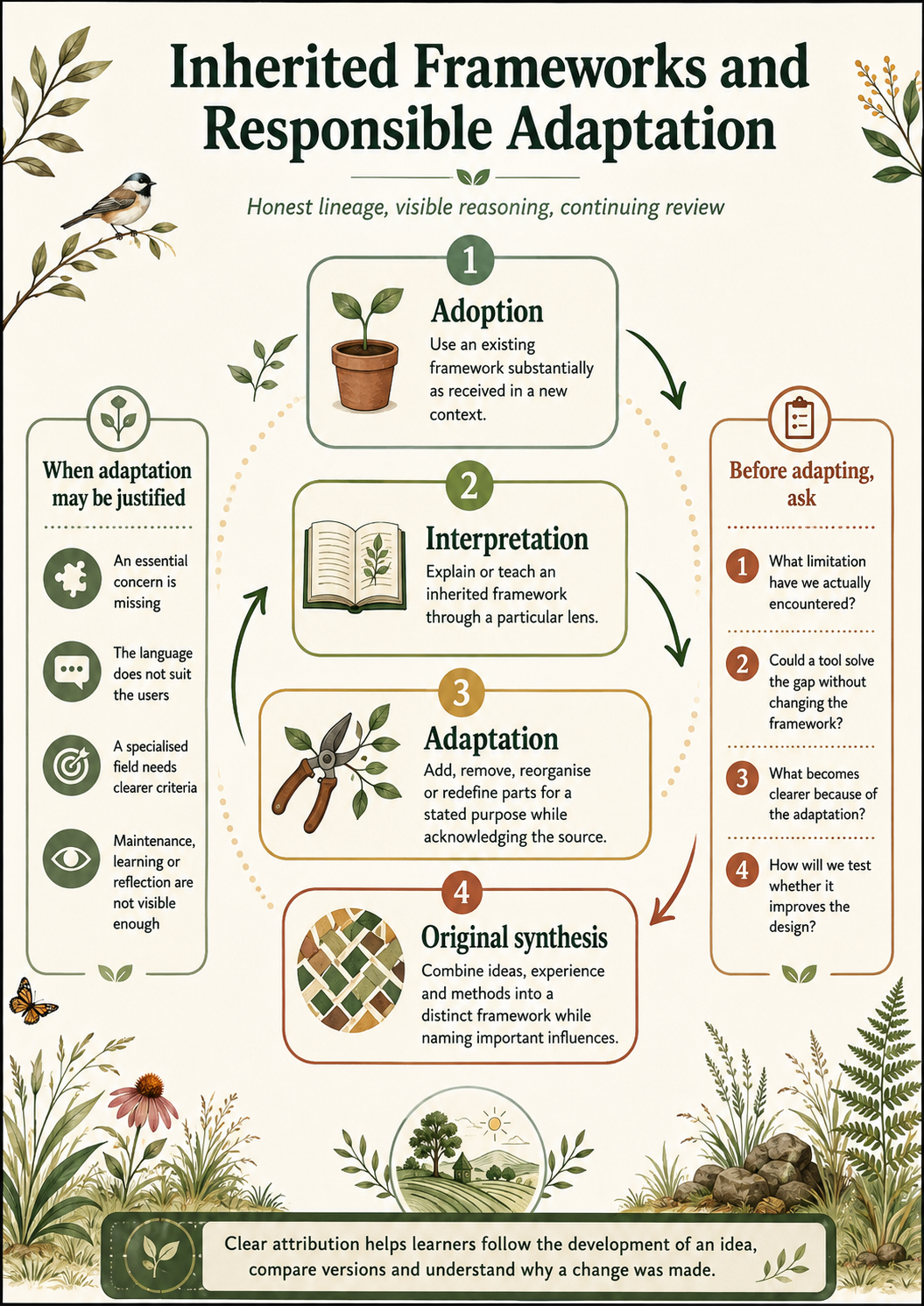
Permaculture is a living field shaped by many practitioners. Using an inherited framework is not a weakness. Nor does adapting it automatically make the adaptation an entirely new invention.
Responsible practice distinguishes among four forms of work:
- Adoption: using an existing framework substantially as received in a new context.
- Interpretation: explaining or teaching an inherited framework through a particular lens.
- Adaptation: adding, removing, reorganising or redefining parts of an inherited framework for a stated purpose while acknowledging its source.
- Original synthesis: combining ideas, experience and methods into a distinct framework or teaching model while naming important influences.
Clear attribution is more than academic manners. It enables learners to follow the development of an idea, compare versions and understand why a change was made.
Permaculture as design literacy
Permaculture should teach more than the correct use of established frameworks. It should develop the capacity to recognise the kind of problem before us, select an appropriate way of working and build a new process where inherited models do not adequately serve the context.
That freedom is not permission to manufacture an acronym and declare the design complete. A new framework must still be grounded in observation, evidence, participation, appropriate knowledge and continuing evaluation. It must also explain why an existing framework or combination of tools was insufficient.
The constant is ethics. Earth Care, People Care and Fair Share provide the coherence that allows the surrounding process to remain flexible. The stages, tools, language and sequence may change with the problem. Ethical responsibility must not.
This flexibility matters because many contemporary problems have no close historical precedent. Industrial science and technology have produced remarkable knowledge and capability, but they have also enabled new scales of extraction, pollution, simplification and unintended consequence. Religious and political institutions can offer moral traditions and social cohesion, yet they too can become rigid, fragmented or detached from the living effects of their decisions.
Permaculture need not reject science, technology or religious wisdom. It asks a harder question: how should any body of knowledge or power be used in service of living systems, human dignity, fair limits and long-term responsibility? Technique tells us what may be possible. Ethics helps us decide what should be attempted, for whom, at what scale and with what duty of care.
A framework is therefore provisional. Ethics is the glue that holds the design together while observation, method and action respond to the problem actually encountered.
GADIE as a worked example
GADIE is useful here because it demonstrates the difference between adopting an inherited structure and adapting that structure for a particular field.
The inherited GADIE process
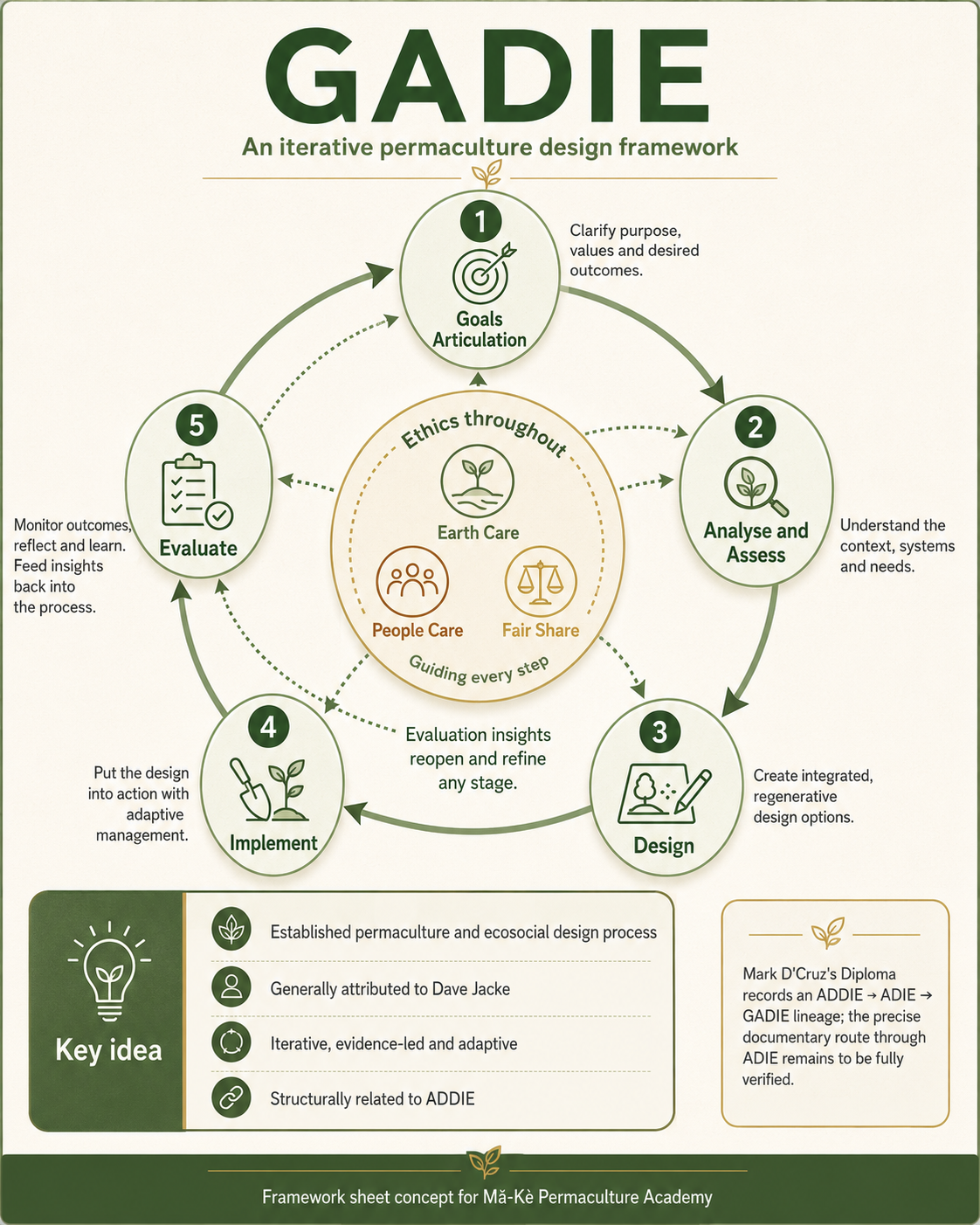
GADIE is an established permaculture and ecosocial design process generally attributed to American permaculture designer Dave Jacke. Its commonly documented stages are:
- G: Goal Articulation
- A: Analyse and Assess
- D: Design
- I: Implement
- E: Evaluate
Earlier teaching materials already present GADIE as iterative rather than as a one-way conveyor belt. Evaluation can return the designer to Goals, Analysis or Design as new evidence emerges. Its use within permaculture and ecosocial education also predates the Mă-Kè Diploma work.
These points matter. The GADIE acronym, the five-stage structure and its iterative character are inherited. Mark D'Cruz does not claim to have originated them.
Its relationship with ADDIE and ADIE
GADIE bears a clear structural relationship to systematic instructional-design models, particularly ADDIE: Analyse, Design, Develop, Implement and Evaluate. Mark's Diploma appendix records a lineage from ADDIE through an intermediate ADIE form to GADIE.
That recorded lineage is retained as part of the evidence behind the Diploma design, but the precise historical source for the intermediate ADIE stage has not yet been recovered. Until it is, the responsible public position is:
GADIE is structurally related to ADDIE, and Mark's Diploma records an ADDIE to ADIE to GADIE lineage. The precise documentary route through ADIE remains to be verified.
This is not evasive attribution. It distinguishes what the design record says from what the available public evidence can presently establish.
Mark D'Cruz's instructional-design adaptation
In Design 2, Growing Bonsai Sustainably: Beginners Bootcamp, Mark selected GADIE to redesign an existing bonsai course. He retained the inherited stages and their iterative relationship, then interpreted and strengthened them for permaculture-led course development.
The adaptation makes the following features explicit:
- Permaculture ethics as active criteria. Earth Care, People Care and Fair Share shape the Goals, evidence, design decisions, implementation and evaluation rather than sitting in a decorative preface.
- The course as a learning ecosystem. Learners, tutors, place, resources, culture, community and ecological effects are treated as relationships rather than isolated inputs.
- Ecological and instructional analysis together. Learner needs and teaching resources sit alongside inputs, outputs, site conditions, stakeholder needs and environmental consequences.
- Permaculture tools within course construction. SWOC analysis, input-output analysis, resource mapping and Pattern Language help organise both the content and the learning experience.
- Staged and adaptive implementation. Teaching materials and activities can be trialled, observed and refined rather than launched as a supposedly finished product.
- Evaluation as continuing feedback. Evidence from learners, tutors and outcomes can reopen any earlier stage, including the Goals themselves.
The distinctive contribution is therefore not "a new GADIE" detached from its history. It is a documented adaptation of inherited GADIE for permaculture instructional design, demonstrated through a real course-development project.
How the stages work in the Academy adaptation
| Stage | Inherited function | Permaculture instructional-design interpretation |
|---|---|---|
| Goals | Articulate purpose and desired direction | Establish the learning need, stakeholders, ethical commitments, appropriate limits and intended change |
| Analyse | Analyse and assess the situation | Examine learners, prior knowledge, teaching resources, place, ecological effects, culture, access, inputs, outputs, opportunities and constraints |
| Design | Develop a justified response | Connect learning outcomes, content, activities, relationships, sequencing, patterns and assessment to the evidence and ethics |
| Implement | Put the design into practice | Prepare tutors and resources, deliver in manageable stages, observe participation and retain capacity to adjust |
| Evaluate | Examine process and outcomes | Gather evidence, reflect with learners and tutors, test ethical and educational effects, and return to any stage that needs revision |
Goals provide orientation, but they are not beyond review. Analysis may reveal that an initial objective is unrealistic, ethically weak or aimed at the wrong need. Evaluation may show that a successful classroom activity imposes an unacceptable material burden. An iterative framework allows those findings to change the design rather than merely decorate the final report.
The Design 2 evidence
Design 2 records the selection of GADIE as the conceptual framework for transforming the existing Beginners Bonsai Bootcamp into Beginners Bootcamp: Growing Bonsai Sustainably. It documents Goals, Analysis and Assessment, Design, Implementation and Evaluation, supported by SWOC, input-output analysis, resource analysis and Pattern Language.
Its planned outputs were three presentations with teacher notes. The Diploma record is evidence of the design reasoning and proposed educational materials. Claims about delivery results or long-term learning effects should be made only where implementation and evaluation evidence exists.
The GADIE paper appears as an Appendix to Design 2. Within Mark's Diploma practice, appendices generally hold supporting or compiled material, while annexures generally identify more distinct pieces of his own research or synthesis. This internal convention reinforces that the framework was being acknowledged and used, not presented as an invention. Because Appendix and Annexure do not carry that distinction universally, the Academy should state the convention when it is relevant rather than expecting every reader to infer it.
Recommended attribution
For the Academy Library, use:
GADIE is an established permaculture and ecosocial design process generally attributed to Dave Jacke. Mark D'Cruz adapted the inherited process for permaculture instructional design, making ethics, learning-system relationships, ecological analysis, staged implementation and continuing feedback explicit in the development of the Mă-Kè Bonsai learning programme.
In captions or short references, use:
Mark D'Cruz's instructional-design adaptation of Dave Jacke's GADIE process.
Frameworks used and developed through the Academy's Diploma work
The following examples show how different forms of framework use appeared across Mark's Diploma designs. They should not be read as interchangeable or as sharing the same authorship.
| Framework | Role in the Diploma work | Attribution position |
|---|---|---|
| Design Web | Used for regenerative bonsai culture and the Action Learning Pathway | An inherited framework associated with Looby Macnamara, selected and applied by Mark |
| SADIMET | Used as a foundational land-design process | An inherited permaculture design framework |
| GoSADIMET | Used and interpreted in the Vila Pinheiro holistic design | Predates Mark's Diploma; Mark selected, interpreted and applied it |
| GADIE | Used to redesign the sustainable-bonsai workshop | An inherited process generally attributed to Dave Jacke; adapted by Mark for permaculture instructional design |
| GoCEAPER | Used for the energy self-sufficiency design | Mark's adaptation of CEAP, adding Goals, further Evaluation and Personal Reflection |
| PERMA-SADIMET | Used for the water self-sufficiency design | Mark's original adaptation of SADIMET, integrating permaculture ethics and principles throughout |
| GOBRADIMET | Selected and applied in the food self-sufficiency design | An inherited composite framework in the OBREDIM, OBREDIMET and Gaia University design-process family; it was not coined by Mark |
| GODREAMET | Used for regenerative silviculture | Mark's adaptation of the US Forest Service DREAM model for small-scale multifunctional forestry |
This table deliberately uses different verbs. Used, interpreted, adapted and developed do not mean the same thing.
Four Academy adaptations ready for framework sheets
The following frameworks are ready to be developed as public Academy framework sheets:
GoCEAPER
Open the accessible GoCEAPER framework sheet →
Mark's adaptation of CEAP for the Vila Pinheiro energy self-sufficiency design. It makes Goals explicit and extends evaluation into personal reflection and continued learning.
PERMA-SADIMET
Open the accessible PERMA-SADIMET framework sheet →
Mark's original adaptation of SADIMET. It carries permaculture ethics and principles through the stages rather than treating them as introductory decoration.
GODREAMET
Open the accessible GODREAMET framework sheet →
Mark's adaptation of the US Forest Service DREAM model for regenerative silviculture at a small, multifunctional homestead scale. Its public sheet must retain the DREAM lineage and identify exactly what Mark added or redefined.
GRAZER
Open the accessible GRAZER framework sheet →
These sheets should not simply decode four acronyms. Each should show:
- the problem that prompted the framework or adaptation;
- the inherited framework and intellectual lineage;
- the limitation Mark encountered;
- the components he added, removed or reinterpreted;
- how ethics operate throughout it;
- the tools that may be used within it;
- the Diploma design in which it was applied;
- the evidence available and the limits of any outcome claims;
- how another practitioner might test, adapt or reject it responsibly.
Together, the sheets will demonstrate an important Academy proposition: permaculture gives practitioners tools and design literacy, not a compulsory procession of acronyms. A designer may adopt, combine or construct a suitable process when the need is real, provided its lineage is honest, its reasoning is visible and its consequences remain open to review.
When should a framework be adapted?
Adaptation may be justified when the original omits an essential concern, its language does not suit its users, a specialised field requires more explicit criteria, or maintenance, learning and reflection are insufficiently visible.
An attractive acronym is not sufficient justification. Each addition should answer a real design need. Before adapting a framework, ask:
- What limitation have we actually encountered?
- Is the limitation in the framework, or in the way we are using it?
- Could an existing tool address the gap without changing the framework?
- What becomes clearer because of the adaptation?
- What might become more cumbersome or confusing?
- How will we test whether the adaptation improves the design?
- Have we acknowledged the inherited structure accurately?
Choosing a framework in practice
Begin with the nature of the project and the people who must use the framework. Consider how much uncertainty is present, how important formal documentation will be and whether the process makes implementation, care and learning sufficiently visible.
Projects with weak evidence or rapidly changing conditions need short cycles, reversible trials and frequent review. Projects governed by firm technical or legal constraints may require more explicit documentation and stage gates. A framework used by one experienced designer may tolerate complexity that would obstruct a community group.
Use the lightest structure that protects the work. Too little structure allows assumptions and forgotten responsibilities to dominate. Too much structure can consume the energy needed for observation and action. The aim is disciplined usefulness.
A framework selection check
Before committing to a framework, consider:
- Purpose: Does it clarify the real need without fixing the solution prematurely?
- Ethics: Does it carry Earth Care, People Care and Fair Share into decisions?
- Evidence: Does it distinguish observation from assumption?
- Relationships: Does it reveal flows, connections and responsibilities?
- Action: Does it support staged and proportionate implementation?
- Care: Does it make maintenance and human capacity visible?
- Learning: Does it create feedback, evaluation and adaptation?
- Usability: Can the people involved understand and use it?
- Lineage: Can its origin and any adaptations be described honestly?
If a framework performs poorly against several of these questions, choose another, simplify it or adapt it transparently.
Frameworks should remain alive
A framework is a scaffold for thought and action. It should help us see more clearly, remember our responsibilities and learn from consequences. It becomes dangerous when its diagram is mistaken for the living system itself.
Permaculture design requires both inheritance and invention: respect for methods passed down, and the confidence to adapt them when evidence and context require it. The bridge between the two is honest attribution, explicit reasoning and continued evaluation.
Use a framework firmly enough to protect the integrity of the design, and lightly enough to hear when the land, the people or the evidence is telling you something new.
Sources and provenance
- Permaculture Association, “Design Methods”.
- Dave Jacke attribution and an early public presentation of GADIE, “Permaculture and Ecosocial Design Process”. The precise documentary route through ADIE remains unresolved.
- US Forest Service, “Desired REgeneration through Assisted Migration (DREAM)”.
- Mark D’Cruz, Designs 2, 4, 5, 8 and 9 within the Applied Permaculture Diploma journey.