Cornerstone Guide 2 of 12
Permaculture Ethics in Practice
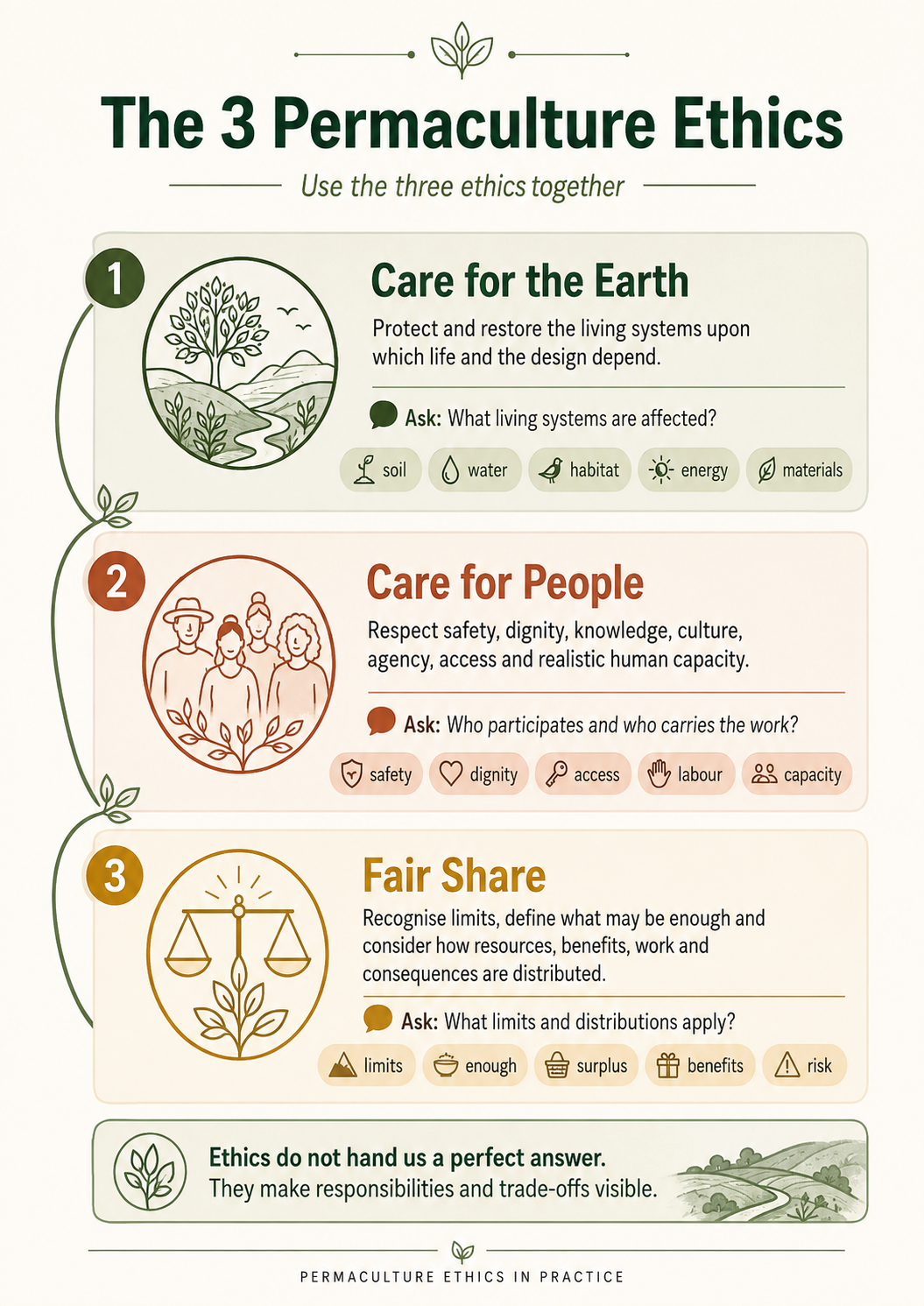
The three permaculture ethics are Earth Care, People Care and Fair Share. Use them together to test who and what a design affects, which limits matter, how benefits and burdens are distributed, and whether a well-intended intervention should proceed, change or stop.
Ethics shape what we protect, whose knowledge we respect, which limits we accept and how we share benefits, labour, responsibility and risk. They also ask us to notice when our admirable intentions are disguising an inconvenient consequence.
I do not treat the ethics as a purity test. Design takes place in an imperfect world, often with incomplete information and competing needs. The ethics give us a direction, a means of questioning ourselves and a reason to remain accountable for what follows.
In brief
Use the three ethics together:
Care for the Earth
Protect and restore the living systems upon which life and the design depend.
Ask: What living systems are affected?
Care for People
Respect safety, dignity, knowledge, culture, agency, access and realistic human capacity.
Ask: Who participates and who carries the work?
Fair Share
Recognise limits, define what may be enough and consider how resources, benefits, work and consequences are distributed.
Ask: What limits and distributions apply?
David Holmgren gives the fuller third ethic as setting limits to consumption and reproduction and redistributing surplus in the revised 2020 Essence of Permaculture, PDF page 6, printed pages 8 to 9. Other teachers use formulations such as return of surplus. Fair Share is the shorthand I use here, but it should not conceal Holmgren’s fuller wording or the deeper challenge of limits and distribution.
Ethics do not hand us a perfect answer. They make our responsibilities and trade-offs visible.
Ethics must enter the decision
An ethical statement is easy to support in the abstract. A design decision is where it becomes real.
Suppose we want to store more water. That intention may serve Earth Care by reducing pressure on mains supply and holding winter rain for the dry season. It may serve People Care by improving household and growing resilience. It may support Fair Share by encouraging us to define enough and moderate demand.
The same proposal may require high-impact materials, create a hazard, exceed the household’s maintenance capacity or alter the movement of water beyond the place where it is stored.
The ethical work is not to call the tank or pond green. It is to investigate the effects, compare alternatives and decide what we are prepared to take responsibility for.
Care for the Earth
Earth Care begins with humility. The land is not an empty surface waiting for our design. Soil, water, air, fungi, plants, animals and existing patterns are already at work.
Questions I find useful include:
- What living systems are present and what do we understand about their condition?
- Which ecological functions should be protected or strengthened?
- What materials, energy and land will the proposal require?
- Could it create pollution, erosion, habitat loss, invasive spread or depletion elsewhere?
- Can we begin with something smaller, slower or reversible?
- What signs would tell us to continue, change or stop?
Earth Care does not mean making a system resemble wilderness. Nor does it require human absence. It asks us to understand ourselves as participants in a living system and to accept responsibility for the effects of our participation.
Care for People
People Care asks whether a design supports the people who use, build, maintain or are otherwise affected by it.
This includes more than health and safety. It includes dignity, meaning, culture, knowledge, time, affordability and the right to influence decisions that affect one’s life.
Questions to ask include:
- Who has defined the need and who has not yet been heard?
- Whose knowledge, experience and attachment to place matter?
- Is the proposal safe and realistic for the people expected to care for it?
- Whose physical, mental or emotional labour will it require?
- Can people with different abilities, confidence, language or resources take part?
- Does it increase agency or quietly make people dependent on a system they cannot manage?
- Who may call for a review when circumstances change?
Care is not the same as making decisions on behalf of others. A benevolent intention can still remove choice or transfer an unreasonable burden.
Fair Share
Fair Share is perhaps the most challenging ethic because it asks two uncomfortable questions: what is enough, and who carries the consequences of our choices?
It applies before the surplus is produced, not merely when we decide what to give away afterwards.
Questions to ask include:
- What is enough for the real purpose?
- Which ecological, financial, spatial and time limits apply?
- Who receives the benefit and who carries the cost, labour and risk?
- Can seeds, tools, knowledge, access or surplus be shared responsibly?
- Are future generations and non-human life represented in the decision?
- Would this choice remain responsible if everyone at our scale made it?
Fair does not always mean equal. Different people and living systems have different needs and vulnerabilities. Fairness requires judgement, honesty and a willingness to question our own entitlement.
The ethics belong together
The three ethics overlap but cannot be averaged into a comforting score.
An efficient irrigation system may reduce water consumption but be too complicated for the people expected to maintain it. A community planting project may create social connection while introducing plants unsuitable for the site. A low-cost material may make a project affordable while exporting pollution or exploitative labour elsewhere.
When the ethics reveal a genuine conflict, we may need to redesign, add safeguards, test at a smaller scale, seek other knowledge or decide not to proceed.
That is not ethical failure. It is the ethics doing their work.
From Vila Pinheiro: designing water within limits
This is a bounded account of my Design 05 case, not evidence that its conclusions transfer to another site. The source records seasonal conditions on PDF pages 10 and 13, climate and runoff on page 13, and the relationship between water components and soil moisture on page 16.
The requirements and analysis appear on PDF pages 17 to 20. Proposed system components and consumption are set out on pages 22 to 24, with demand calculations on pages 39 to 41 and component specifications on pages 43 to 46. Ethics are considered on page 33. The design’s phased trials appear on page 25, while maintenance responsibilities appear on pages 29 and 42.
Those records support a case-specific account of roof catchment, storage, runoff, soil moisture, demand, staged trials and maintenance. They do not prove that every proposal was implemented, that the system has reached water self-sufficiency or that the same arrangement is suitable elsewhere.
The ethical value lies not in claiming that a final answer has been achieved. It lies in allowing the ethics to change the questions and sequence of action.
PERMA-SADIMET in my Diploma work
In my water self-sufficiency design, I documented PERMA-SADIMET as my particular adaptation of the established SADIMET framework. It makes permaculture ethics and principles visible throughout the framework rather than allowing them to vanish when technical work begins.
I did not invent SADIMET. My Design 05 records the adaptation on PDF pages 3 and 5 and explains it in Appendix 1 on PDF pages 37 to 38. Those locators establish my documented framing and application in this case. They do not establish universal uniqueness, the earliest use across the wider field or independent scholarly corroboration.
At each stage it asks:
- Survey: Have we observed the living system and listened to the people affected?
- Analyse: Have we identified needs, limits, power, patterns, risks and unintended effects?
- Design: Have we compared alternatives and made responsibilities visible?
- Implement: Are we acting carefully, competently and with informed participation?
- Maintain: Have we provided realistic resources rather than transferring hidden labour?
- Evaluate: Are we examining what happened, including effects we did not intend?
- Tweak: Are we willing to correct harm, revise assumptions and change course?
Its purpose is simple: do not allow ethics to disappear once practical work begins.
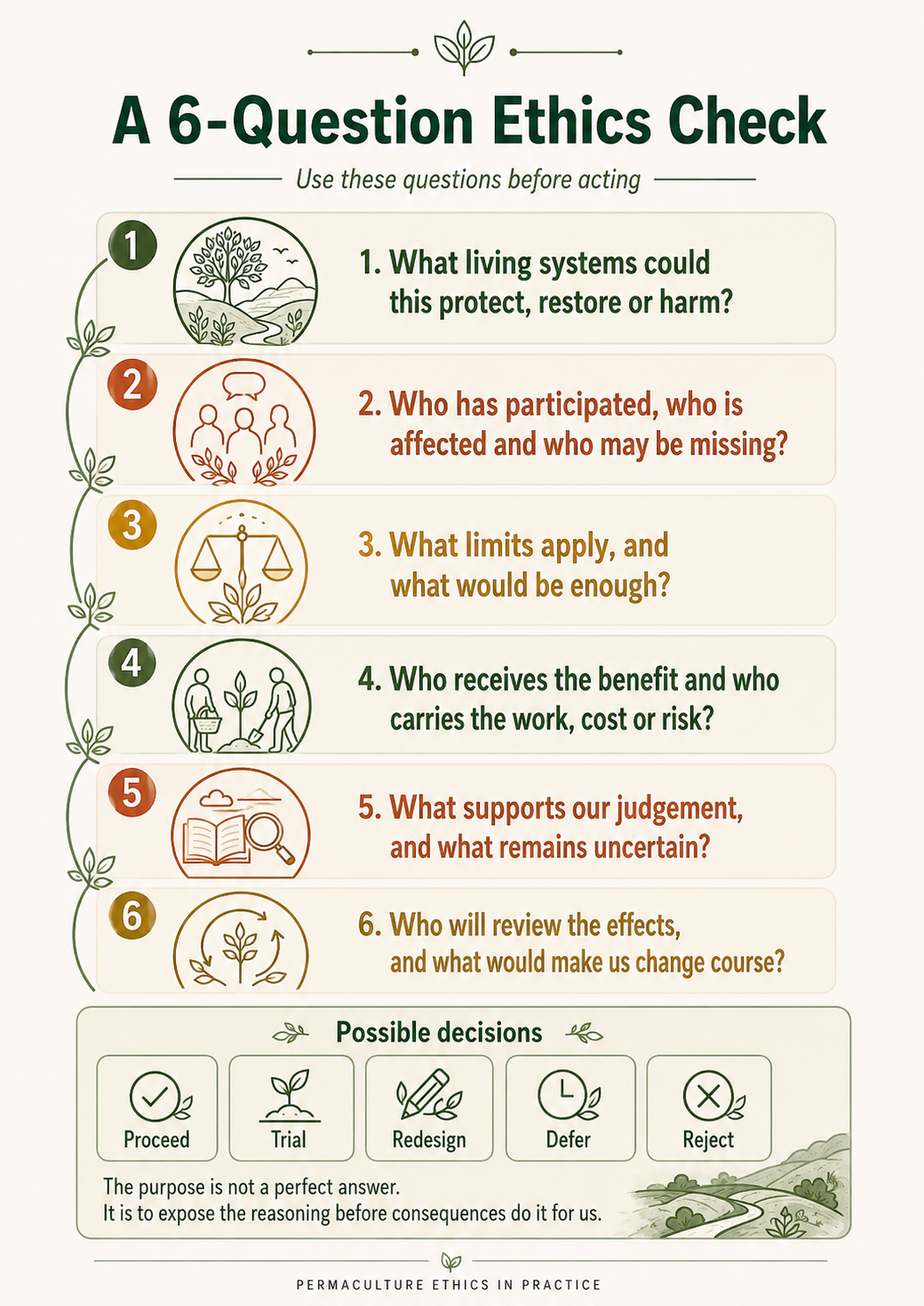
A six-question ethics check
- What living systems could this protect, restore or harm?
- Who has participated, who is affected and who may be missing?
- What limits apply, and what would be enough?
- Who receives the benefit and who carries the work, cost or risk?
- What supports our judgement, and what remains uncertain?
- Who will review the effects, and what would make us change course?
The purpose is not to produce a faultless answer. It is to expose the reasoning before consequences make the hidden parts visible for us.
Everyday ethics
Permaculture ethics are not reserved for masterplans and large projects. They appear when we choose between imported and locally available materials, decide whether to disturb a habitat, share plants and knowledge, design a task around someone’s actual capacity or accept that enough may be wiser than maximum yield.
Small choices are where an ethic becomes a habit.
A practical ethics decision record
For each credible option, record:
| Review area | What to record |
|---|---|
| Intended need | The need, affected people and desired change |
| Earth Care | Likely ecological benefits, harms, uncertainties and safeguards |
| People Care | Participation, safety, access, labour, culture and capacity |
| Fair Share | Limits and distribution of resources, benefits, work and risk |
| Evidence | Observations, experience, sources and missing information |
| Decision | Proceed, trial, redesign, defer or reject, with reasons |
| Responsibility | Who will implement, maintain and review the decision |
| Review point | The date or condition for examining the consequences |
The record need not be long. It exists so that assumptions and compromises are not conveniently forgotten.
Download status: the accessible standalone worksheet is still in production. The complete decision record is available in HTML above; no incomplete download is linked.
Ethics and expertise
Ethics do not replace practical competence. Knowing when to seek experienced or qualified help is itself an ethical decision, particularly where work involves structures, drinking water, sanitation, electricity, fire, protected habitats or public access.
Permaculture encourages whole-system thinking. It does not make one person an expert in every part of the system.
Continue learning
Return to What Is Permaculture Design? for the wider discipline, or continue to SADIMET: A Practical Permaculture Design Process to carry ethical questions through a structured project.
This guide and its decision record remain freely usable without enrolment.
Where this material comes from
The three ethics are inherited permaculture teaching. The six-question check and PERMA-SADIMET application are Mark D’Cruz’s teaching and Diploma adaptations; they are not presented as additions to the universally recognised ethics.
- David Holmgren, Essence of Permaculture, revised 2020, third ethic at PDF page 6, printed pages 8 to 9.
- Bill Mollison, Permaculture: A Designer’s Manual, 1988.
- Mark D’Cruz, Vila Pinheiro Water Self-sufficiency Design, Applied Permaculture Diploma, 2024 to 2025: source boundaries and locators stated in the Vila Pinheiro section above.
- Mark D’Cruz, “PERMA-SADIMET Framework: Empowering Regeneration”, public account of the framework.
- Mark D’Cruz, “Empowering Regeneration through SADIMET and Permaculture”, Design 05 Appendix 1, PDF pages 37 to 38.