Cornerstone Guide 1 of 12
What Is Permaculture Design?
Permaculture is often recognised by what can be seen: a food forest, a pond, a compost heap, chickens beneath fruit trees or rainwater being guided into the soil. These are valuable expressions of permaculture, but none of them defines it.
Permaculture is first a way of designing. It asks us to observe carefully, work with relationships, make ethical choices and learn from the consequences of what we do.
I came to permaculture after decades of working with bonsai, teaching and designing information systems. Those fields may appear far apart, but they taught me the same lesson: a living result cannot be understood by looking at its parts in isolation. Context, timing, relationships, care and feedback matter.
That is the position from which I teach permaculture design.
In brief
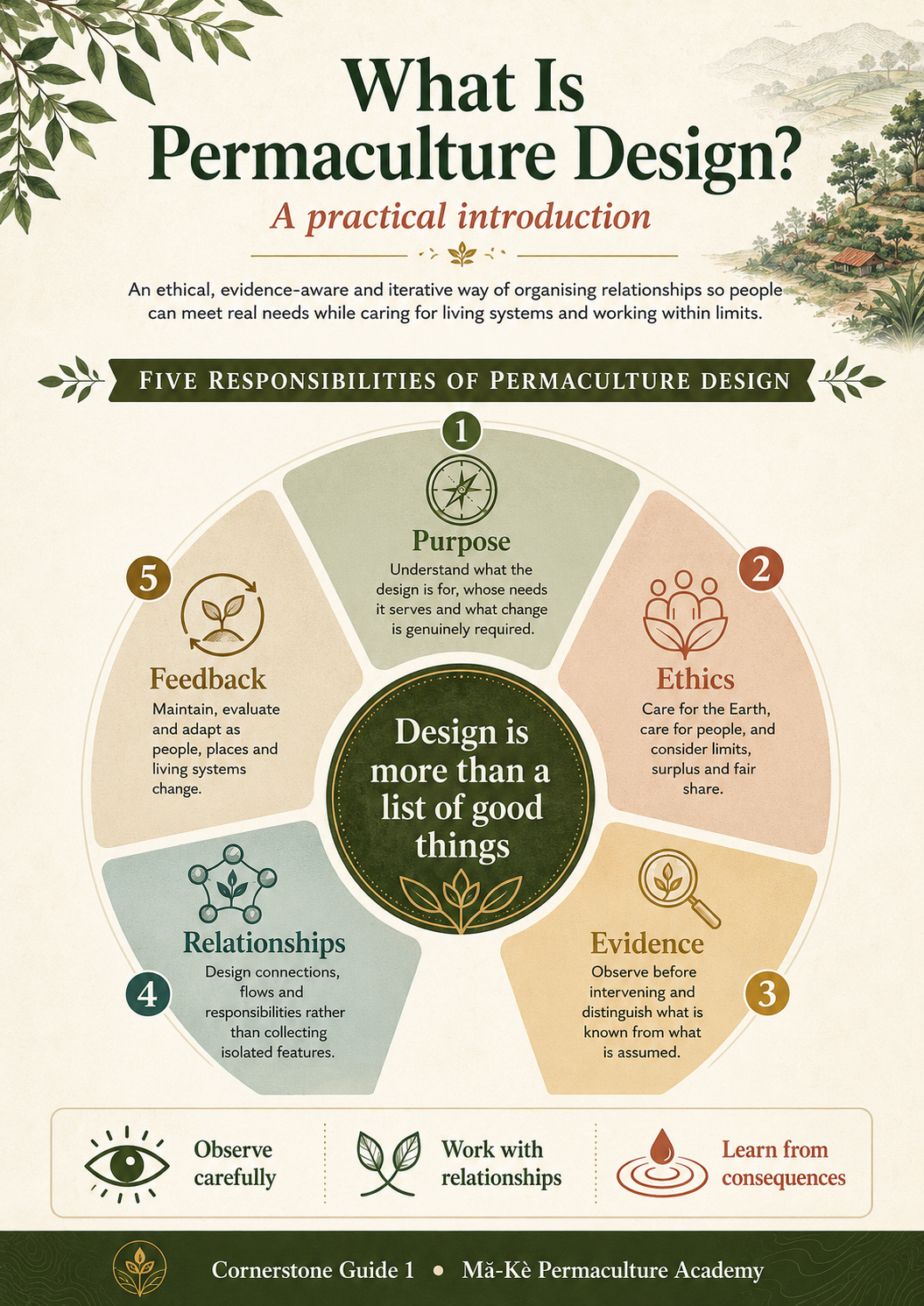
At Mă-Kè Permaculture Academy, I introduce permaculture design through five connected responsibilities:
Five responsibilities of permaculture design
An Academy-original teaching synthesis. Each responsibility remains connected to the others, and feedback returns the design to its purpose.
- Purpose Understand what the design is for, whose needs it serves and what change is genuinely required.
- Ethics Care for the Earth, care for people and consider limits, surplus and fair share.
- Evidence Observe before intervening and distinguish what is known from what is assumed.
- Relationships Design connections, flows and responsibilities rather than collecting isolated features.
- Feedback Maintain, evaluate and adapt as people, places and living systems change.
This five-part lens is my teaching synthesis. I first published it for this Cornerstone guide on 14 August 2026, drawing on my 2023 to 2025 Diploma practice at Vila Pinheiro. I refined the provenance note on 17 August 2026. It draws on established permaculture ethics and design thinking, but the five-part arrangement and teaching wording are mine.
Where permaculture came from
Bill Mollison and David Holmgren co-originated permaculture in Australia in the mid-1970s. Holmgren states this directly in the revised 2020 Essence of Permaculture, PDF page 2, printed page 1. On the same page he describes the early meaning as integrated systems of useful perennial and self-perpetuating plants and animals. PDF pages 2 to 3, printed pages 1 to 3, explain the later widening from permanent agriculture towards permanent or sustainable culture.
That wider scope is important. It also creates a danger: if permaculture is made to mean everything environmentally desirable, it ceases to mean anything precise.
Holmgren presents permaculture as an organising design framework rather than a branded collection of techniques. Organic growing, natural building, renewable energy, water harvesting and community projects may all contribute to a permaculture design, but the technique alone is not the design.
A design is more than a list of good things
Imagine a plan containing a pond, solar panels, composting, a food forest and chickens. It sounds admirably green. It may also be completely unsuitable for the place, the people or the resources available.
The design work begins when we ask:
- What need is each element meant to meet?
- What evidence shows that it belongs here?
- What does it require and what does it produce?
- How does it connect with the other elements?
- Who will build, use and care for it?
- What could go wrong or create an unexpected burden?
- How will we learn whether it is working?
A pond may store water, create habitat and influence a microclimate. It may also require excavation, permissions, protection, maintenance and a clear understanding of water movement. Permaculture does not give a pond magical properties. It teaches us to investigate the relationships before falling in love with the feature.
I have made that mistake myself. Enthusiasm often arrives before evidence. Design gives enthusiasm somewhere useful to go.
Ethics give the design direction
Permaculture is commonly grounded in three ethics:
- Care for the Earth
- Care for People
- Fair Share
These are not ornamental statements for the first page of a report. They help determine what a good result means.
Earth Care asks what happens to soil, water, habitat and the wider living system. People Care asks whose needs, knowledge, labour and wellbeing are involved. Fair Share asks what is enough, which limits must be respected and how benefits, responsibilities and surplus are distributed.
The ethics sometimes expose uncomfortable tensions. A solution can be ecologically elegant but unaffordable to maintain. A productive system can demand more labour than the people involved can realistically provide. A well-intentioned intervention can improve one part of a site while exporting a problem elsewhere.
Ethical design does not promise a perfect answer. It requires us to see the consequences and take responsibility for our choices.
The next Cornerstone guide, Permaculture Ethics in Practice, turns these ethics into questions for real decisions.
Principles are tools for thinking
Permaculture principles help us notice patterns and test possibilities. They are not commandments and they do not prescribe identical solutions everywhere.
David Holmgren set out twelve design principles in Permaculture: Principles and Pathways Beyond Sustainability. The revised 2020 Essence of Permaculture presents the twelve numbered principle sections on PDF pages 7 to 17, printed pages 10 to 31. They begin with observing and interacting and conclude with creatively using and responding to change. This is Holmgren’s formulation, not a set jointly published with Mollison in Permaculture: A Designer’s Manual, and it is not the only way permaculture thinking has been organised.
A principle such as catch and store energy might lead us to consider water, fertility, sunlight, knowledge, money or community capacity. It does not automatically prescribe a pond, battery or tank. The principle opens the enquiry; context and evidence shape the response.
Observation is an active practice
Observation is sometimes misunderstood as waiting indefinitely before doing anything. I see it differently. Observation is an active relationship with a place.
It may include:
- walking the land in different weather and seasons;
- recording water, wind, sunlight and shade;
- studying soil, vegetation and wildlife;
- listening to the people who use and care for the place;
- examining maps, records and specialist knowledge;
- testing assumptions through small and reversible trials;
- noticing our own habits, preferences and blind spots.
The strength and permanence of an intervention should reflect the strength of the evidence. When knowledge is incomplete, a modest trial may be wiser than either confident construction or endless hesitation.
Design relationships, not isolated objects
A permaculture design follows flows of water, energy, nutrients, materials, money, information, labour and care. It asks how one element affects another and whether useful connections can be created without producing an unmanageable system.
Placing a herb garden near a kitchen is a familiar example of relative location. The relationship may reduce walking and encourage observation. It will only work if sunlight, water, access, cooking habits and maintenance also support it.
People belong inside this analysis. A system that looks ecologically sophisticated but depends on invisible, unsafe or unaffordable labour is not well designed.
Design is a living process
A drawing is not the end of design. Living systems change. People learn. Plants mature. Climate varies. Assumptions fail, and sometimes a bold idea works for reasons we did not foresee.
The Academy uses SADIMET as one practical process: Survey, Analyse, Design, Implement, Maintain, Evaluate and Tweak. In Design 03 I recorded my selection and use of GoSADIMET on PDF page 9 and explained it in Annexure I on PDF pages 39 to 40. That evidence supports use and interpretation, not invention. In Design 05 I documented my particular PERMA-SADIMET adaptation on PDF pages 3 and 5 and in Appendix 1 on PDF pages 37 to 38. I do not claim that this establishes universal uniqueness or priority beyond my documented work.
These uses and adaptations are part of my own evolving design practice. They do not replace established permaculture thinking. They show how I have worked with it, questioned it and shaped it into tools that help me design.
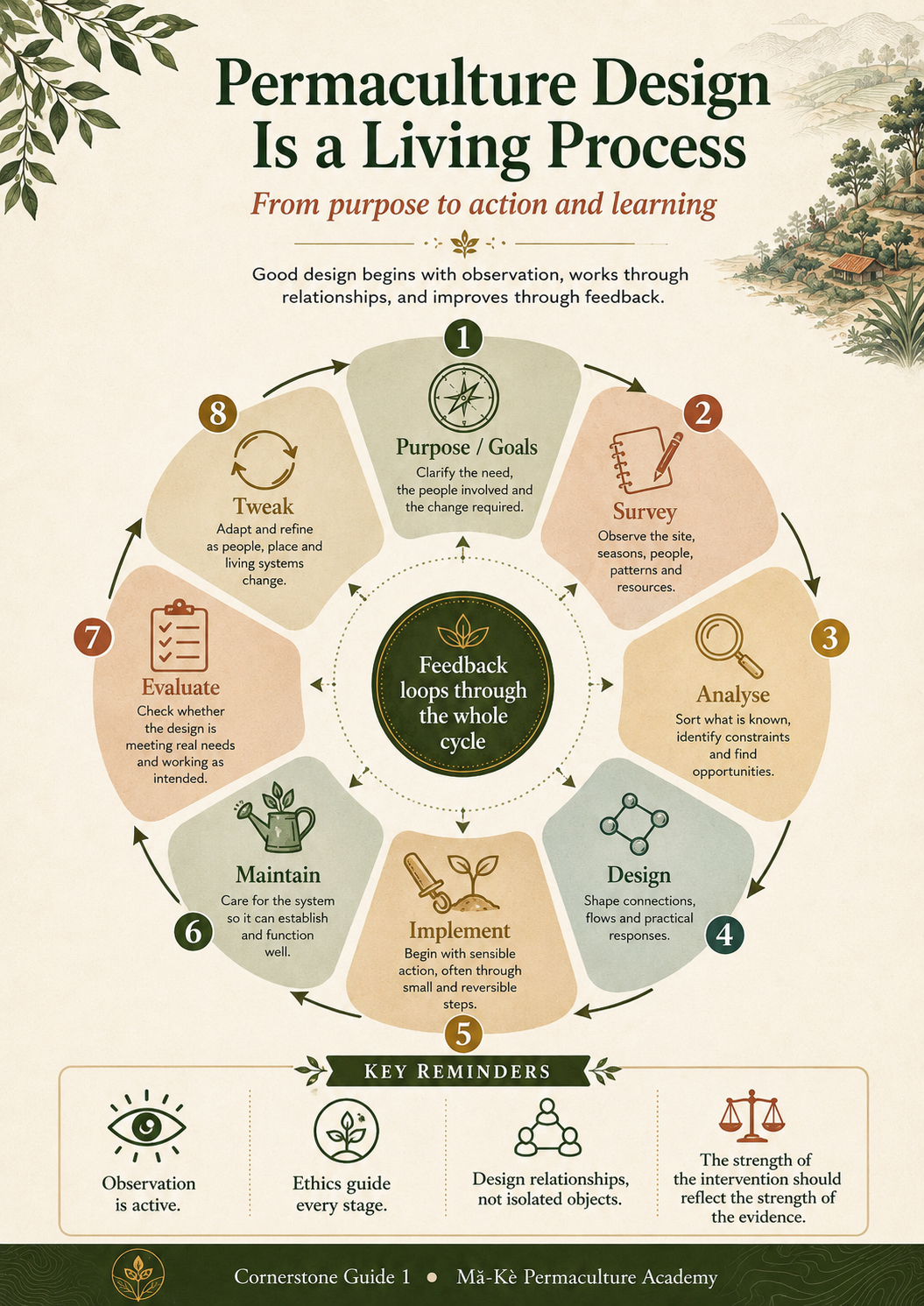
The third Cornerstone guide, SADIMET: A Practical Permaculture Design Process, explains the stages in detail.
From Vila Pinheiro: one place, many connected questions
Vila Pinheiro began as a home and a piece of land in Central Portugal. It became the shared context for ten Diploma designs covering regenerative bonsai, education, whole-site planning, energy, water, food, an Ayurvedic food forest, silviculture, animal integration and my own action-learning pathway.
The water design shows why permaculture design is broader than selecting techniques. The initial question was not simply where to put a tank or pond. It involved winter rain, dry summers, roof catchment, storm-water movement, contours, soil infiltration, household demand, growing systems, the existing well, future animals and the capacity to maintain what we built.
Not every proposal has been implemented exactly as first imagined. Some remain plans, some became trials and others changed as the land revealed more of itself. I do not see that as a weakness in the design record. It is evidence that design is iterative.
The ten designs are my designs. They record my reasoning, influences, experiments and sometimes imperfect assumptions. Assessment records exist for parts of the Diploma pathway, but I have not completed a controlled reconciliation proving an equivalent review record for all ten designs. I therefore make no claim here that every design has been independently verified or formally reviewed.
Explore Mark D’Cruz’s Diploma design journey on Vila Pinheiro.
A five-question starting exercise
Choose one change you are considering. Before naming the solution, answer:
- Purpose: What need are we trying to meet, and for whom?
- Ethics: Who and what may benefit, carry a cost or be excluded?
- Evidence: What do we know, how do we know it and what remains uncertain?
- Relationships: What will this change need, produce and affect?
- Feedback: Who will care for it, what will we observe and when will we review it?
If an answer is missing, write down the question. An honest uncertainty is more useful than a confident fiction.
Common misunderstandings
Permaculture is a gardening method
Growing systems are one important field of application. Permaculture design can also address water, energy, buildings, livelihoods, learning, organisations and community life.
A permaculture feature is automatically sustainable
No feature becomes sustainable through its name. Its effects depend on source, scale, location, construction, use, maintenance and relationships.
Principles provide a universal recipe
Principles guide attention and judgement. They do not remove the need for local knowledge, cultural understanding, practical competence or experimentation.
A design must be perfect before action begins
Waiting for complete certainty can be as unhelpful as acting without observation. Permaculture encourages small and slow solutions, feedback and learning.
My working definition
At Mă-Kè Permaculture Academy, I use permaculture design to mean an ethical, evidence-aware and iterative way of organising relationships so that people can meet real needs while caring for living systems and working within limits.
This is my teaching synthesis, informed by Mollison, Holmgren, later practitioners and my own applied work. It is offered as a useful position, not as the final word. Permaculture remains a living field, and responsible disagreement is part of its development.
Continue learning
Continue with Permaculture Ethics in Practice, then use SADIMET: A Practical Permaculture Design Process to move from intention and observation into action and learning.
This guide remains freely useful whether or not you enrol.
References
- David Holmgren, Essence of Permaculture, revised 2020: co-origin and early meaning at PDF page 2, printed page 1; wider development at PDF pages 2 to 3, printed pages 1 to 3; twelve numbered principle sections at PDF pages 7 to 17, printed pages 10 to 31.
- David Holmgren, Permaculture: Principles and Pathways Beyond Sustainability, 2002.
- Bill Mollison, Permaculture: A Designer’s Manual, 1988.
- Mark D’Cruz, Vila Pinheiro: A Sustainable Homestead, Design 03, PDF page 9 and Annexure I, PDF pages 39 to 40.
- Mark D’Cruz, Water Self-sufficiency with Attachments, Design 05, PDF pages 3 and 5 and Appendix 1, PDF pages 37 to 38.