Cornerstone Guide 7 of 12
Principles, Patterns and Systems Thinking
Learn to see relationships before selecting solutions: use principles as questions, read patterns as evidence and understand the living systems within which every design must work.
What you will learn
- How ethics, principles, patterns, strategies and techniques differ.
- How to use principles as thinking tools without turning them into a checklist.
- How to recognise spatial, temporal, ecological and human patterns.
- How boundaries, flows, feedback and delays shape a system.
- How to move from broad patterns towards appropriate detail.
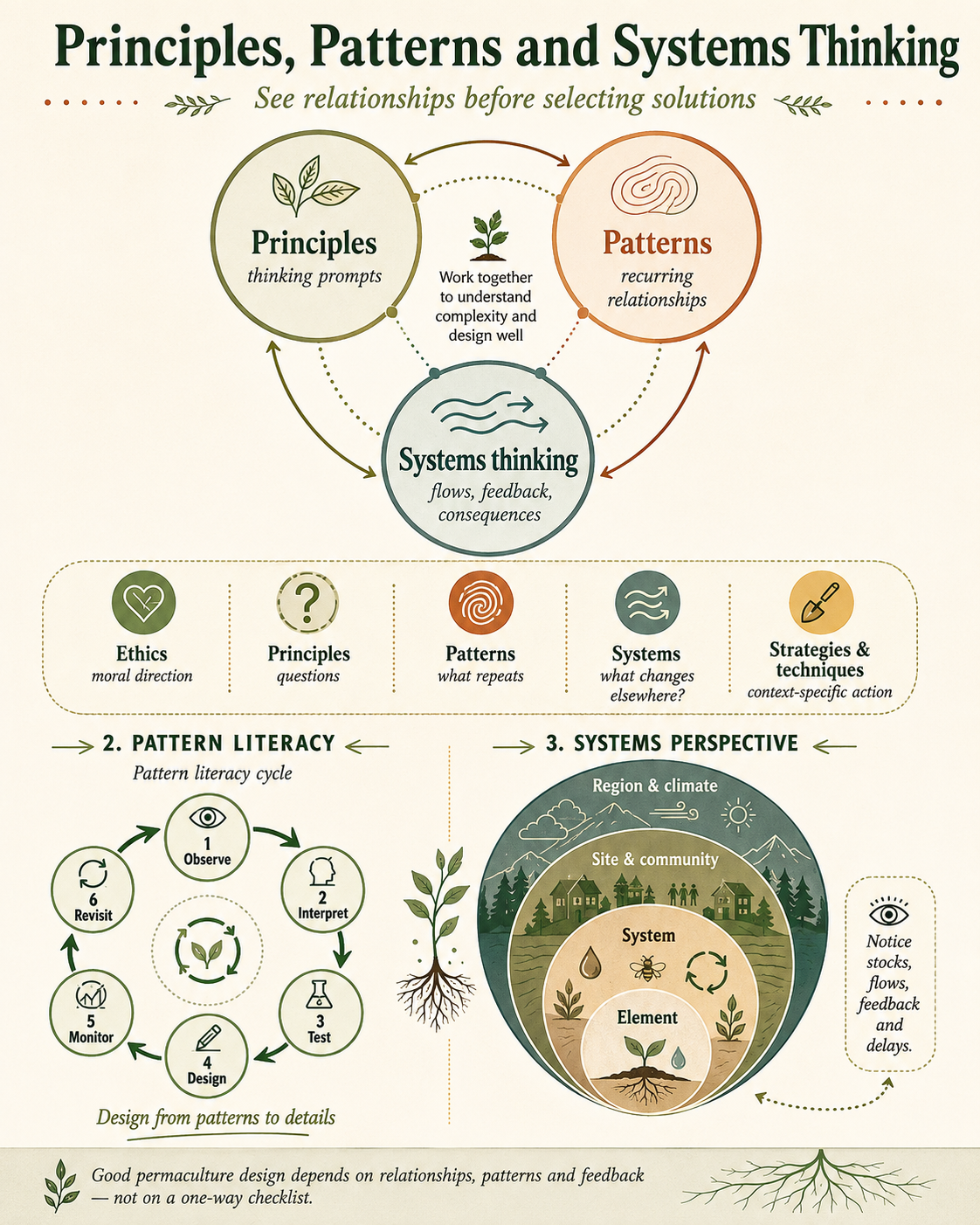
Infographic: complete text equivalent
Principles are thinking prompts. Patterns are recurring relationships. Systems thinking examines flows, feedback and consequences. These three ways of thinking work together to help designers understand complexity.
Five related levels
- Ethics provide moral direction.
- Principles provide questions.
- Patterns reveal what repeats.
- Systems thinking asks what changes elsewhere.
- Strategies and techniques provide context-specific action.
Pattern-literacy cycle
- Observe.
- Interpret.
- Test.
- Design.
- Monitor.
- Revisit.
The process moves from patterns to details and repeats as new evidence emerges.
Nested systems perspective
- Element.
- System.
- Site and community.
- Region and climate.
Designers should notice stocks, flows, feedback and delays across these nested levels.
Good permaculture design depends on relationships, patterns and feedback rather than a one-way checklist.
Three ways of thinking together
Principles, patterns and systems thinking are related, but they do different work. Principles help us ask better questions. Patterns reveal recurring forms, behaviours and relationships. Systems thinking helps us understand how those relationships produce consequences over time.
A designer may notice that winter runoff repeatedly follows the same low route, interpret this as a landscape pattern, and then use principles such as Observe and interact, Catch and store energy and Design from patterns to details to explore possible responses. The response is not supplied by the principle. It emerges from the place, the evidence and the relationships involved.
| Concept | What it does | Question to ask |
|---|---|---|
| Ethics | Set the moral direction and limits of the design. | Who or what receives care, carries risk or shares the benefit? |
| Principles | Provide broadly applicable thinking prompts. | Which principle reveals something we have overlooked? |
| Patterns | Reveal recurring structures, movements or behaviours. | What repeats across space, time or scale? |
| Systems thinking | Examines relationships, flows, feedback and consequences. | What changes elsewhere if we intervene here? |
| Strategies and techniques | Turn understanding into context-specific action. | What is appropriate here, now, with these resources? |
Principles are thinking tools
David Holmgren presents design principles as thinking tools. That wording matters. A tool supports judgement; it does not replace it. Several principles may point towards different concerns, and a good design may require balancing them rather than following one slogan in isolation.
Holmgren’s twelve principles can be translated into design questions:
| Holmgren principle | Design question |
|---|---|
| Observe and interact | What have we witnessed directly, and what still needs observation? |
| Catch and store energy | Which useful flows can be retained for later use? |
| Obtain a yield | What useful return will sustain people and the system? |
| Apply self-regulation and accept feedback | What limits or signals should change our behaviour? |
| Use and value renewable resources and services | Which living or replenishing resources can reduce dependency? |
| Produce no waste | Where could an unwanted output become a useful input? |
| Design from patterns to details | Which large relationships must be settled before components are specified? |
| Integrate rather than segregate | Which placements or connections create mutual support? |
| Use small and slow solutions | What modest intervention can teach us before we commit heavily? |
| Use and value diversity | Which kinds of diversity increase resilience or opportunity? |
| Use edges and value the marginal | Where do transitions create productive or neglected possibilities? |
| Creatively use and respond to change | How can change become information, capacity or opportunity? |
Learning to recognise patterns
A pattern is a recurring arrangement or relationship. It may be visible, such as branching drainage or a sun-facing edge, but it may also unfold through time: seasonal labour peaks, repeated equipment failures, animal movement, visitor routines or a household’s tendency to postpone maintenance.
- Spatial patterns: slope, contour, clustering, edges, paths, branching and patchiness.
- Temporal patterns: seasons, succession, daily routines, maintenance cycles and periods of scarcity.
- Flow patterns: water, wind, sunlight, nutrients, money, labour and information.
- Behavioural patterns: habits, decision bottlenecks, conflicts, participation and learning rhythms.
- Disturbance patterns: drought, fire, grazing, pruning, storm damage and human interruption.
Pattern recognition is not permission to impose a favourite geometry on a site. Spirals, circles and branching forms can be inspiring, but a decorative resemblance to nature is not evidence that a design will function. Begin with what the place is doing, not with the shape the designer happens to fancy.
Thinking in systems
A system is a set of elements whose relationships produce behaviour over time. The elements matter, but the behaviour of the whole cannot be understood by listing components alone. A pond, orchard, household and flock become a system through exchanges of water, nutrients, shelter, labour, money, knowledge and care.
Boundaries and nested systems
Every analysis draws a boundary. A vegetable garden may be treated as one system, yet it sits within a homestead, watershed, market, climate and community. Boundaries make enquiry manageable, but they are analytical choices rather than walls in reality. Important causes and consequences often cross them.
Stocks, flows and delays
A stock is something accumulated, such as water in a tank, organic matter in soil, stored seed, savings or practical knowledge. A flow increases, reduces or transfers that stock. Delays matter because the result of an action may appear much later: soil improvement, tree establishment, aquifer recharge and community trust rarely respond on the designer’s preferred timetable.
Feedback
Feedback occurs when the result of an action influences what happens next. Reinforcing feedback accelerates change; balancing feedback restrains it. Improved soil cover may increase infiltration, which supports stronger plants, which create more cover. Conversely, a storage tank reaching capacity stops accepting additional water and forces overflow elsewhere. Feedback is information, not praise or criticism.
Relationships create function
Permaculture design is often described as placing elements in relationship. The practical meaning is that location, timing and management determine whether one element’s outputs meet another’s needs. A compost bay beside the kitchen but far from the garden may be convenient for deposits and inconvenient for finished compost. The relationship must work in both directions and through time.
From patterns to details
Designing from patterns to details means settling the organising relationships before specifying individual components. On land, broad water movement, access, fire exposure, microclimate and zones of activity usually deserve attention before individual plant positions. In a course or organisation, purpose, learner journey, communication and decision rights may precede the choice of software or forms.
- Identify the wider system and state the boundary being used.
- Observe the dominant flows, recurring patterns and constraints.
- Describe the functions the design must support.
- Use ethics and principles to challenge assumptions and generate options.
- Choose an organising pattern and test it against evidence.
- Add elements and specifications only when their relationships are clear.
- Monitor behaviour after implementation and revise the pattern if needed.
Worked example: Vila Pinheiro as an interconnected design
Mark D’Cruz’s Diploma portfolio treats Vila Pinheiro not as ten unrelated projects but as an evolving living system. Water design affects food production, woodland regeneration and animal husbandry. Trees influence shade, forage, fire behaviour, soil and learning. Animals may contribute fertility and vegetation management while creating needs for water, fencing, shelter, forage and daily care. The Academy and bonsai work connect the land to education, livelihood and community.
This is a design interpretation and a planning framework. Some components remain proposed or developing, so they should not be represented as proven outcomes. Its value as a worked example lies in showing how one design decision can enable, constrain or reshape several others.
| System | Important relationships | Example design question |
|---|---|---|
| Water | Roof catchment, drains, storage, soil infiltration, pond, irrigation. | Where can wet-season water be slowed and stored without creating flood risk? |
| Food | Water, soil, labour, season, preservation, household demand. | Which production pattern matches actual diet and available care? |
| Trees and woodland | Fire, shade, biodiversity, forage, biomass and succession. | Which interventions reduce risk while supporting ecological succession? |
| Animals | Forage, shelter, water, fertility, fencing, health and labour. | Can animal needs be met before their potential yields are counted? |
| Learning and livelihood | Demonstration, evidence, access, safety, communication and income. | Which land activities create honest educational value without overstating results? |
Practical activity
Draw a living system map
Choose a place, project or organisation and map relationships before proposing solutions.
- Write the design subject in the centre of a large page.
- Add the principal living, physical and human elements around it.
- Draw incoming and outgoing flows: water, nutrients, energy, money, labour, information and care.
- Mark repeated patterns, delays, dependencies and vulnerable single points of failure.
- Draw at least one wider system outside your initial boundary.
- Use three permaculture principles to question the map.
- Identify one relationship worth strengthening and one assumption requiring observation.
Record: Keep the first map dated. Repeat the exercise after a season or major change and compare what became visible.
Common mistakes
- Treating principles as slogans that certify a preferred solution.
- Copying a natural-looking shape without understanding the process that produced it.
- Drawing the system boundary so narrowly that major causes or consequences disappear.
- Assuming every connection is beneficial; some relationships spread pests, work, cost or risk.
- Ignoring delays and declaring success or failure too early.
- Confusing a proposed relationship with an observed outcome.
Key takeaways
- Ethics provide direction; principles support judgement; patterns reveal organisation; systems thinking reveals consequences.
- The purpose of pattern literacy is functional understanding, not decoration.
- A system’s behaviour arises largely from relationships, flows, feedback and delays.
- Boundaries are necessary for analysis but should remain open to wider influences.
- Move from pattern to detail, then return to observation as the living system responds.
Sources and attribution
Holmgren’s twelve principles are inherited and attributed. Systems terminology is informed by Donella Meadows and wider systems practice. Vila Pinheiro examples and the teaching synthesis are Mark D’Cruz’s interpretation and application.
- David Holmgren, Permaculture: Principles and Pathways Beyond Sustainability, Holmgren Design Services, 2002; revised edition, Melliodora Publishing, 2017.
- David Holmgren, Essence of Permaculture (PDF), revised 2020.
- Donella H. Meadows, Thinking in Systems: A Primer, Chelsea Green Publishing, 2008.
- Bill Mollison, Permaculture: A Designers’ Manual, Tagari Publications, 1988.
- Mark D’Cruz, Design 7: Ayurvedic Food Forest; Design 8: Regenerative Silviculture; Design 10: Action Learning Pathway, Diploma in Applied Permaculture Design, 2025.