Cornerstone Guide 6 of 12
From Vision to Action with SMARTER Goals
SMARTER goals give direction to a living design without pretending that people, places and ecological conditions will remain still.
In brief
SMARTER commonly asks whether a goal is:
- Specific: Is the intended change clear?
- Measurable: What evidence will show progress or effect?
- Achievable: Is it realistic within available capacity and constraints?
- Relevant: Does it serve the real purpose and ethical responsibilities?
- Time-bound: When will action and review occur?
- Evaluated: What do the findings show?
- Reviewed: What should be retained, changed, deferred or stopped?
The final two letters are particularly valuable in living systems. Evaluation and review prevent a goal from becoming a contract with an outdated assumption.
Purpose becomes visible through vision and goals
Purpose names why the design exists
Purpose expresses the underlying need, responsibility or reason for the work. It should be clear enough to guide enquiry without prescribing a premature solution.
“Improve household water resilience” is a purpose. “Install six tanks” has already selected an intervention.
Vision articulates the qualities of a desired future
A vision gives an image of the conditions we hope to help create. It can include ecological, social, practical and personal qualities that are not captured by one measurement.
For a regenerative homestead, a vision might describe water cycling through soil and vegetation, reduced dependence on external supply, secure household needs, greater habitat and a community able to learn from the system.
Goals articulate purpose as reviewable commitments
Goals identify what will be attempted, at what scale, with what evidence and within what period. Several goals may serve one vision, and together the vision and goals make the purpose communicable and actionable.
This is not necessarily a rigid conveyor belt from Purpose to Vision to Goals. Purpose is the originating why. Vision expresses its direction and desired qualities. Goals express the commitments through which people try to move towards it. Drafting a vision or testing a goal may also reveal that the purpose is incomplete, confused or changing. The three remain connected and may be refined together.
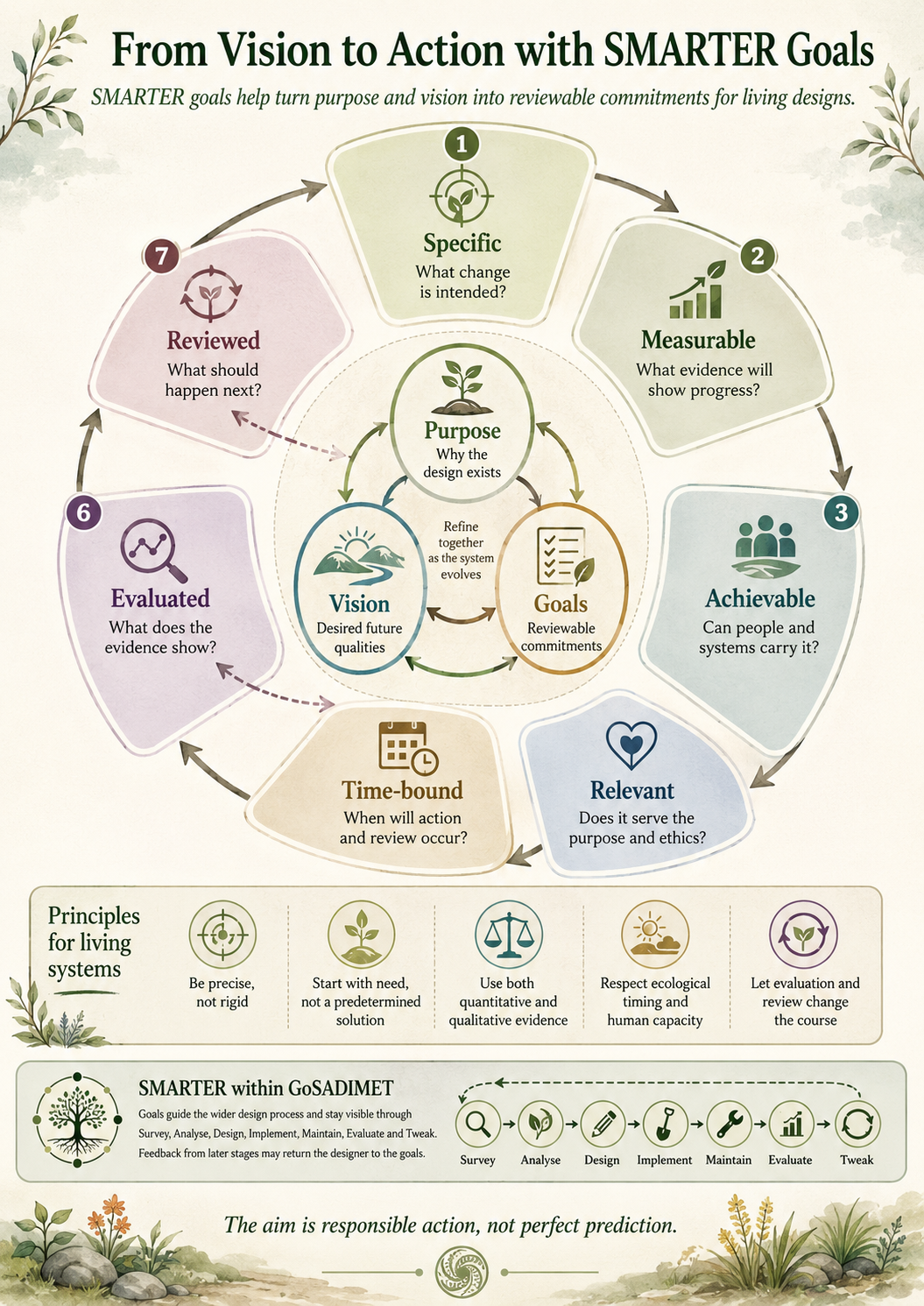
Infographic: complete text equivalent
Purpose names why the design exists. Vision describes desired future qualities. Goals turn them into reviewable commitments. The three refine one another as the system evolves.
- Specific: What change is intended?
- Measurable: What evidence will show progress?
- Achievable: Can people and systems carry it?
- Relevant: Does it serve the purpose and ethics?
- Time-bound: When will action and review occur?
- Evaluated: What does the evidence show?
- Reviewed: What should happen next?
Five principles for living systems guide their use: be precise, not rigid; start with a need, not a predetermined solution; use quantitative and qualitative evidence; respect ecological timing and human capacity; and let evaluation and review change the course.
Within GoSADIMET, goals guide the wider design process and remain visible through Survey, Analyse, Design, Implement, Maintain, Evaluate and Tweak. Feedback from later stages may return the designer to the goals. Evaluated and Reviewed remain distinct: evaluation interprets evidence; review decides what happens next.
Goals and GoSADIMET
The inherited SADIMET acronym stands for Survey, Analyse, Design, Implement, Maintain, Evaluate and Tweak. GoSADIMET makes Goals an explicit opening stage rather than leaving them as implied preparation.
In Mark D'Cruz's Diploma work and Academy teaching, GoSADIMET is the preferred working form when goals need to be stated, tested and kept visible throughout a project. The Goals stage helps translate purpose and vision into direction for Survey, Analysis and the decisions that follow. Feedback from any later stage can return the designer to the goals.
The attribution still matters. Goals is not a letter within the inherited SADIMET acronym, but it is part of the name and process of GoSADIMET. GoSADIMET predates Mark's Diploma work. He selected, interpreted and applied it; he did not claim to have invented it.
The seven SMARTER questions
Specific: what change is intended?
A specific goal identifies the system, people or condition concerned and the nature of the desired change. It avoids broad verbs such as improve, enhance or support unless they are explained.
Instead of:
Improve water sustainability.
Consider:
Reduce the use of treated mains water for garden irrigation by increasing rainwater capture, storage and soil infiltration.
The second version still allows several possible solutions. It clarifies the need without fixing the design too early.
Measurable: what will count as evidence?
Measurement should help the designer understand effects, not merely produce an impressive number.
Evidence may be quantitative:
- litres of rainwater captured;
- percentage reduction in grid electricity;
- soil organic matter;
- crop yield;
- survival rates;
- labour hours;
- costs or external inputs.
It may also be qualitative:
- participant experience;
- observed animal behaviour;
- ease of maintenance;
- perceived safety;
- changes in confidence or skill;
- photographic evidence of habitat development.
A good measurement is relevant, feasible and interpreted in context. A single metric can create a distorted design if it becomes the only definition of success.
Achievable: can people and systems carry it?
Achievable does not mean timid. It means that the goal has been examined against actual resources, knowledge, labour, finance, time, ecology and legal constraints.
Human capacity deserves particular attention. A system that functions only through unsustainable effort has transferred the problem into the people caring for it.
Achievability may improve through staged implementation, partnerships, training, smaller trials or a longer timescale.
Relevant: does it serve the purpose?
A goal can be specific and measurable while remaining irrelevant. Relevance asks whether the proposed change addresses the real need and aligns with the design's ethics.
Ask:
- Does it contribute materially to the purpose?
- Does it protect or restore living systems?
- Does it respect the people affected?
- Does it recognise limits and fair distribution?
- Does it complement other parts of the design?
- Are we pursuing it because it is useful, or because it is fashionable?
Time-bound: when will action and review occur?
Time boundaries create rhythm and responsibility. They can specify a start, completion target, seasonal window, monitoring period or review date.
Ecological time does not always obey project-management convenience. Tree establishment, soil change, water behaviour and community trust may require several seasons. A sensible time boundary respects the process being observed.
Where outcomes take years, use intermediate review points rather than pretending that nothing useful can be learned until the final date.
Evaluated: what does the evidence show?
Evaluation compares observed effects with the intended change and examines consequences that were not originally anticipated.
It asks:
- What changed?
- What did not change?
- What evidence supports that judgement?
- Who benefited?
- Who carried the work, cost or risk?
- What maintenance was required?
- What unexpected effects emerged?
- What remains uncertain?
- How did the process change the designer's understanding, skills, assumptions or responsibilities?
- What did the designer learn about their own capacity, habits and relationship with the work?
Evaluation therefore examines more than the object of design. It examines the effects, the design process and the designer who has been changed by participating in it. It should not be postponed until the project is supposedly complete. Proportionate evaluation belongs throughout implementation and care.
Reviewed: what should happen next?
Review turns findings into a responsible decision. Depending on the evidence, the project may:
- continue as planned;
- continue with closer monitoring;
- expand a successful trial;
- revise the goal or method;
- reduce the scale;
- defer action while gathering evidence;
- stop an ineffective or harmful intervention.
Review should also ask how the findings affect other goals, people, living systems and resources; whether an external or newly recognised factor has changed the context; and whether the purpose, vision or goal now needs to be revisited.
Review is not merely confirmation. If changing course is never a permitted outcome, the review has no teeth.
A goal can be precise without being rigid
Living systems require a distinction between commitment and attachment.
We can commit to a purpose, ethical responsibilities and careful evaluation without becoming attached to one forecast or technique. A goal establishes a hypothesis about useful change. Implementation tests that hypothesis in the real world.
This is why thresholds and review triggers are helpful. Before acting, decide what evidence would lead to expansion, redesign, delay or rejection.
For example:
Trial a defined rainwater-supported growing area for one dry season. Record stored water, irrigation demand, plant survival, labour and any use of mains water. Review the scale and planting mix before expanding.
This goal provides direction while retaining the ability to learn.
Worked example: from homestead vision to connected goals
The Vila Pinheiro Diploma designs began with a broad vision of a regenerative homestead that would improve resilience in energy, water and food while supporting learning, biodiversity and responsible stewardship.
That vision was translated into related areas of work:
- reducing dependence on external energy while first understanding demand;
- increasing water capture, storage, infiltration and reuse;
- developing food production appropriate to household needs and available land;
- regenerating woodland rather than treating trees as isolated products;
- integrating animals as ecosystem partners rather than only as producers;
- connecting practical work with education, reflection and community participation.
The goals did not all use identical measures or timescales. Nor should they. An energy audit, a young woodland and a learning programme reveal progress differently.
What connected them was a shared purpose and repeated evaluation through the wider Diploma design process.
The later changes do not make the earlier goals mistakes. They demonstrate that designs remain alive after a plan appears finished. New evidence, changing needs, external events or the development of the designer may make a responsible return to an apparently settled goal necessary.
Example: improving an energy goal
An initially attractive goal might be:
Become energy self-sufficient within one year.
This creates direction but leaves important questions unanswered. Which energy uses are included? Is the target annual net production or reliable supply during peak demand? Does it assume that present consumption should continue? What cost and embodied impact are acceptable?
A more useful design goal might be:
During the next twelve months, establish an evidenced household energy baseline, reduce avoidable demand and develop a staged renewable-energy design. Compare expected seasonal generation, peak demand, cost, maintenance and resilience before committing to full installation.
The revised goal treats demand reduction and evidence as part of the design. It does not confuse buying equipment with achieving resilience.
Example: improving a food goal
“Produce 50 per cent of our food” appears measurable, but measurement becomes ambiguous very quickly. Fifty per cent by weight, calories, value, meals, nutritional requirement or number of ingredients?
A better goal defines the intended contribution and the method of measurement. It may focus first on vegetables, herbs, fruit or culturally important foods, record seasonal yields and include labour, water and storage.
The exercise reveals a larger lesson: a percentage can conceal as much as it clarifies.
Goal conflicts must be designed, not hidden
Several desirable goals may compete for the same land, water, finance, labour or attention. Fast food production may conflict with woodland regeneration. Increased animal numbers may conflict with dry-season water limits. A technically efficient system may create an unreasonable maintenance burden.
When goals conflict:
- return to purpose and ethics;
- identify the people and living systems affected;
- make resource and capacity limits explicit;
- examine relationships rather than evaluating each goal alone;
- consider sequencing and smaller trials;
- record the trade-off and reasoning;
- establish what evidence would justify revisiting the decision.
A collection of individually SMARTER goals does not automatically form a coherent design.
Practical tools
Use SMARTER in your own design
Both tools have complete HTML equivalents. The PDFs are optional print formats, not the only way to reach the content.
SMARTER reference
History, terminology and the Academy’s Evaluated and Reviewed distinctions.
Read the accessible referenceDownload the tagged PDF →One-page worksheet
Practical writing space from Purpose and Intended change through Evaluated and Reviewed.
Use the accessible worksheetDownload the printable PDF →Common mistakes
Beginning with a predetermined solution
“Install a solar array” is an action, not a complete statement of purpose. Clarify the need and investigate demand before fixing the intervention.
Measuring only what is easy
Cost and yield may be simple to count while care, access, biodiversity or labour are ignored. Use a balanced evidence set.
Setting goals for other people's work
Participation matters. Do not assign labour, responsibility or behavioural change to people who have not helped shape the goal.
Treating achievable as comfortable
A goal may be ambitious and still achievable when it is staged, supported and reviewed.
Treating the deadline as more real than the season
Project dates should respect ecological timing, weather and human capacity.
Evaluating without changing anything
If evidence cannot alter the decision, Evaluation and Review have become ceremonial initials.
Goals as part of an iterative design
SMARTER goals do not replace a design framework. They support it.
Within GoSADIMET, Goals is the explicit starting stage, while feedback keeps it connected to every later stage. Evidence gathered through Survey, Analysis, Implementation, Maintenance and Evaluation may reveal that a goal is poorly defined, unrealistic or ethically incomplete. The designer returns to it, reviews it and continues.
SMARTER strengthens that Goals stage by making intentions and review criteria clearer. GoSADIMET provides the wider design process; SMARTER helps designers formulate and revisit the goals that orient it. Neither should be treated as mechanically linear.
The objective is not to predict a living project perfectly. It is to make intentions, assumptions, evidence and decisions visible enough to support responsible action.
Direction with humility
A useful goal says where we intend to move, why the change matters and how we will learn whether our actions are helping. It does not claim control over every consequence.
SMARTER goals are valuable because they combine clarity with review. Used well, they help a design move from aspiration to action without losing the humility to change course.
Sources and provenance
- George T. Doran, “There’s a S.M.A.R.T. way to write management’s goals and objectives”, Management Review, 1981. Doran’s original terms were Specific, Measurable, Assignable, Realistic and Time-related.
- Mark D’Cruz, Design 3 Annexure 2 and goal-setting examples across the Applied Permaculture Diploma journey. The Academy’s current SMARTER teaching uses Achievable, Relevant, Time-bound, Evaluated and Reviewed; no single inventor is claimed for that later formulation.