Cornerstone Guide 11 of 12
Designing for Mediterranean Water, Drought and Wildfire
Treat seasonal scarcity, intense rainfall and rural fire as one resilience challenge, with life safety, access and continuing care at the centre.
What you will learn
- Why wet winters and dry summers create both water opportunity and drought exposure.
- How to build a measured water balance before selecting tanks, ponds or earthworks.
- How soil cover, shade, vegetation structure and establishment care influence drought resilience.
- Why water and wildfire must be designed together around life safety, access and maintenance.
- How Vila Pinheiro observations informed a staged resilience strategy.
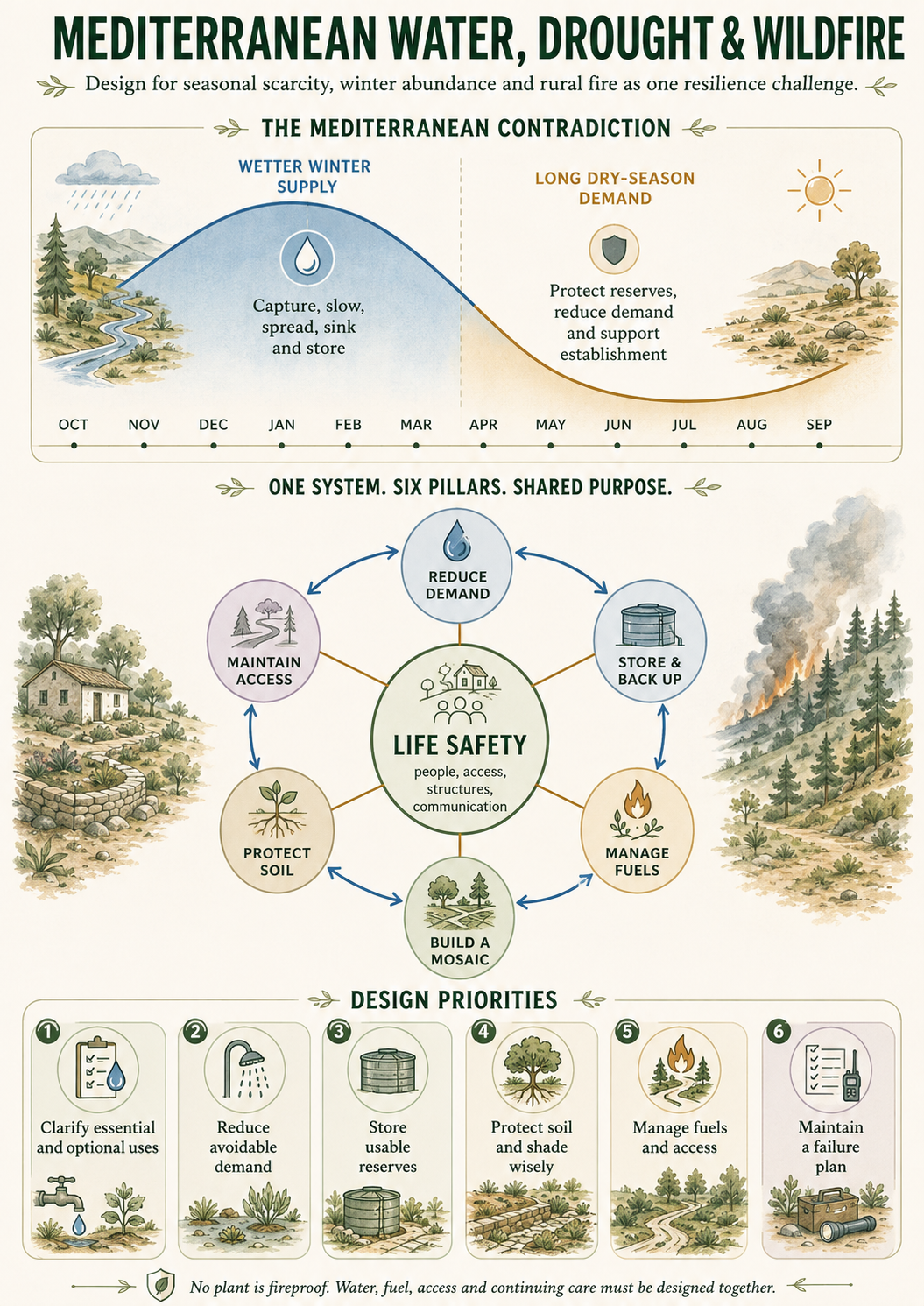
Read the complete text equivalent
Mediterranean water, drought and wildfire infographic: complete text equivalent
The Mediterranean contradiction: wetter winter supply must carry a landscape through long dry-season demand. During wetter months, capture, slow, spread, sink and store water safely. During the dry season, protect reserves, reduce demand and support establishment.
Life safety remains central: people, access, structures and communication come before landscape ambition. Six connected responsibilities surround it:
- Reduce demand.
- Store and back up usable reserves and supplies.
- Manage fuels.
- Build a landscape mosaic.
- Protect soil.
- Maintain access.
Design priorities
- Clarify essential and optional water uses.
- Reduce avoidable demand.
- Store usable reserves.
- Protect soil and shade wisely.
- Manage fuels and access.
- Maintain a failure plan.
No plant is fireproof. Water, fuel, access and continuing care must be designed together. Stored water does not guarantee wildfire protection, and swales, ponds, grazing or planting are not universally suitable. This overview does not replace emergency planning, fire engineering, hydrological assessment, Portuguese law or current official guidance.
The Mediterranean contradiction
Mediterranean-climate landscapes commonly receive much of their rain during cooler months and very little during the hottest part of the year. Rain can arrive in intense events, creating runoff, erosion and local flooding, while vegetation and household demand peak during a long dry season.
The European Environment Agency reports that climate change is increasing fire danger and lengthening fire seasons in much of Europe. Landscape configuration, fuel continuity, weather, topography, management and human activity all influence fire occurrence, spread and consequence. The challenge is not simply to collect more water or plant more trees. It is to shape a maintained landscape that protects people, stores winter abundance, survives summer scarcity and avoids dangerous fuel continuity.
Begin with a water balance
A water design begins with quantities and uncertainty. Estimate supply, demand, losses and required reserves across the dry period. Use site measurements wherever possible and keep optimistic assumptions visible.
| Component | Questions | Evidence |
|---|---|---|
| Demand | Who or what needs water, how much, of what quality, in which months and at what priority? | Meter readings, crop areas, establishment plans, animal needs, occupancy and irrigation records. |
| Catchment | Which surfaces can be used safely, and how much runoff can reach storage? | Measured area, rainfall, runoff assumptions, first-flush needs and conveyance limits. |
| Storage | What usable volume remains after dead storage, evaporation, leakage and quality controls? | Geometry, levels, losses, inspection records and drawdown tests. |
| Soil and infiltration | Where can water slow and infiltrate without instability, waterlogging or damage? | Contours, soil and infiltration tests, slope, geology, vegetation and overflow routes. |
| Reserve and failure | What must remain available during drought, power loss, contamination or fire? | Priorities, backup supply, gravity or independent pumping and emergency procedures. |
Use a hierarchy before building infrastructure
- Clarify essential and optional water uses.
- Reduce avoidable demand and match production to capacity.
- Protect soil, organic matter, shade and valuable vegetation.
- Catch and safely convey water from appropriate surfaces.
- Slow, spread and infiltrate water where landform, soil and overflow allow.
- Store water in tanks, soil, ponds or groundwater according to quality and use.
- Distribute efficiently, using gravity where possible.
- Reuse water only where treatment, health protection and current regulations permit.
- Maintain a protected reserve and failure plan.
Earthworks require particular caution. A swale is not a universal answer. On steep, unstable, poorly understood or high-consequence sites, interception can concentrate water, weaken slopes or send overflow towards buildings and neighbours. Survey contours, soil and spillways, and seek competent advice where consequences are significant.
Design plants and soil for the dry season
- Build organic matter and maintain appropriate cover while managing combustible material near assets.
- Group plants by water requirement and place high-demand systems close to reliable supply and observation.
- Prioritise establishment watering, root development and browsing protection before expanding.
- Use shade, wind moderation and layers where these reduce stress without unsafe fuel ladders.
- Select species for actual soil, exposure, cold, heat, drought duration and management—not a generic list.
- Plan for mortality, replacement, water restrictions and climate conditions beyond past experience.
Wildfire design begins with people and access
Wildfire planning starts with evacuation, communication, safe access, defendable structures and current official instructions. Landscape measures support these priorities but do not guarantee that a property can be defended during extreme fire weather.
| Layer | Design considerations |
|---|---|
| People and plans | Alerts, evacuation triggers, vulnerable people, animals, meeting points and rehearsed responsibilities. |
| Access | Routes for occupants and responders, gates, turning, signage, vegetation management and alternatives. |
| Buildings and ignition | Roof, vents, gutters, decks, stored materials, utilities, machinery, ember entry and maintained surroundings. |
| Vegetation and fuels | Horizontal and vertical continuity, dead material, ladder fuels, managed edges and maintenance access. |
| Water and power | Identified sources, protected pumps, gravity options, reserves and power-failure plans. |
| Stewardship | Seasonal inspections, pruning, appropriate grazing, residue handling and review after change. |
No plant is fireproof. Moisture, arrangement, dead material, spacing, wind, topography and maintenance influence behaviour. A diverse, actively managed landscape may interrupt fuel continuity more effectively than an unmanaged block, but species choice alone cannot carry the safety strategy.
Water and fire are one system
| Design move | Water benefit | Fire implication or trade-off |
|---|---|---|
| Mulch and ground cover | Reduces evaporation, erosion and temperature extremes. | Dry organic material close to structures may add fuel. |
| Trees and shelter | Shade and wind reduction can lower stress and demand. | Crowns, deadwood and ladder fuels can increase continuity. |
| Ponds and tanks | Store seasonal water for habitat or use. | Access, usable reserve, pumps, quality and extreme-event limits matter. |
| Swales and infiltration | Slow runoff and support moisture where suitable. | Poor design can damage access or send overflow unsafely. |
| Grazing and mowing | May manage vegetation and cycle nutrients. | Timing, welfare, soil impact, fencing and residue handling determine the result. |
Vila Pinheiro: observations and design responses
Vila Pinheiro lies in a valley landscape in Central Portugal. The Diploma survey recorded pronounced seasonal rainfall, stormwater entering through drains and a seasonal stream, a low pond area, a historic well, mains supply and summer irrigation demand. The property also includes pine, eucalyptus, cork oak and holm oak woodland and is exposed to neighbouring flammable vegetation.
The layered response included roof collection and tanks; stormwater conveyance; possible contour infiltration where appropriate; a pond and safe overflow; well investigation; efficient irrigation; soil and shade strategies; managed access and firebreaks; and gradual movement towards a diverse, actively stewarded woodland mosaic.
Phase the resilience work
- Confirm emergency plans, access, legal duties and immediate conditions around inhabited structures.
- Measure water use, catchments, flows, storage and the dry-season gap.
- Repair leaks, reduce demand and protect soil and valuable vegetation.
- Manage priority fuels and maintain routes before expanding planting.
- Trial small catchment, infiltration, irrigation and planting interventions with safe overflows.
- Add storage and distribution only after demand, losses and maintenance capacity are clearer.
- Diversify woodland gradually while protecting habitat, soil and mature trees.
- Review after intense rain, drought, heat, storms and every fire season.
Practical activity
A Mediterranean resilience audit
- Draw the boundary, neighbouring land, buildings, access, slopes and likely fire sectors.
- Mark inflows, catchments, storage, overflow, erosion and water-quality risks.
- List essential dry-season demands and calculate a cautious usable reserve.
- Mark vegetation structure, dead and ladder fuels, managed areas and maintenance access.
- Identify people, animals, structures and ecological assets with different priorities.
- Find three places where a water intervention affects fire safety.
- Choose one life-safety action, one demand-reduction action and one monitored land trial.
- Review before summer and after the first major autumn rain.
Common mistakes
- Sizing storage from annual rainfall while ignoring the dry period and usable volume.
- Treating swales, ponds or greywater as universally suitable.
- Expanding irrigation demand faster than secure supply and maintenance capacity.
- Calling plants fireproof or relying on species lists without managing structure and dead fuel.
- Assuming stored water remains accessible during power loss, contamination or extreme fire.
- Ignoring neighbours, roads, legal duties, responders and evacuation.
Key takeaways
- Design for seasonal timing, not annual averages.
- Reduce demand and protect soil before relying on large infrastructure.
- Water storage, vegetation, access and fuel management belong in one design.
- Life safety and official guidance take precedence over landscape ambition.
- Resilient Mediterranean landscapes are maintained, monitored and revised.
Sources and attribution
The Vila Pinheiro application and synthesis are Mark D’Cruz’s work. Climate and fire-risk context is supported by European and Portuguese authorities. Check current local law, alerts and professional advice before acting.
- Mark D’Cruz, Designs 3, 5 and 8, Diploma in Applied Permaculture Design, 2023–2025.
- European Environment Agency, “Forest fires in Europe”.
- European Environment Agency, “Nature-based solutions for fire-resilient European forests”.
- Agência para a Gestão Integrada de Fogos Rurais, National Action Plan and Portugal Chama public guidance.
- Food and Agriculture Organization of the United Nations, Agricultural water management, including water harvesting and storage.
- David Holmgren, Permaculture: Principles and Pathways Beyond Sustainability, 2002; revised 2017.