Cornerstone Guide 12 of 12
Designing an Action Learning Pathway
Turn experience into a continuing cycle of reflection, integration and action—and allow the design process to change both the work and the designer.
What you will learn
- How action learning differs from simply doing more work.
- How to frame a live question, take proportionate action and collect useful evidence.
- How to reflect across the place, the practice and the person.
- How to integrate learning across connected designs.
- How Mark’s Diploma pathway became a meta-design for continuing practice at Vila Pinheiro and the Academy.
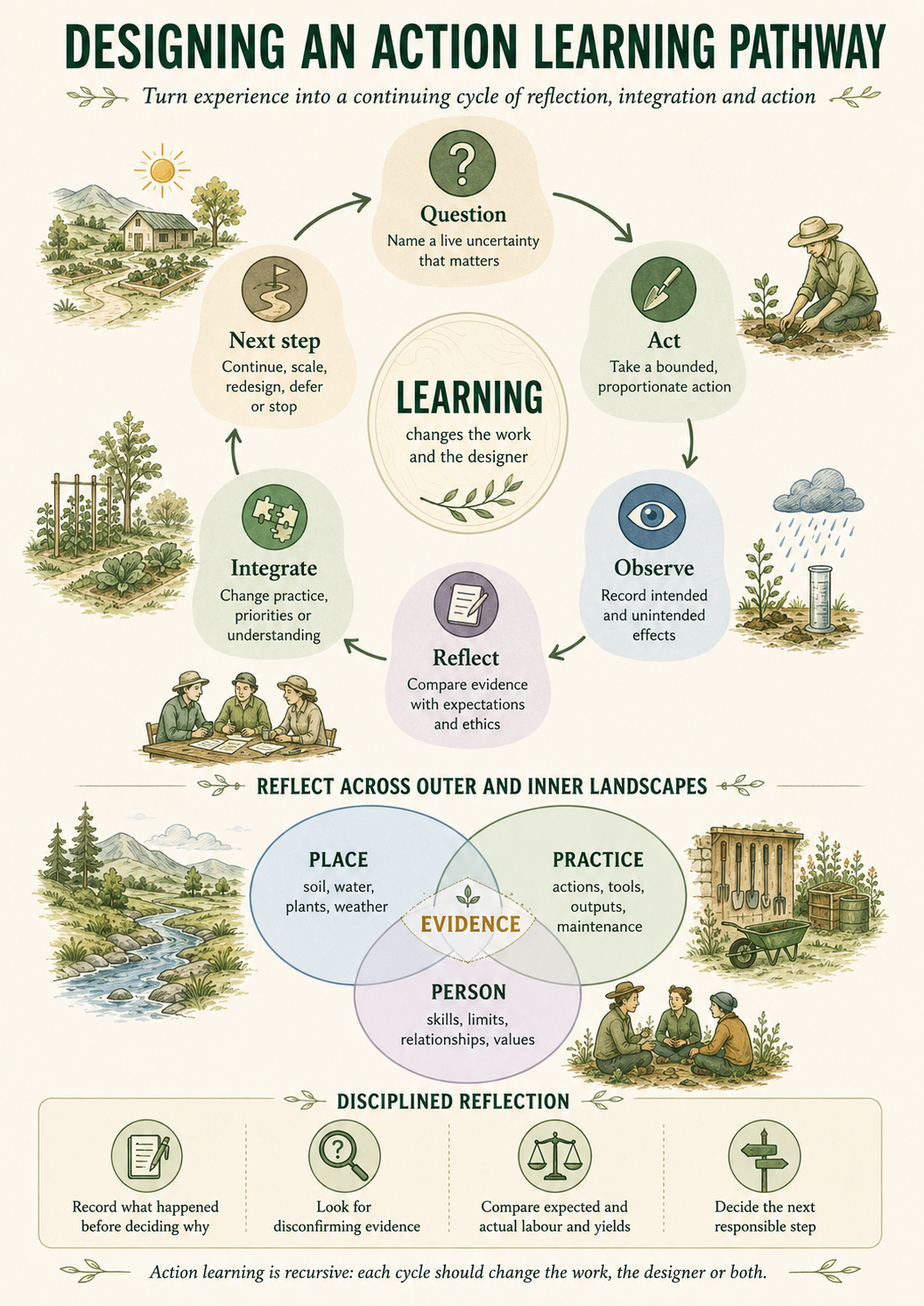
Read the complete text equivalent
Action Learning Pathway infographic: complete text equivalent
The pathway is recursive: each cycle should change the work, the designer or both.
- Question: name a live uncertainty that matters.
- Act: take a bounded, proportionate action.
- Observe: record intended and unintended effects.
- Reflect: compare evidence with expectations and ethics.
- Integrate: change practice, priorities or understanding.
- Next step: continue, scale, redesign, defer or stop.
Reflect across outer and inner landscapes
- Place: soil, water, plants and weather.
- Practice: actions, tools, outputs and maintenance.
- Person: skills, limits, relationships and values.
Disciplined reflection
- Record what happened before deciding why.
- Look for disconfirming evidence.
- Compare expected and actual labour and yields.
- Decide the next responsible step.
Action learning is an established educational tradition associated particularly with Reg Revans. The Design Web was created by Looby Macnamara. This Action Learning Pathway is Mark D’Cruz’s application and synthesis across his ten Diploma designs.
Action is not automatically learning
Experience becomes learning when it is examined. A busy project can repeat the same assumptions for years. Action learning introduces a deliberate rhythm: work with a live question, act at an appropriate scale, observe consequences, reflect honestly, integrate what has been learned and choose the next step.
The process is recursive rather than a circle that returns unchanged. Each cycle should alter understanding, practice, relationships or the question itself. Sometimes the responsible result is expansion; sometimes it is redesign, delegation, delay or stopping.
Begin with a learning edge
A learning edge is a real uncertainty that matters to the design and cannot be resolved by theory alone. It is narrower than a vision and more open than a predetermined solution.
| Weak framing | Stronger learning question | Why it is stronger |
|---|---|---|
| Build a food forest. | Which establishment pattern can maintain young trees through the dry season within our water and labour limits? | Names the uncertainty, constraints and evidence needed before scaling. |
| Integrate goats. | Can a small, welfare-led grazing trial reduce selected vegetation without damaging regeneration or exceeding daily care capacity? | Keeps inclusion conditional on welfare, effects and capacity. |
| Become self-sufficient. | Which dependencies most reduce household resilience, and which small changes produce learning without greater maintenance? | Replaces a slogan with priorities and manageable experiments. |
| Run workshops. | What format helps participants apply one design skill while remaining achievable for tutor and site? | Connects learner outcomes, teaching capacity and evidence. |
Design the learning cycle
- State the purpose, ethics and live learning question.
- Record the present condition, assumptions and evidence.
- Choose a small action or experiment with boundaries and responsibilities.
- Decide what quantitative and qualitative evidence to collect.
- Observe intended and unintended effects, labour, maintenance and responses.
- Reflect against the question, goals, ethics and limits.
- Integrate the learning into the wider design.
- Choose the next action, review date and conditions for redesign or stopping.
Evidence has outer and inner dimensions
Permaculture action learning can examine ecological performance, practical delivery and human development together. These fields should not be collapsed into one feeling of success.
Reflection is disciplined interpretation
- Record what happened before deciding why.
- Look for disconfirming evidence and effects outside the original boundary.
- Compare expected and actual labour, maintenance, timing and yields.
- Ask who benefited, who carried cost or risk and which living systems were affected.
- Distinguish a one-off event from a recurring pattern.
- Notice how identity, attachment, confidence or reluctance to delegate shaped decisions.
- Preserve appreciation without allowing it to erase failure or uncertainty.
Integration turns lessons into design
A lesson has not changed the design until it affects priorities, relationships, responsibilities, placement, sequence or review. Integration asks what new evidence means for the whole system.
| Learning | Integration response |
|---|---|
| Summer care exceeds available time. | Reduce area, simplify crops, improve irrigation reliability, share responsibility or pause expansion. |
| Storage is adequate but distribution is fragile. | Prioritise valves, pressure, filtration, gravity, repair access and monitoring before capacity. |
| An animal trial produces fertility but damages young trees. | Redesign timing, protection, density or access; do not count manure while ignoring browsing. |
| A workshop inspires participants but exhausts the tutor. | Change group size, duration, preparation, facilitation and recovery before repeating. |
| A framework generates insight but poor accountability. | Add named actions, evidence, owners and review dates. |
Mark D’Cruz’s Diploma pathway
Mark and his Diploma tutor, Dr Tom Henfrey, selected Looby Macnamara’s Design Web for the Action Learning Pathway during the 2023 induction. The pathway began early but was presented as Design 10, allowing it to gather evidence and learning from the other nine designs.
The first two designs explored regenerative bonsai culture and teaching. Design 3 established the whole-site vision for Vila Pinheiro. Designs 4 and 5 examined energy and water. Designs 6 to 9 deepened food, Ayurvedic planting, silviculture and animal relationships. Design 10 turned towards the designer and the connections among them all.
The pathway named helps such as five decades of bonsai knowledge, teaching, family, tutors, digital skills and Vila Pinheiro. It also named limits: time, finance, physical capacity, language, regulation, ecological recovery and the temptation to carry too many ambitions at once.
Reflection shifted the emphasis from completing projects to developing a sustainable rhythm of observation, action, maintenance, appreciation and pause. The final design functioned as a meta-design: it organised learning and opened the next cycle rather than declaring land or designer complete.
Use the Design Web without repeating Guide 9
Guide 9 explains the Design Web’s twelve anchor points and four phases. In an action-learning pathway, those anchor points can serve as reflective locations rather than a checklist. A cycle may enter through Limits, move to Patterns and Ideas, integrate a small Action, build Momentum, then return through Appreciation, Reflection and Pause to a renewed Vision.
Other frameworks can host action learning too. SADIMET makes Evaluate and Tweak explicit. A simple experiment log may be sufficient for a small trial. Choose the lightest structure that preserves purpose, evidence, responsibility, reflection and a next decision.
Build a durable learning record
| Record field | What to capture |
|---|---|
| Date and context | Season, weather, people, location and relevant system condition. |
| Question and expectation | What is being learned, what is expected and the assumptions behind it. |
| Action | What was done, by whom, at what scale, with which resources and safeguards. |
| Evidence | Measurements, observations, photographs, feedback, failures, costs, labour and maintenance. |
| Reflection | Interpretation, alternative explanations, ethical effects, emotions and changed understanding. |
| Integration | Consequences for connected designs, priorities, roles, boundaries and maintenance. |
| Next decision | Continue, scale, redesign, defer or stop; owner and review date. |
Practical activity
Run one action-learning cycle
- Choose a live question that matters and cannot be answered from theory alone.
- State purpose, ethics, evidence, assumptions and limits.
- Choose the smallest useful action that can generate evidence safely.
- Define what you will observe in the place, practice and people.
- Act and record what happens, including maintenance and unintended effects.
- Reflect with someone who can question your preferred explanation.
- Integrate the learning into connected designs and responsibilities.
- Choose the next decision and schedule action and pause.
Record: keep the first version. Cross out, annotate and date changes. Learning is visible in the revisions.
Common mistakes
- Calling ordinary activity action learning without a live question or reflection.
- Collecting only evidence that confirms the hoped-for result.
- Measuring ecological outputs while ignoring labour, care, fatigue and relationships.
- Reflecting eloquently without changing the next decision.
- Expanding a promising trial before it has crossed relevant seasons.
- Treating pause as failure or momentum as permanent acceleration.
- Using a named framework without attribution.
- Polishing the story until uncertainty, rejected ideas and mistakes disappear.
Key takeaways
- Action becomes learning through questioning, evidence, reflection and changed practice.
- A useful pathway examines the place, work and designer together.
- Integration connects local lessons to the wider system and its responsibilities.
- Appreciation and pause protect learning from relentless productivity.
- The final yield is not certainty but a more capable, honest and adaptive practice.
Sources and attribution
Action learning is associated particularly with Reg Revans. The Design Web is attributed to Looby Macnamara. The ten-design synthesis, Vila Pinheiro application, learning-record prompts and public teaching interpretation are Mark D’Cruz’s work.
- Reg W. Revans, The Origins and Growth of Action Learning, Chartwell-Bratt, 1982.
- Looby Macnamara, People & Permaculture, second edition, 2019.
- Cultural Emergence, “The Design Web”.
- Looby Macnamara, “Action learning pathway designs”.
- David Holmgren, Permaculture: Principles and Pathways Beyond Sustainability, 2002; revised 2017.
- Mark D’Cruz, Designs 1–10 and Design 10: Action Learning Pathway, Diploma in Applied Permaculture Design, 2023–2025.