Land and Living Systems · 7 of 7
Ayurvedic Food Forest Design
Explore a careful dialogue between permaculture, Ayurveda and historical plant traditions through Mark D’Cruz’s proposed Ayurvedic food forest at Vila Pinheiro.
The short answer
An Ayurvedic food forest is not an ancient synonym for permaculture. In Mark D’Cruz’s Diploma work, it is a modern design synthesis: permaculture organises ecological relationships and an iterative process, while selected Ayurvedic ideas inform questions about food, season, place and human wellbeing.
The traditions remain distinct. This educational article does not diagnose, prescribe treatment or claim that a plant, diet or landscape prevents or cures disease. Plant safety, cultural authority and evidence must be checked independently.
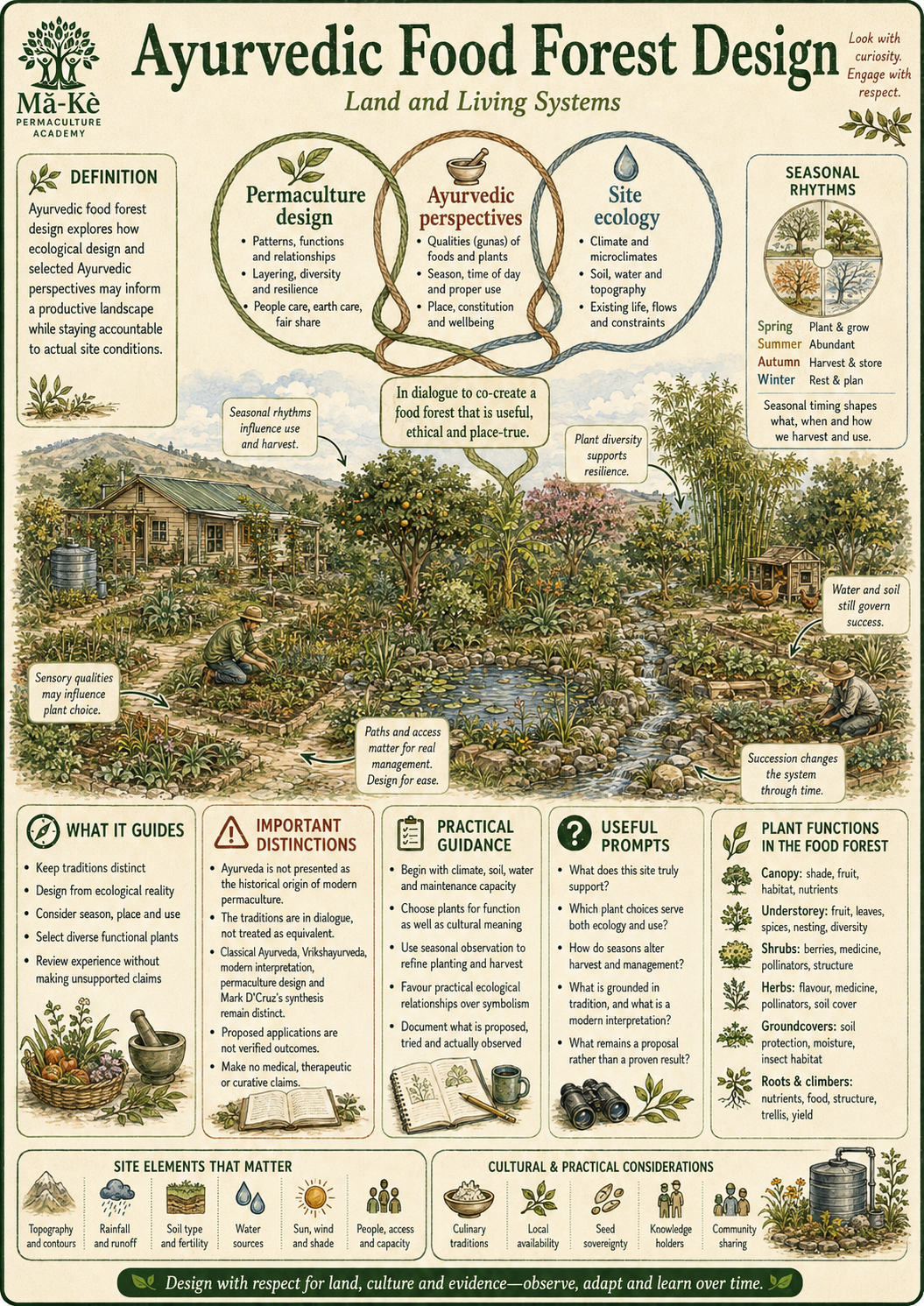
The teaching sections that follow provide the substantive HTML text equivalent of this infographic.
Keep the knowledge traditions distinct
- Classical Ayurveda
- A diverse South Asian medical and life-knowledge tradition with its own texts, practitioners, diagnostic concepts and regulatory contexts.
- Vrikshayurveda
- A name used for historical Indian plant-care and arboricultural traditions; its texts, periods and practices should not be collapsed into medical Ayurveda.
- Modern permaculture
- An ethical design discipline co-originated by Bill Mollison and David Holmgren in Australia during the 1970s.
- Mark’s synthesis
- A contemporary, place-based dialogue developed through his Diploma design; it is neither a recovered ancient system nor scientific proof of every correspondence.
Where dialogue can be useful
Both the Diploma synthesis and permaculture ask designers to attend to relationships, seasonal change and the consequences of daily practice. An Ayurvedic lens can prompt culturally informed questions about which foods are valued, when they are used, how sensory qualities are described and how a household’s routines change through the year. Permaculture contributes site observation, water and soil design, succession, access, diversity and feedback.
Similarity does not establish shared origin or equivalence. A symbolic correspondence may be meaningful to a practitioner while remaining different from an ecological measurement or clinical claim.
Design from site and household needs
Begin with climate, soil, water, sun, wind, fire, access and existing vegetation. Ask which foods and plants the household actually recognises, uses and can cultivate safely. Check botanical identity, invasiveness, toxicity, legal status, mature size, water needs and local ecological fit before selecting a culturally significant species.
At Vila Pinheiro, the design began with an identified forest patch and expanded conceptually towards orchard, kitchen garden, silviculture and animal areas. This expansion is a proposed whole-homestead framework. It should be tested in phases rather than treated as an established model.
Use functions and relationships
For every proposed plant, record its intended food, shade, habitat, soil-cover, wind, pollinator, biomass or cultural-learning role. Then record its needs, possible conflicts and evidence status. “Medicinal” in a historical or cultural source does not establish safe self-treatment, effective dose or suitability for an individual.
Design vertical and seasonal relationships as in any food forest: mature crown and root space, pollination, irrigation, harvest access, support plants, ground cover and planned succession. Ayurvedic categories may inform the questions a household asks, but they do not override horticultural evidence or local ecological limits.
Work with season without prescribing a diet
Seasonal rhythm can guide observation: what is available, what requires irrigation, what stores well and how labour changes. Record flowering, harvest, taste, aroma, texture and household use where these are directly observed. If Ayurvedic terms such as ritucharya or rasa are used, explain their source and context rather than converting them into universal nutrition rules.
Dietary or therapeutic advice belongs with appropriately qualified professionals and the needs of the individual. This page supports garden design and cultural enquiry only.
Treat Vrikshayurveda and sacred geometry cautiously
The Diploma sources explore Vrikshayurveda, plant care and symbolic geometry in temple architecture. These materials can open historical and philosophical enquiry, but they do not show that a geometric planting pattern will improve yield, health or ecological function. Historical texts also require specialist translation, dating and cultural interpretation.
A designer may use a symbolic pattern for meaning, orientation or participation, provided access, water, mature plant size and ecological function remain workable and the symbolic status is explicit. Do not present correspondence as scientific causation.
Mark’s Vila Pinheiro design process
- State a vision connecting food, place, cultural learning and ecological care.
- Survey the proposed patch and the wider site.
- Inventory existing and possible plants, marking identification and evidence gaps.
- Develop relationships among soil, water, access, succession and household use.
- Test a small planting close to observation before extending the concept.
- Record survival, growth, inputs, harvest and actual use.
- Review cultural claims with suitable knowledge holders and ecological claims against field evidence.
The Diploma documents design development and intended application. It does not provide controlled evidence of therapeutic outcomes, nor a mature long-term ecological evaluation.
Limitations and evidence status
- Ayurveda contains multiple textual, regional and practitioner traditions; one alignment table cannot represent all of them.
- Plant names and uses require botanical and cultural verification.
- Traditional use is not identical to demonstrated clinical efficacy or safety.
- Mediterranean suitability cannot be inferred from South Asian cultural importance.
- The Vila Pinheiro design includes proposals and early experiments, not a completed proof of the synthesis.
- Health, pregnancy, medicine interactions and toxic plants are outside this article’s scope.
Where this material comes from
The principal source is Mark’s Design 07 and its annexure proposing points of dialogue between permaculture and Ayurveda. Design 08 and its Vrikshayurveda annexure supply later plant-tradition and symbolic material. Designs 03 and 06 provide the wider homestead and food-system context. The Academy has recast health-promotional passages as questions or design intentions and retained explicit cultural and evidential limits.
Related Library resources
Sources and evidence notes
- Mark D’Cruz, Design 07 - Ayurvedic Food Forest, controlled Diploma source.
- Mark D’Cruz, Design 07 Annexure 03 - The Alignment of Permaculture with Ayurveda, controlled Diploma source.
- Mark D’Cruz, Design 08 - Regenerative Silviculture, controlled Diploma source.
- Mark D’Cruz, Design 08 Annexure 03 - Vrikshayurveda and the Sacred Geometry of Plants in Temple Architecture, controlled Diploma source; treated as interpretive material.
- Mark D’Cruz, Design 03 - Vila Pinheiro: A Sustainable Homestead, whole-site survey, analysis, zoning, implementation planning and review.
- Mark D’Cruz, Design 06 - Food Self-sufficiency, controlled Diploma source.
- World Health Organization, WHO Benchmarks for the Practice of Ayurveda, safety, quality and scope boundaries for Ayurvedic practice.
Diploma source locators
- Design 07, PDF pages 5-19: stated influences, vision, goals, site analysis, evolving concept and proposed functions.
- Design 07, PDF pages 25-45: design development, species and implementation planning.
- Design 07 Annexure 03, PDF pages 1-2: authored alignment table requiring cultural and evidential qualification.
- Design 08, PDF pages 20-31: Vrikshayurveda influence and silviculture design context.
- Design 08 Annexure 03, PDF pages 1-5: historical and symbolic claims held as interpretive rather than scientific evidence.
Planning proposals, completed activity and measured outcomes are identified separately throughout this article.