Authored living-practice collection
The Mă-Kè Bonsai Way
Explore The Mă-Kè Bonsai Way: six tenets and eighteen practices connecting bonsai care, permaculture ethics, regenerative cultivation and learning.
Choose a way into the collection
Read the six tenets in order, beginning with nature and the health of the tree.
Use the eighteen practices to explore water, soil, sourcing, pruning, seasonal awareness and knowledge-sharing.
What The Mă-Kè Bonsai Way is
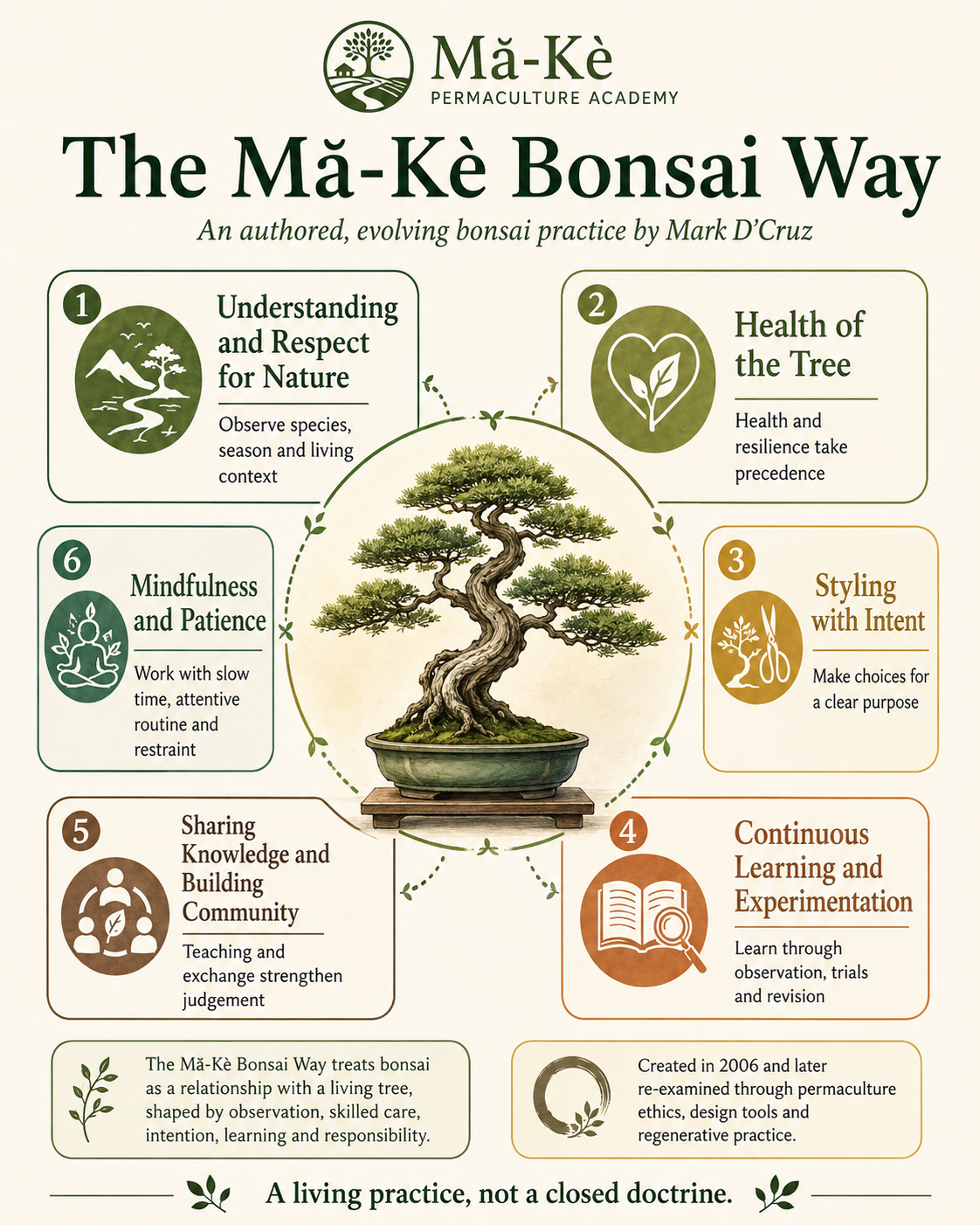
The Mă-Kè Bonsai Way is Mark D’Cruz’s evolving synthesis of long-term bonsai practice, teaching, permaculture ethics, regenerative cultivation, mindfulness and community learning. It treats bonsai as a relationship with a living tree, shaped by observation, skilled care, intention, learning and responsibility.
It is an authored practice rather than a closed doctrine. The six tenets provide stable points of orientation while their interpretation continues to develop through evidence and experience.
How it developed
Mark began developing and teaching Mă-Kè Bonsai before his Applied Permaculture Diploma. Design 01 records that Mă-Kè Bonsai was created in 2006 and that the philosophy already existed before the Diploma. The Diploma then gave Mark a structured opportunity to re-examine it through permaculture ethics, design tools and regenerative practice.
The source record supports a history of development in Mark’s own practice. It does not establish universal priority, external adoption or independent validation.
What changed through the Diploma
Design 01 uses the Design Web, SWIC and Six Thinking Hats to explore how permaculture could inform the existing philosophy. Design 02 turns related ideas into a three-module course and records evaluation and future direction. The result was not the replacement of bonsai with permaculture. It was a more explicit account of ecological responsibility, feedback, learning and community.
The six original tenets
Tenet 1 of 6
Understanding and Respect for Nature
Begin with attentive observation of the tree, its species, season and wider living context rather than forcing a predetermined image.
Read Understanding and Respect for Nature →Tenet 2 of 6
Health of the Tree
Treat horticultural health, resilience and aftercare as conditions of responsible bonsai design rather than secondary concerns.
Read Health of the Tree →Tenet 3 of 6
Styling with Intent
Make design choices for stated purposes while allowing the tree’s health, character and future development to constrain the image.
Read Styling with Intent →Tenet 4 of 6
Continuous Learning and Experimentation
Develop bonsai knowledge through observation, careful trials, records, feedback and willingness to revise rather than novelty for its own sake.
Read Continuous Learning and Experimentation →Tenet 5 of 6
Sharing Knowledge and Building Community
Treat teaching, mentorship and exchange as reciprocal practices that strengthen judgement without pretending that a community always agrees.
Read Sharing Knowledge and Building Community →Tenet 6 of 6
Mindfulness and Patience
Use the slow timescales and attentive routines of bonsai as a disciplined practice of presence, patience and relationship with living change.
Read Mindfulness and Patience →Tenets, ethics, principles and practices
- Tenets
- Core authored propositions of The Mă-Kè Bonsai Way.
- Ethics
- Directions for judging responsibility and consequences, including permaculture ethics where explicitly mapped.
- Principles
- Prompts for design judgement rather than fixed rules.
- Practices
- Repeatable ways of acting that may express one or more tenets.
These categories overlap in use but should not be collapsed. A Mă-Kè tenet may be examined through a permaculture ethic without becoming a universal permaculture ethic.
Relationship with wider traditions
The collection credits horticultural knowledge, bonsai traditions, permaculture, pedagogy, community-of-practice thinking and contemplative traditions where they provide context. It does not present the six tenets as ancient Japanese doctrine or attribute modern Mă-Kè wording to Zen. Mark remains accountable for the synthesis and its claims.
How to use this collection
Read the tenets as connected responsibilities. Begin with nature and tree health, then examine intent, learning, community and patience. For any intervention, identify what is known, what is assumed, who or what may be affected, what care will follow and when the decision will be reviewed.
The eighteen practices
The practices extend the six tenets into repeatable ways of observing, caring, making, reflecting and sharing. They remain authored Mă-Kè propositions rather than universal bonsai rules, new permaculture ethics or settled scientific laws.
They are grouped into three connected batches so readers can follow ecological care, regenerative craft, and personal, place and community practice without collapsing the practices into the six tenets.
Batch 1 of 3
Ecological care
Observe natural cycles and meet the living tree’s ecological needs.
Practice 1 of 18
Embracing Nature's Cycle and Environment
Embracing Nature's Cycle and Environment is a Mă-Kè practice of observing how a tree species grows, responds to seasons and relates to place before translating those lessons carefully into bonsai cultivation.
Read Embracing Nature's Cycle and Environment →Practice 2 of 18
Creating a Bonsai Ecosystem
Creating a Bonsai Ecosystem explains the Mă-Kè practice of designing the growing area as a network of trees, organisms, shelter, water and care relationships while respecting the limits of a managed nursery.
Read Creating a Bonsai Ecosystem →Practice 3 of 18
Balanced Watering and Efficient Water Use
Balanced Watering and Efficient Water Use joins close observation of each bonsai's moisture needs with responsible collection, delivery and monitoring of water, without relying on a fixed universal schedule.
Read Balanced Watering and Efficient Water Use →Practice 4 of 18
Healthy Soil Management
Healthy Soil Management is the routine stewardship of a bonsai's existing root zone: checking drainage, aeration, moisture, compaction, root condition and substrate performance before problems become severe.
Read Healthy Soil Management →Practice 5 of 18
Natural Pest Control
Natural Pest Control in the Mă-Kè Bonsai Way uses prevention, accurate identification, monitoring and least-disruptive interventions first, while recognising when stronger action is needed to protect trees.
Read Natural Pest Control →Practice 6 of 18
Seasonal Awareness
Seasonal Awareness is the Mă-Kè practice of reading weather, tree development and species rhythm through the year, then adapting watering, feeding, protection, pruning and repotting to observed conditions.
Read Seasonal Awareness →Batch 2 of 3
Regenerative craft
Shape, feed, source and maintain with deliberate attention to consequences.
Practice 7 of 18
Mindful Pruning and Training
Mindful Pruning and Training applies observation, purpose and restraint to every cut, bend and wire, balancing design aims with species growth, tree health, recovery capacity and the option not to intervene.
Read Mindful Pruning and Training →Practice 8 of 18
Organic Fertilisation
Organic Fertilisation in the Mă-Kè Bonsai Way uses responsibly sourced nutrient inputs within a measured feeding plan, guided by species, growth stage, substrate, water, season and observed tree response.
Read Organic Fertilisation →Practice 9 of 18
Eco-friendly Practices
Eco-friendly Practices identify and reduce avoidable environmental harms in day-to-day bonsai work, including water, energy, materials, waste, pollution and habitat, without treating a green label as proof.
Read Eco-friendly Practices →Practice 10 of 18
Regenerative Practices
Regenerative Practices move beyond reducing harm to redesign the bonsai system so materials circulate, waste and pollution fall, biodiversity is supported and the capacity to care improves through feedback.
Read Regenerative Practices →Practice 11 of 18
Regenerative Soil Management
Regenerative Soil Management asks how bonsai root-zone materials and biological functions can improve over time through careful cycling, reduced waste, observation and testing without sacrificing drainage.
Read Regenerative Soil Management →Practice 12 of 18
Regenerative Sourcing
Regenerative Sourcing examines the origin, durability, repair, reuse and eventual disposal of bonsai trees, pots, tools, wire and substrates, looking beyond local or green labels to whole-life consequences.
Read Regenerative Sourcing →Batch 3 of 3
Personal, place and community
Cultivate presence, fit practice to place and share learning responsibly.
Practice 13 of 18
Mindful Cultivation
Mindful Cultivation brings deliberate attention to ordinary bonsai care: pausing, observing the tree and context, acting with a clear purpose, and recording useful feedback before routine becomes automatic.
Read Mindful Cultivation →Practice 14 of 18
Cultivating Inner Harmony
Cultivating Inner Harmony is the reflective dimension of the Mă-Kè Bonsai Way, using patient care of living trees as an occasion to examine attention, values, limits and one's relationship with nature.
Read Cultivating Inner Harmony →Practice 15 of 18
Working with the Environment
Working with the Environment adapts bonsai placement, protection and care to the actual site's sun, shade, wind, heat, frost, water and biodiversity rather than forcing every tree into one fixed routine.
Read Working with the Environment →Practice 16 of 18
Choosing Suitable Tree Species
Choosing Suitable Tree Species matches a tree's biological needs and growth characteristics with climate, microclimate, available care, design aims, legal provenance and the practitioner's practical capacity.
Read Choosing Suitable Tree Species →Practice 17 of 18
Natural and Organic Soil
Natural and Organic Soil examines how to formulate a bonsai substrate from suitable, traceable materials while balancing drainage, aeration, water retention, nutrient behaviour, durability and climate.
Read Natural and Organic Soil →Practice 18 of 18
Sharing Knowledge
Sharing Knowledge is the practical Mă-Kè discipline of exchanging methods, observations, failures and evidence with enough context for others to learn without mistaking personal experience for a universal rule.
Read Sharing Knowledge →Limits and open questions
The collection is grounded primarily in Mark’s own designs, teaching and reflective record. That is strong evidence of authorship and development, but it is not independent evaluation of horticultural outcomes or universal acceptance. Species-specific care, safety and diagnosis require appropriate sources and expertise. References to mindfulness are reflective rather than medical or therapeutic.
Where this material comes from
Design 01 records the earlier Mă-Kè philosophy and its later examination through permaculture; Design 02 records the associated course design, evaluation and future direction. These are primary, self-authored development records. They establish Mark’s authorship and process, not universal adoption or independent proof of horticultural outcomes.
- Design 01, design summary, PDF page 5; printed pages 2 to 3, PDF pages 6 to 7; printed pages 12 to 16, PDF pages 16 to 20; printed pages 26 and 31 to 32, PDF pages 30 and 35 to 36.
- Design 02, PDF pages 6 and 8; printed pages 7 and 9 to 12, PDF pages 12 and 14 to 17; evaluation and future direction, PDF pages 20 to 23.
- Design 01 Appendix 01, The Mă-Kè Bonsai Way, PDF pages 1 to 2.
- Royal Horticultural Society, bonsai cultivation guidance.
- David Holmgren, Essence of Permaculture.