Personal, place and community · Practice 16 of 18
Choosing Suitable Tree Species
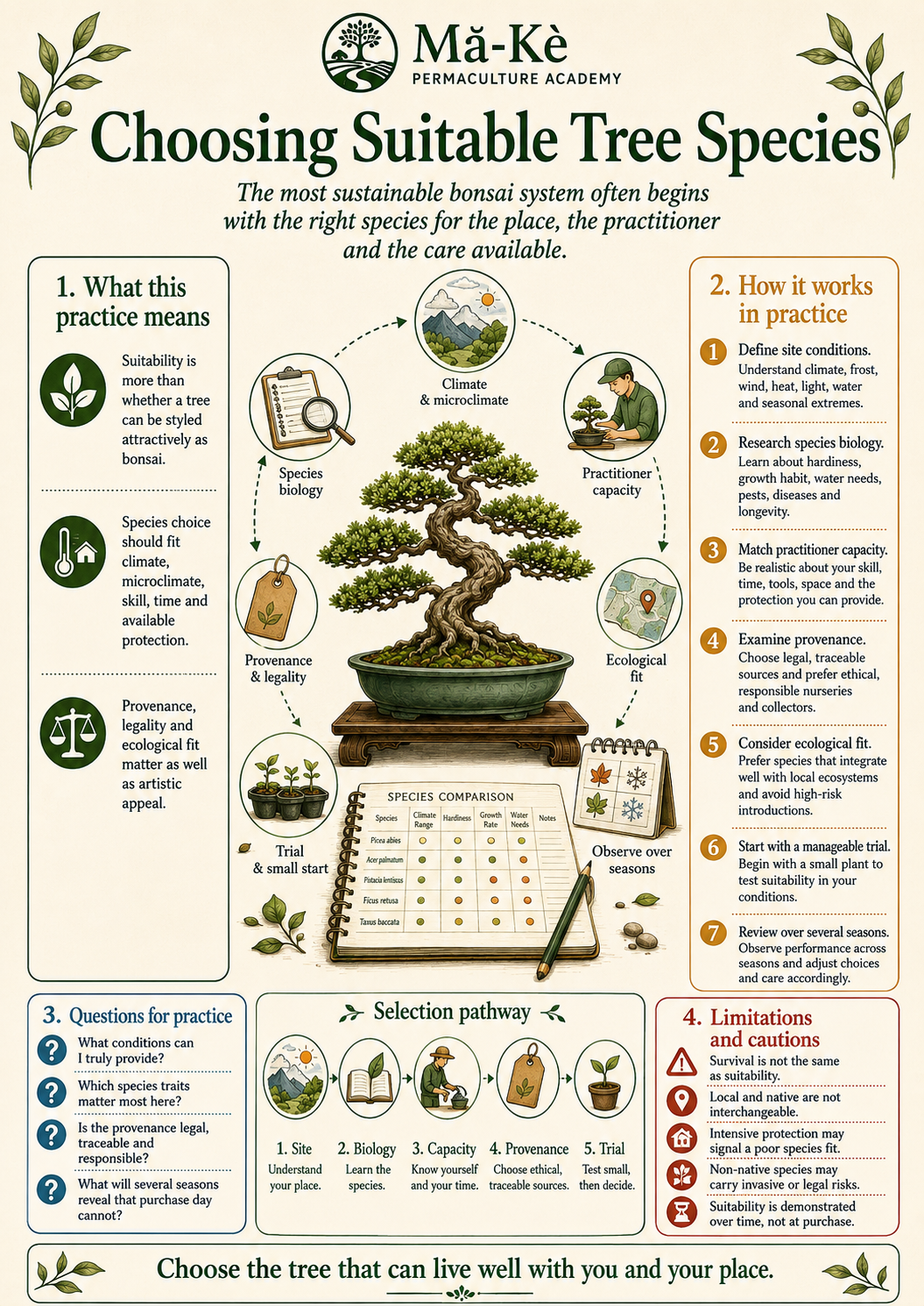
The most sustainable care system may begin with the right tree. Species selection should fit climate, microclimate, skill, time and available protection, as well as the artistic qualities sought in bonsai.
Why this matters
A tree can survive in a place yet depend on intensive protection, water, heating or cooling. Another species may thrive under local conditions with fewer interventions. Suitability is therefore more than whether a species can be styled as bonsai.
The decision also includes provenance and legality. Wild collection, international plant movement and invasive potential can carry ecological, ethical and biosecurity consequences.
The practice
- Define site conditions. Use actual temperature ranges, frost, heat, humidity, wind, light and water quality.
- Research species biology. Check hardiness, dormancy, growth habit, root behaviour, water needs, pest susceptibility and response to training.
- Match practitioner capacity. Consider observation frequency, travel, physical access, winter protection, emergency watering and skill.
- Examine provenance. Prefer traceable, legal material. Understand whether it was propagated, nursery-grown, imported or collected.
- Consider ecological fit. Check invasive potential and local restrictions before placing or propagating non-native species outdoors.
- Start with a manageable trial. Learn from one or a few trees before expanding a demanding group.
- Review over several seasons. Suitability is demonstrated over time, not at purchase.
From Mark's Diploma
The appendix states that selecting the right species is crucial to a harmonious fit between tree and environment. Design 01 joins suitable species with seasonal awareness and later describes mindful selection through natural habitat, growth characteristics and adaptability to local climate.
'Local species' and 'native species' are not interchangeable, and neither is automatically the best bonsai choice. The conclusion depends on aims, provenance, cultivation knowledge and ecological risk.
Limitations and cautions
- Hardiness ratings describe defined conditions, not every container microclimate.
- Roots in shallow pots may be more exposed to heat and cold than roots in the ground.
- Climate projections and extreme events may change long-term suitability.
- Imported trees can carry pests even when they appear healthy.
- Wild collection requires legal permission, ecological judgement and specialist aftercare; it should not be romanticised.
Questions for practice
- Can this tree thrive here without disproportionate inputs?
- What seasonal or emergency protection will it require?
- Is its provenance legal, traceable and ethically acceptable?
- Does my current skill and availability match its needs?
Connections
Read with Embracing Nature's Cycle and Environment, Working with the Environment, Seasonal Awareness, Regenerative Sourcing and Health of the Tree.
Diploma connections
- MKE-APP, PDF p. 2, practice 15.
- MKE-D01, printed pp. 17-19, PDF pp. 21-23.
- MKE-D01, printed p. 32, PDF p. 36.
References and further reading
- D'Cruz, Mark. The Mă-Kè Bonsai Way Appendix and Design 01.
- Royal Horticultural Society. Plant profiles, hardiness definitions and container-tree guidance.
- Warren, Peter. Step-by-Step Bonsai. Dorling Kindersley, 2014.
- Relevant national plant-health, import and invasive-species authorities for the reader's location.