Personal, place and community · Practice 15 of 18
Working with the Environment
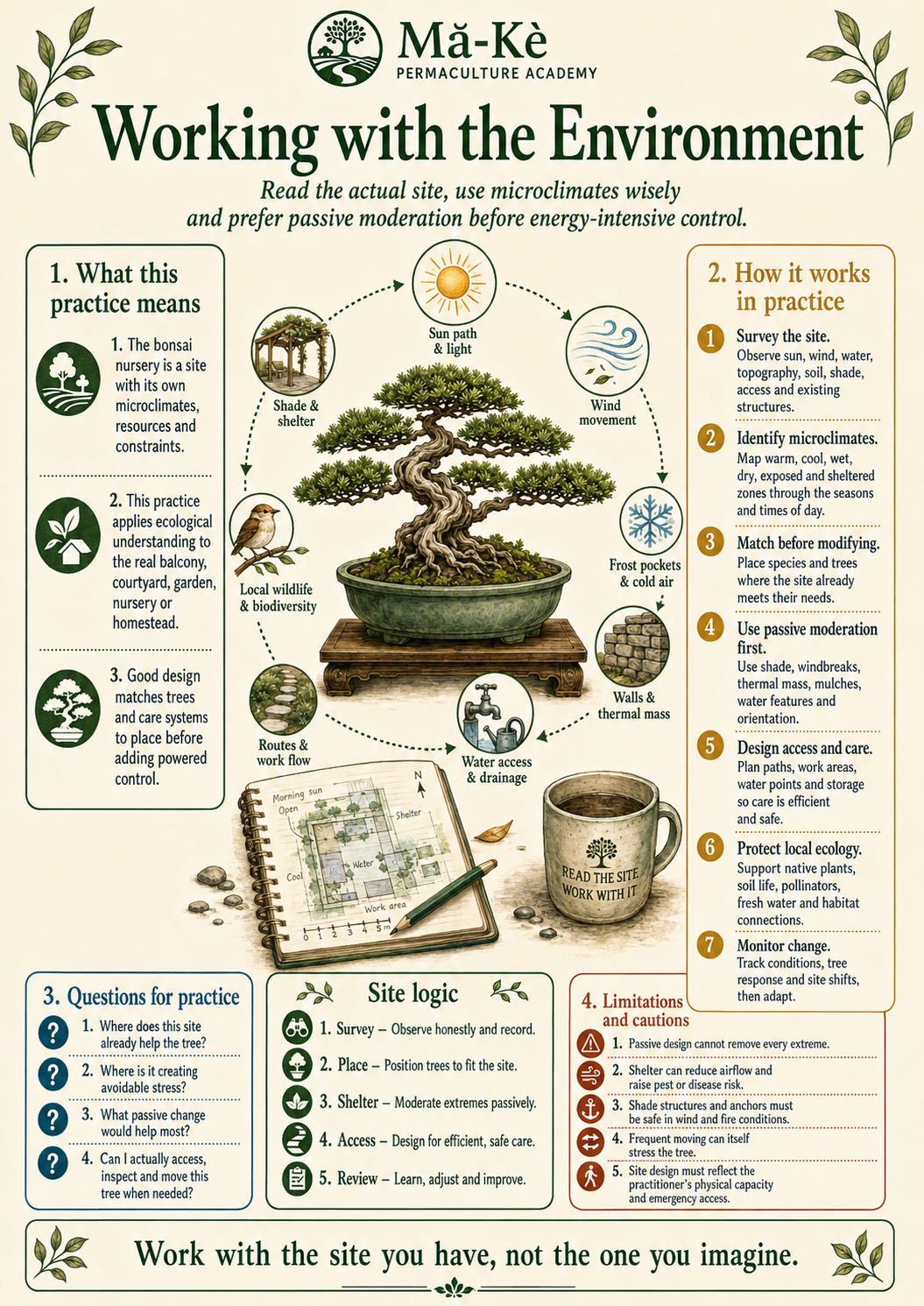
The bonsai nursery is a site with its own microclimates, resources and constraints. Working with the Environment begins by mapping those conditions, then matching trees and care systems to place before adding energy-intensive controls.
Defining the boundary
Embracing Nature's Cycle and Environment learns from species ecology and natural patterns. Working with the Environment applies that learning to the practitioner's actual site: balcony, courtyard, garden, nursery or homestead.
The practice
- Survey the site. Record seasonal sun, reflected heat, wind, frost, rainfall, drainage, water access, security and routes used by people and animals.
- Identify microclimates. Walls, paving, slopes, vegetation, buildings and benches create meaningful differences over short distances.
- Match before modifying. Place species and development stages where existing conditions meet their needs most closely.
- Use passive moderation first. Consider orientation, shade, wind shelter, grouping and thermal buffering before powered heating or cooling.
- Design access and care. A theoretically ideal position fails if inspection, watering or emergency movement is impractical.
- Protect local ecology. Prevent contaminated runoff, invasive escape, pest movement and unnecessary disturbance.
- Monitor change. Development, construction, tree growth and changing weather can alter the site.
From Mark's Diploma
The appendix connects this practice with permaculture and balanced microenvironments, including climate, soil composition and ecosystem dynamics. Design 01 frames it as adapting care to biodiversity and climate and applying observation and interaction.
Mark's wider Vila Pinheiro designs offer site-analysis context. They are not bonsai-specific evidence unless the connection is explicit, and any case claim requires the relevant design and exact locator.
Limitations and cautions
- Passive design cannot eliminate every extreme.
- Shelter can reduce airflow and increase pest or disease risk.
- Shade materials, anchors and structures must be safe in wind and fire conditions.
- Moving a tree frequently can itself create stress or inconsistent care.
- A site design must reflect the practitioner's physical capacity and emergency access.
Questions for practice
- What are the site's strongest existing supports and hazards?
- Which trees fit each microclimate without major modification?
- What passive change could reduce ongoing energy or labour?
- How will the site perform during the most likely extreme event?
Connections
Read with Embracing Nature's Cycle and Environment, Choosing Suitable Tree Species, Creating a Bonsai Ecosystem, Seasonal Awareness and Site Observation, Sector and Zone Analysis.
Diploma connections
- MKE-APP, PDF p. 2, practice 14.
- MKE-D01, printed pp. 17-20, PDF pp. 21-24.
- MKE-D01, printed pp. 31-33, PDF pp. 35-37.
References and further reading
- D'Cruz, Mark. The Mă-Kè Bonsai Way Appendix and Design 01.
- Holmgren, David. Permaculture: Principles and Pathways Beyond Sustainability. 2002.
- Royal Horticultural Society. Container-tree and species-specific guidance.
- Mă-Kè Library. Site Observation, Sector and Zone Analysis.