Personal, place and community · Practice 14 of 18
Cultivating Inner Harmony
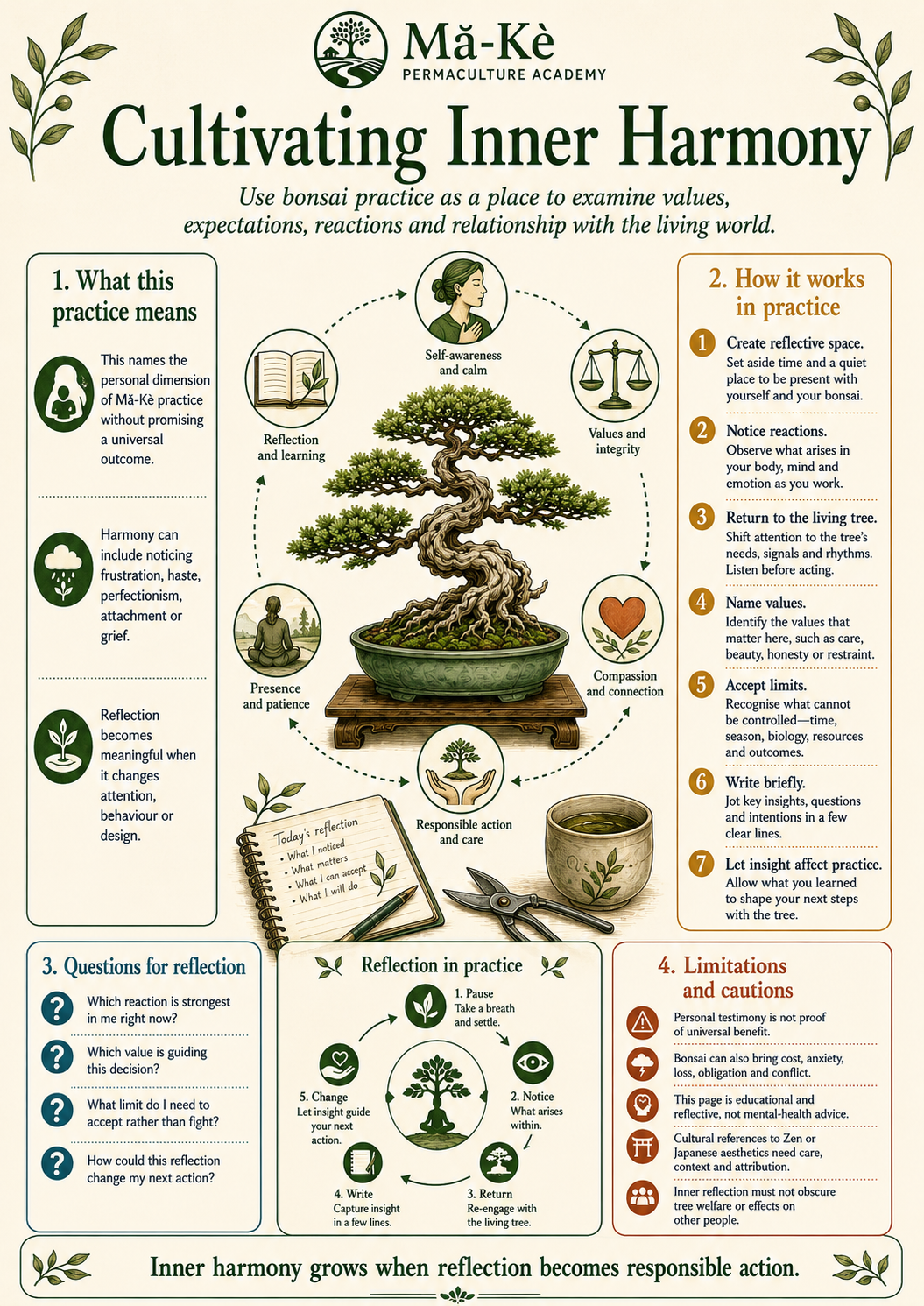
Bonsai can offer a setting for reflection, patience and a changed sense of time. Cultivating Inner Harmony names that personal dimension of Mă-Kè practice without promising that growing a tree will produce a particular psychological or medical outcome.
Defining the boundary
Mindful Cultivation concerns attention during care tasks. Cultivating Inner Harmony concerns what the practitioner learns about values, reactions, expectations and relationship with the living world through sustained practice.
Harmony does not mean permanent calm or the absence of conflict. It can include noticing frustration, attachment, haste, perfectionism or grief and deciding how to respond responsibly.
The practice
- Create reflective space. Set aside moments in which care is not reduced to task completion.
- Notice reactions. Observe impatience, certainty, disappointment, protectiveness and the desire to control.
- Return to the living tree. Compare the internal narrative with what can actually be observed.
- Name values. Ask what respect, care, beauty, restraint, responsibility and fairness mean in this decision.
- Accept limits. Trees, seasons, bodies, time and resources impose real boundaries.
- Write briefly. Record an observation, response, decision and question without forcing a lesson from every event.
- Let insight affect practice. Reflection becomes meaningful when it changes attention, behaviour or design.
From Mark's Diploma
The appendix describes tranquillity, mindfulness and deeper connection with nature as possible personal experiences within Mă-Kè practice. Design 01 organises part of the action pathway around 'My Inner Journey' and links the Mă-Kè approach with People Care.
These observations retain Mark's first-person and practice-based basis: the practice may offer or can provide an occasion for reflection, rather than promising a universal result.
Limitations and cautions
- Personal testimony is valid evidence of personal experience, not proof of universal benefit.
- Bonsai can also bring cost, anxiety, loss, obligation and conflict.
- This page is educational and reflective, not mental-health advice.
- Cultural references to Zen or Japanese aesthetics require care, context and attribution.
- Inner reflection should not obscure the welfare of the tree or effects on other people.
Questions for practice
- What reaction is shaping my decision about this tree?
- Which value do I want the practice to express?
- What limit must be accepted rather than overcome?
- Has reflection changed what I will do next?
Connections
Read with Mindfulness and Patience, Mindful Cultivation, Health of the Tree, Styling with Intent and Action Learning Pathway.
Diploma connections
- MKE-APP, PDF p. 2, practice 13.
- MKE-D01, printed pp. 18-21, PDF pp. 22-25.
- MKE-D01, printed p. 21 and pp. 27-28, PDF p. 25 and pp. 31-32, 'My Inner Journey' action pathway and designer reflection.
References and further reading
- D'Cruz, Mark. The Mă-Kè Bonsai Way Appendix and Design 01.
- Schön, Donald A. The Reflective Practitioner. 1983.
- Kabat-Zinn, Jon. Full Catastrophe Living. 1990.
- Specific Zen concepts require appropriate primary sources, cultural context and attribution.