Personal, place and community · Practice 13 of 18
Mindful Cultivation
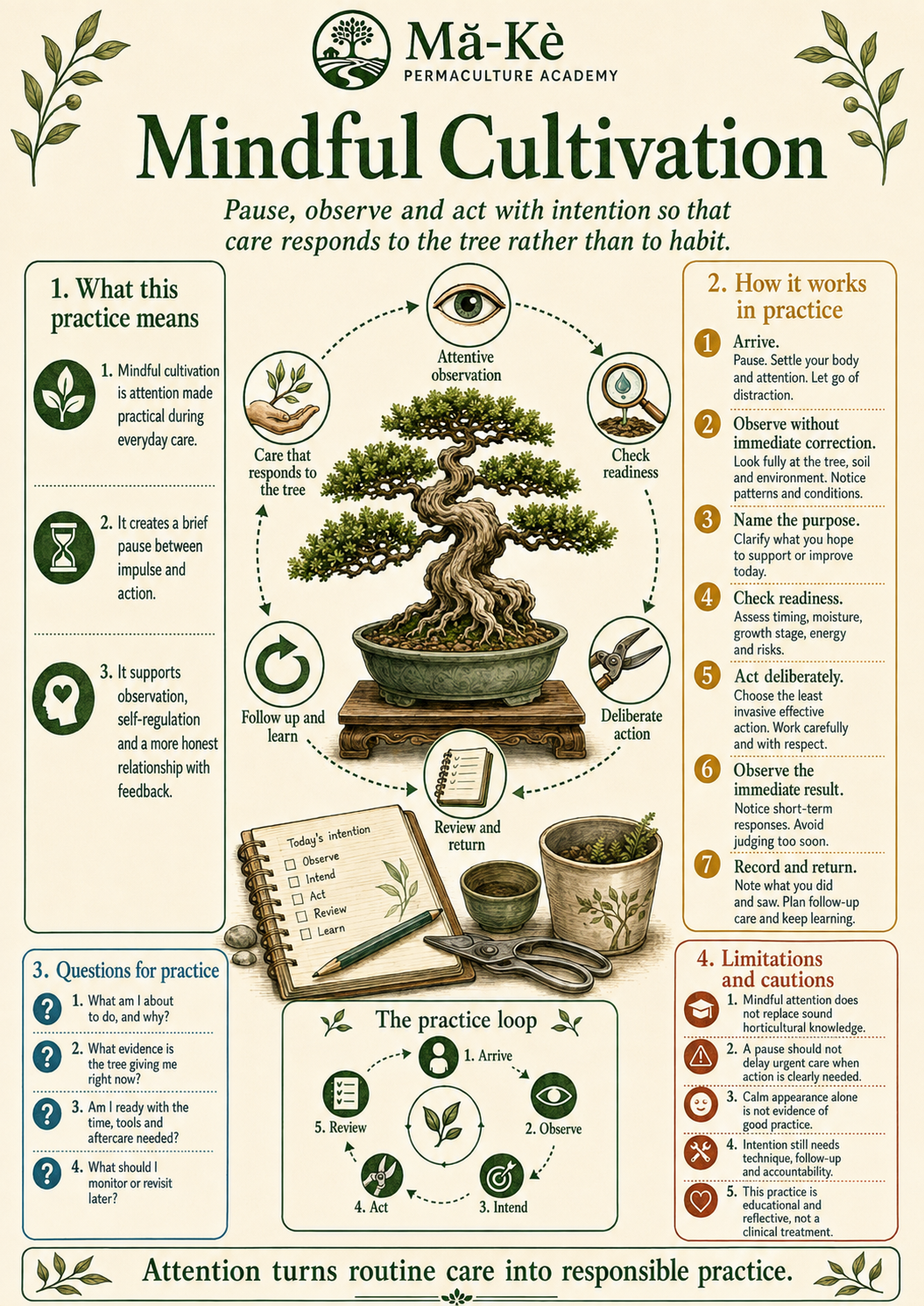
Mindful Cultivation is attention made practical. It is the habit of arriving, observing, naming the purpose of an action and noticing its result during watering, pruning, feeding, cleaning, repotting and daily inspection.
An authored Mă-Kè practice
This practice belongs to Mark D'Cruz's Mă-Kè Bonsai Way. It draws on his long bonsai practice, reflective learning and engagement with mindfulness traditions. It should not be presented as an ancient universal bonsai doctrine or as a clinical treatment.
Why this matters
Many failures occur not because knowledge is absent, but because care becomes hurried or automatic. A fixed watering round can override evidence from an individual tree. A familiar technique can be repeated without checking health or season. A design preference can become more visible than the tree's response.
Mindful attention creates a small interruption between impulse and action. That pause supports observation, self-regulation and a more honest relationship with feedback.
The practice
- Arrive. Put aside the next task long enough to look at the whole tree and growing area.
- Observe without immediate correction. Note moisture, foliage, buds, shoots, bark, wire, pests, weather and recent interventions.
- Name the purpose. State what the proposed action is meant to achieve.
- Check readiness. Consider health, season, available time, tools and aftercare.
- Act deliberately. Use an appropriate method and stop when the intended task is complete.
- Observe the immediate result. Check for damage, instability or a changed care need.
- Record and return. Schedule follow-up where necessary and compare expectation with later response.
From Mark's Diploma
The appendix describes mindfulness and presence as integral to Mă-Kè cultivation, promoting a deeper connection with the tree and care undertaken with intention. Design 01 links this to People Care, small and thoughtful steps, and the broader tenet of mindfulness and patience.
Limitations and cautions
- Attention does not replace horticultural knowledge or skilled technique.
- A contemplative experience for the practitioner is not evidence that the tree is healthy.
- Avoid claims that bonsai practice treats anxiety, depression or other health conditions unless a separate, appropriately reviewed evidence base supports them.
- Mindfulness language should be credited and used respectfully, without presenting a simplified practice as the whole of Zen or Buddhist tradition.
Questions for practice
- What did I observe before deciding to act?
- Am I responding to the tree or completing a habitual routine?
- What purpose does this action serve?
- When will I check whether my interpretation was correct?
Connections
Read with Mindfulness and Patience, Mindful Pruning and Training, Cultivating Inner Harmony, Health of the Tree and Continuous Learning and Experimentation.
Diploma connections
- MKE-APP, PDF p. 2, practice 10.
- MKE-D01, printed pp. 18-19, PDF pp. 22-23.
- MKE-D01, printed p. 32, PDF p. 36.
References and further reading
- D'Cruz, Mark. The Mă-Kè Bonsai Way Appendix and Design 01.
- Schön, Donald A. The Reflective Practitioner. 1983.
- Kabat-Zinn, Jon. Full Catastrophe Living. 1990. Use for the modern mindfulness context, not as evidence of bonsai outcomes.
- Warren, Peter. Step-by-Step Bonsai. Dorling Kindersley, 2014.