Mă-Kè Bonsai Way tenet
Continuous Learning and Experimentation
Responsible learning combines curiosity with bounded experiments, records and protection for vulnerable trees.
What this tenet means
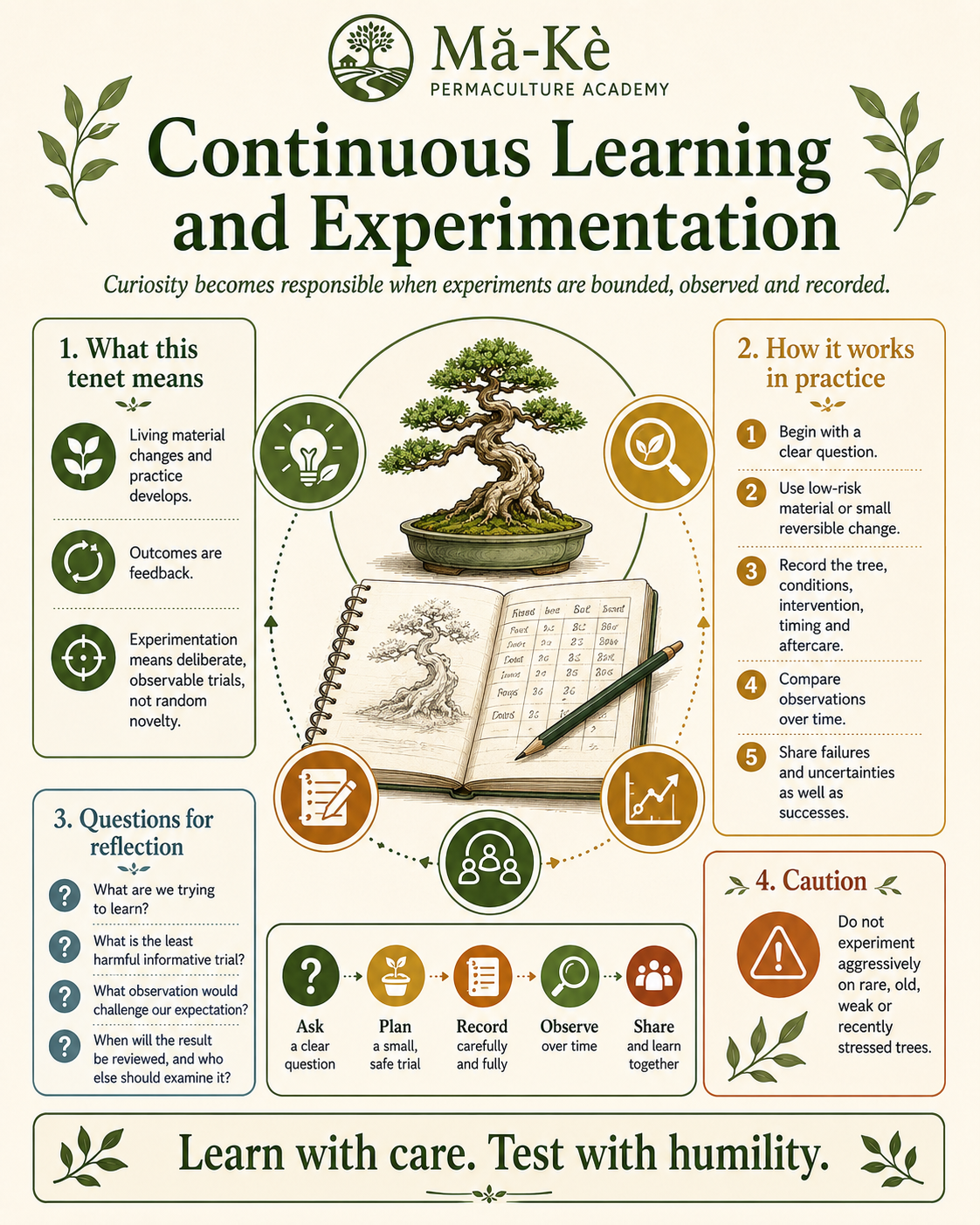
Living material changes, climates differ and practice develops. Continuous learning means treating outcomes as feedback while separating experience, inference and stronger evidence. Experimentation means changing something deliberately so it can be observed, not trying an unbounded technique because it is new.
How it works in practice
- Begin with a clear question and a reason for the trial.
- Use low-risk material or a small reversible change where uncertainty is high.
- Record the tree, conditions, intervention, timing and aftercare.
- Compare observations over an appropriate period.
- Share failures and uncertainties as well as favourable outcomes.
Questions for reflection
- What are we trying to learn?
- What is the least harmful informative trial?
- What observation would challenge our expectation?
- When will the result be reviewed, and who else should examine it?
Relationship with permaculture ethics and principles
Mark relates this tenet to observation, feedback and the permaculture principle of creatively using and responding to change. The relationship shapes his practice but does not turn anecdotal bonsai experience into universal evidence.
Evidence and development
Design 01 describes learning and experimentation within the Mă-Kè philosophy. Design 02 documents an educational structure, evaluation and future direction. These are primary records of Mark’s development and teaching, with the limits of self-authored evidence kept visible.
Limitations and cautions
Do not experiment aggressively on rare, old, valuable, weak or recently stressed trees. A single successful outcome does not establish a general rule. Pests, disease and serious decline require appropriate horticultural judgement.
Sources and context
- Design 01, printed pages 15 to 16, PDF pages 19 to 20; appendix, PDF page 1.
- Design 02, PDF pages 20 to 23: evaluation and future direction.
- Designing an Action Learning Pathway.