Mă-Kè Bonsai Way tenet
Sharing Knowledge and Building Community
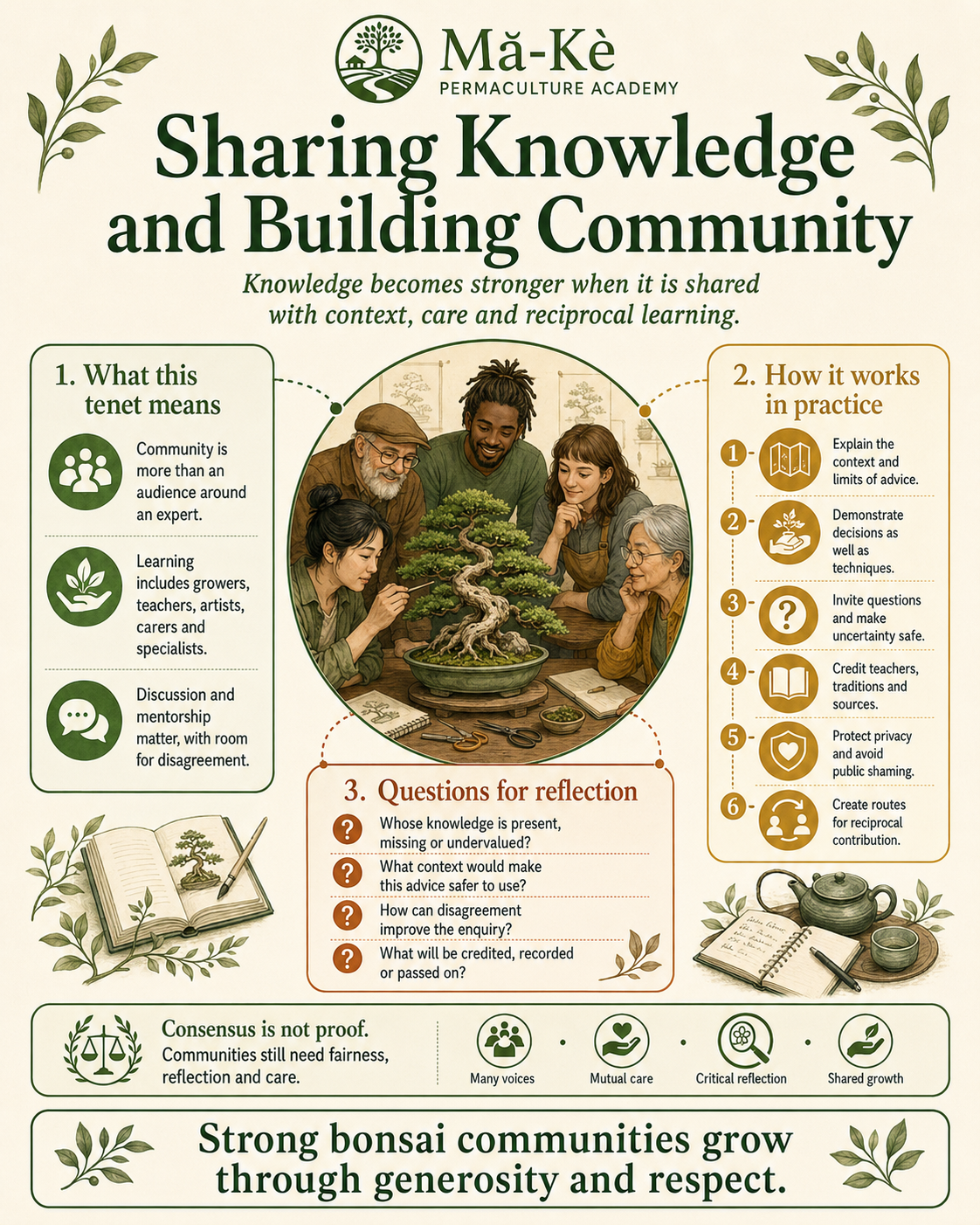
Bonsai knowledge becomes more useful and accountable when it is shared with context, questioned respectfully and supported by reciprocal learning.
What this tenet means
Community is not simply an audience around an expert. It can include learners, teachers, growers, artists, carers and specialists who exchange observations and responsibilities. Mark’s tenet values practical demonstration, discussion and mentorship while leaving room for disagreement.
How it works in practice
- Explain the context and limits of advice.
- Demonstrate decisions as well as techniques.
- Invite questions and make uncertainty safe to acknowledge.
- Credit teachers, traditions and sources.
- Protect private information and avoid public criticism of a learner’s tree or ability.
- Create routes for reciprocal contribution rather than one-way authority.
Questions for reflection
- Whose knowledge is present, missing or undervalued?
- What context would make this advice safer to use?
- How can disagreement improve the enquiry?
- What will be credited, recorded or passed on?
Relationship with permaculture ethics and principles
Mark connects this tenet with People Care, Fair Share and the distribution of knowledge. This is his synthesis. A community of practice is not automatically fair, inclusive or correct, so structures and power still need examination.
Evidence and development
Designs 01 and 02 record community, teaching and learning as parts of the Mă-Kè work. Wenger-Trayner’s introduction to communities of practice provides wider educational context, without implying that the Academy’s community has been independently evaluated against that framework.
Limitations and cautions
Consensus is not proof. Group traditions can preserve error and exclude unfamiliar voices. Public sharing must respect privacy, ownership, cultural context and the welfare of living material.
Sources and context
- Design 01, design summary, PDF page 5, and printed pages 15 to 16, PDF pages 19 to 20.
- Design 02, PDF page 8 and PDF pages 20 to 23: teaching goals, evaluation and future direction.
- Wenger-Trayner, “Introduction to communities of practice”.