Regenerative craft · Practice 7 of 18
Mindful Pruning and Training
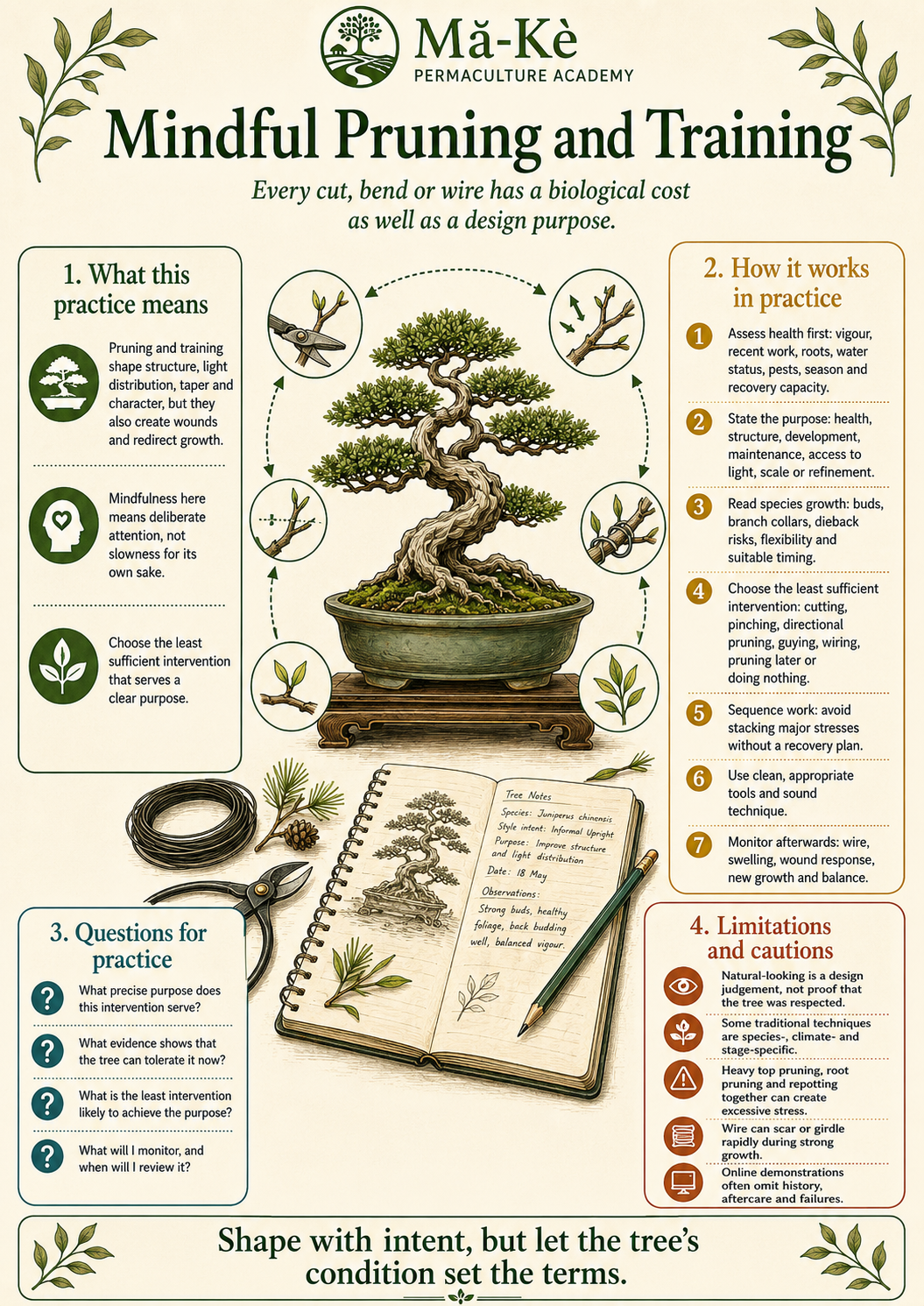
Every intervention has a biological cost as well as a design purpose. Mindful Pruning and Training asks what the tree needs, what the design intends, what the intervention changes and whether the tree is ready before a cut, bend or wire is made.
Why this matters
Pruning and training shape structure, light distribution, taper, branch development and visual character. They also remove photosynthetic tissue, create wounds and redirect growth. Good technique cannot compensate for poor timing, weak health or an unclear objective.
Mindfulness here means deliberate attention, not slowness for its own sake. A practitioner observes the whole tree, names the purpose of the action, considers alternatives, works competently and checks the result over time.
The practice
- Assess health first. Review vigour, recent work, roots, water status, pests, season and recovery capacity.
- State the purpose. Is the work for health, structure, development, maintenance, access to light, scale or refinement?
- Read species growth. Identify buds, branch collars, extension patterns, dieback risks, flexibility and suitable timing.
- Choose the least sufficient intervention. Compare cutting, pinching, directional pruning, guying, wiring, pruning later or doing nothing.
- Sequence work. Avoid stacking major stresses without a recovery plan.
- Use clean, appropriate tools and technique. Protect the tree, practitioner and nearby people.
- Monitor. Check wire, swelling, wound response, new growth and balance. Remove or adjust training materials before damage occurs.
From Mark's Diploma
The appendix defines mindful pruning as energy management as well as aesthetics, respecting the tree's inherent characteristics rather than forcing a predetermined form. Design 01 links pruning to Earth Care, self-regulation and working from patterns to details. This practice is the operational expression of the tenet Styling with Intent.
Limitations and cautions
- 'Natural-looking' is a design judgement, not proof that an intervention respects the tree.
- Some traditional techniques are species-, climate- and stage-specific.
- Heavy top pruning, root pruning and repotting may create excessive combined stress.
- Wire can scar or girdle rapidly during strong growth.
- Online demonstrations often omit the tree's history, aftercare and failures.
Questions for practice
- What precise purpose does this intervention serve?
- What evidence shows that the tree can tolerate it now?
- What is the least intervention likely to achieve the purpose?
- What will I monitor, and when will I review it?
Connections
Read with Styling with Intent, Health of the Tree, Seasonal Awareness, Mindful Cultivation and Apply Self-Regulation and Accept Feedback.
Diploma connections
- MKE-APP, PDF p. 2, practice 4.
- MKE-D01, printed p. 17, PDF p. 21.
- MKE-D01, printed p. 32, PDF p. 36.
References and further reading
- D'Cruz, Mark. The Mă-Kè Bonsai Way Appendix and Design 01.
- Warren, Peter. Step-by-Step Bonsai. Dorling Kindersley, 2014.
- Royal Horticultural Society. Species-specific pruning profiles and 'How to repot a plant'.
- Yoshimura, Yuji and Giovanna M. Halford. The Japanese Art of Miniature Trees and Landscapes. 1957.