Ecological care · Practice 6 of 18
Seasonal Awareness
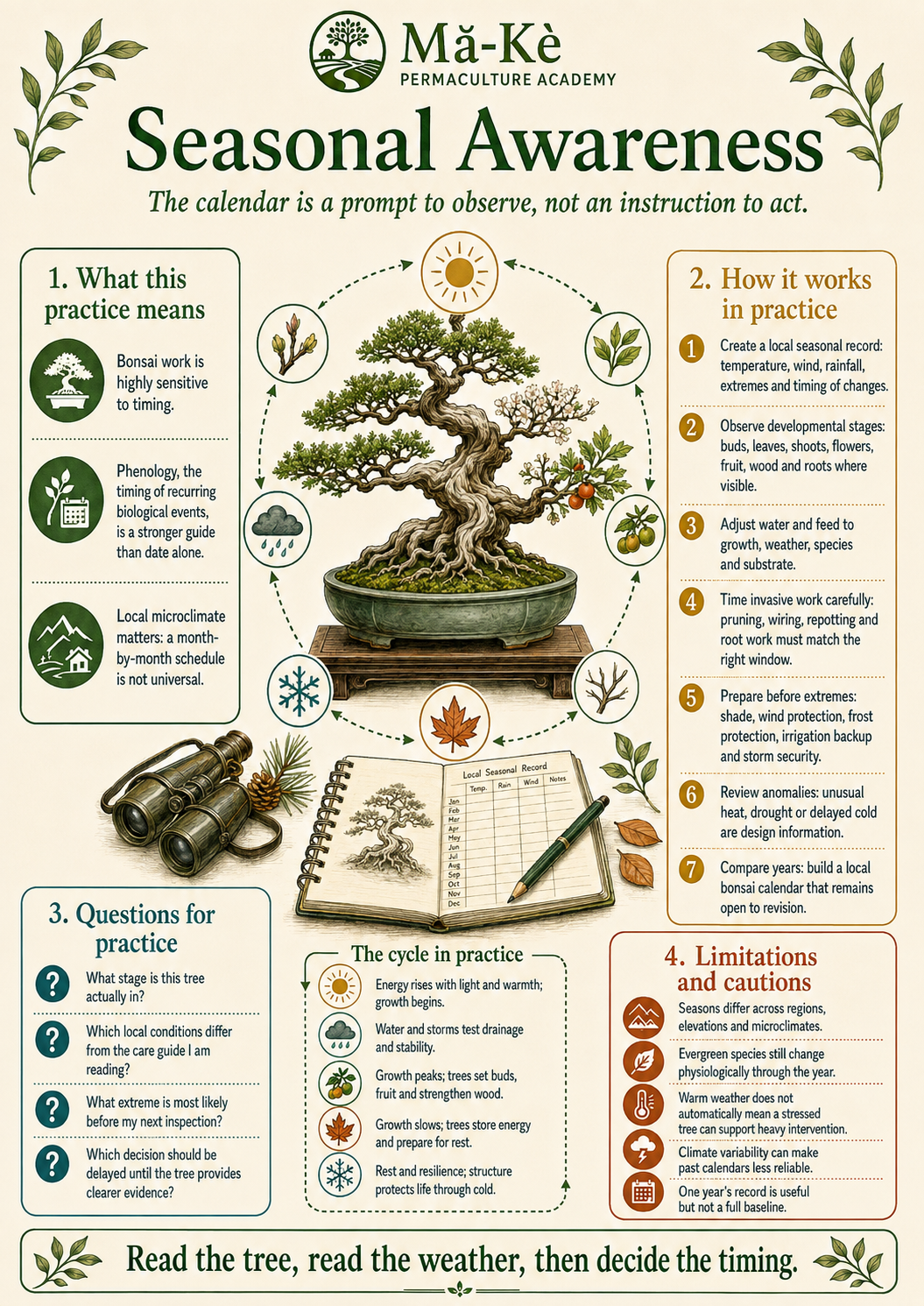
The calendar is a prompt to observe, not an instruction to act. Seasonal Awareness follows the tree's actual stage of growth and the local microclimate, recognising that spring, dormancy and heat stress do not arrive on the same date for every species or place.
Why this matters
Bonsai work is highly sensitive to timing. Water demand, root activity, shoot extension, hardening, dormancy, frost exposure and pest pressure change through the year. A task that is appropriate in one developmental window may be ineffective or damaging in another.
Phenology - the timing of recurring biological events - offers a stronger basis than date alone. Bud swelling, leaf emergence, extension growth, leaf fall and dormancy are observable signals. These should be read alongside weather forecasts, recent conditions and species-specific guidance.
The practice
- Create a local seasonal record. Track temperature, wind, rainfall, extreme events and the timing of changes in key trees.
- Observe developmental stages. Record bud, leaf, shoot, flower, fruit, wood and root indicators where visible.
- Adjust water and feed. Match inputs to growth, weather, species and substrate rather than repeating a year-round schedule.
- Time invasive work carefully. Verify the suitable window for pruning, wiring, repotting and root work for the species and its current health.
- Prepare before extremes. Plan shade, wind protection, frost protection, irrigation backup and storm security in advance.
- Review anomalies. Treat unusual heat, delayed cold, drought or unseasonal growth as design information, not merely inconvenience.
- Compare years. A useful bonsai calendar is built from repeated local observations and remains open to revision.
From Mark's Diploma
The appendix states that bonsai have different needs through the year and that practitioners should adjust care accordingly. Design 01 joins species selection and seasonal awareness, and links adaptation to observing change and protecting tree health.
A northern-European month-by-month schedule is not universal. Mark's move to Portugal itself demonstrates why location, exposure and actual phenology matter.
Limitations and cautions
- Seasons are not identical across regions, elevations or microclimates.
- Evergreen species still change physiologically through the year.
- Warm weather does not always mean that a stressed or recently worked tree can support heavy intervention.
- Climate variability may make past calendars less reliable.
- A single year's record is useful, but not a complete baseline.
Questions for practice
- What stage is this tree actually in?
- Which local conditions differ from the care guide I am reading?
- What extreme is most likely before my next inspection?
- Which decision should be delayed until the tree provides clearer evidence?
Connections
Read with Embracing Nature's Cycle and Environment, Choosing Suitable Tree Species, Balanced Watering and Efficient Water Use, Mindful Pruning and Training and Respond Creatively to Change.
Diploma connections
- MKE-APP, PDF p. 2, practice 17.
- MKE-D01, printed pp. 17-19, PDF pp. 21-23.
- MKE-D01, printed pp. 32-33, PDF pp. 36-37.
References and further reading
- D'Cruz, Mark. The Mă-Kè Bonsai Way Appendix and Design 01.
- Warren, Peter. Step-by-Step Bonsai. Dorling Kindersley, 2014.
- Royal Horticultural Society. Species-specific profiles and container-tree guidance.
- Schwartz, Mark D., ed. Phenology: An Integrative Environmental Science. Use for the general concept of phenology, not as bonsai-specific guidance.