Ecological care · Practice 3 of 18
Balanced Watering and Efficient Water Use
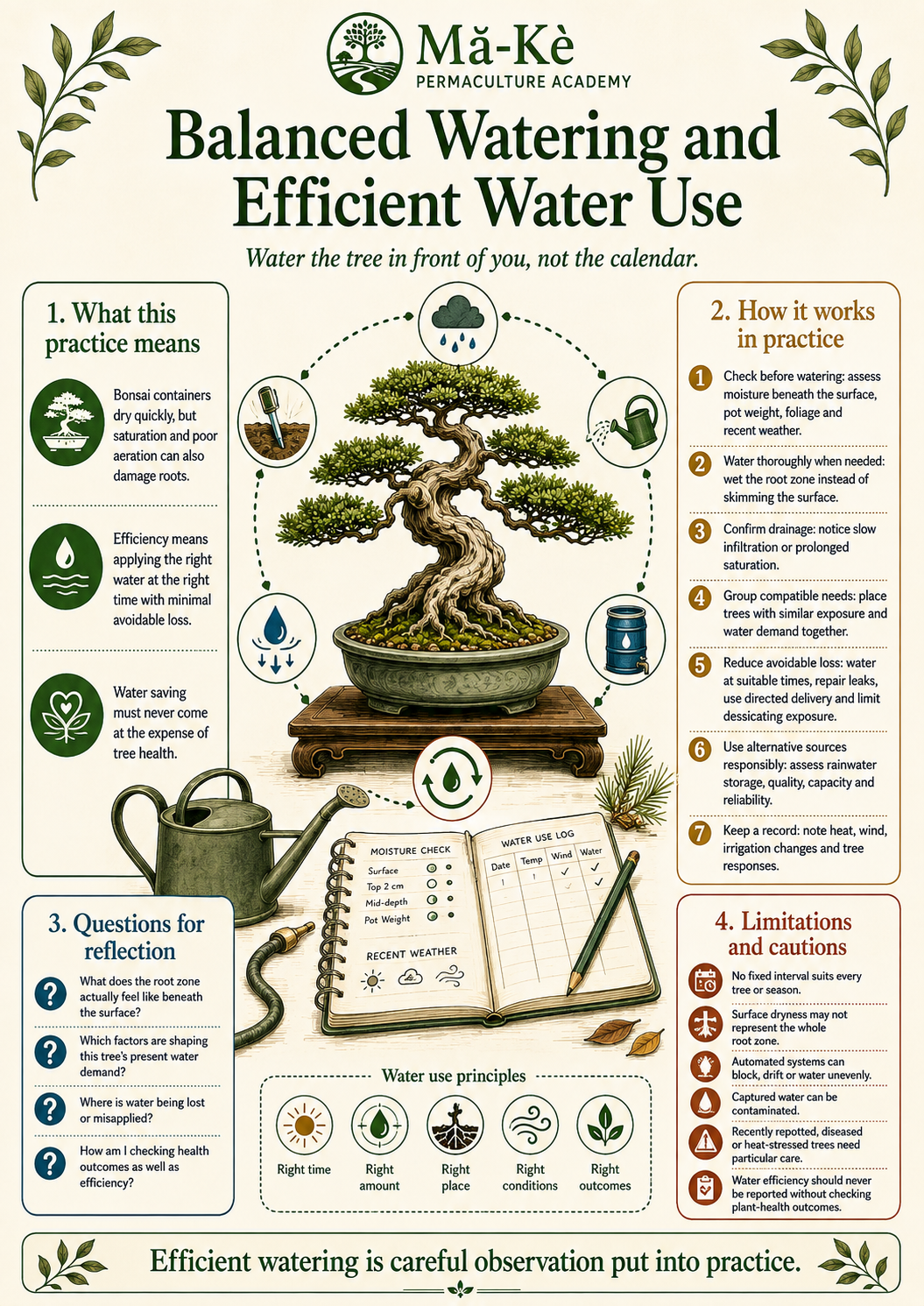
Water the tree in front of you, not the calendar. This Mă-Kè practice combines attentive moisture assessment with responsible water capture and delivery, while keeping tree health ahead of simplistic targets to use less water.
Why this matters
Bonsai containers have little reserve compared with open ground. They may dry rapidly in heat and wind, yet saturated or poorly aerated substrates can also damage roots. The correct response depends on species, season, substrate, pot, root condition, foliage, recent work and microclimate.
Efficiency therefore means applying appropriate water, at an appropriate time, with minimal avoidable loss. It does not mean chronically under-watering a living tree. Nor does it mean installing irrigation and assuming the system can replace observation.
The practice
- Check before watering. Assess moisture beneath the surface, pot weight, foliage condition and recent weather. Learn how the chosen substrate changes as it dries.
- Water thoroughly when needed. Apply water slowly enough to wet the root zone rather than running across a dry or compacted surface.
- Confirm drainage. Watch how water enters and leaves. Slow infiltration or prolonged saturation may indicate substrate, root or drainage problems.
- Group compatible needs. Place trees with similar exposure and water demand together where this improves reliable care.
- Reduce avoidable loss. Water at suitable times, repair leaks, use directed delivery and protect trees from unnecessary desiccating exposure.
- Use alternative sources responsibly. Rainwater collection can reduce demand, but storage, water quality, capacity and seasonal reliability must be assessed.
- Keep a record. Note heat, wind, irrigation changes and tree responses. Review both health and water use.
From Mark's Diploma
The Mă-Kè appendix describes reading the tree's signals, adjusting the watering schedule and using techniques such as rainwater collection and drip irrigation to reduce waste. Design 01 links balanced water use with Earth Care and resource stewardship.
This is a practice framework. Drip systems, rainwater or grouping are not universal prescriptions. A working design must be tested against local water quality, tree collection, substrate and climate.
Limitations and cautions
- No fixed interval suits every tree or season.
- Surface dryness may not represent the whole root zone.
- Automated systems can block, drift out of calibration or distribute unevenly.
- Captured water can be contaminated by roofs, tanks, animals or stagnant storage.
- Recently repotted, root-pruned, diseased or heat-stressed trees require particular care.
- Water efficiency must never be reported without checking plant-health outcomes.
Questions for practice
- What evidence tells me this tree needs water now?
- Does the substrate accept and drain water evenly?
- Where is water being lost without supporting tree health?
- What is the failure plan if an automated system stops?
Connections
Read with Health of the Tree, Healthy Soil Management, Seasonal Awareness, Creating a Bonsai Ecosystem and the Library's water-design material.
Diploma connections
- MKE-APP, PDF pp. 1-2, practice 3.
- MKE-D01, printed pp. 17-18, PDF pp. 21-22.
- MKE-D01, printed p. 32, PDF p. 36, responsible water management.
- Design 05 provides wider water-system design context, but it is not evidence of a bonsai watering prescription.
References and further reading
- Royal Horticultural Society. 'How to water containers'.
- Royal Horticultural Society. 'Trees: growing in containers'.
- D'Cruz, Mark. The Mă-Kè Bonsai Way Appendix and Design 01.
- Warren, Peter. Step-by-Step Bonsai. Dorling Kindersley, 2014.