Ecological care · Practice 4 of 18
Healthy Soil Management
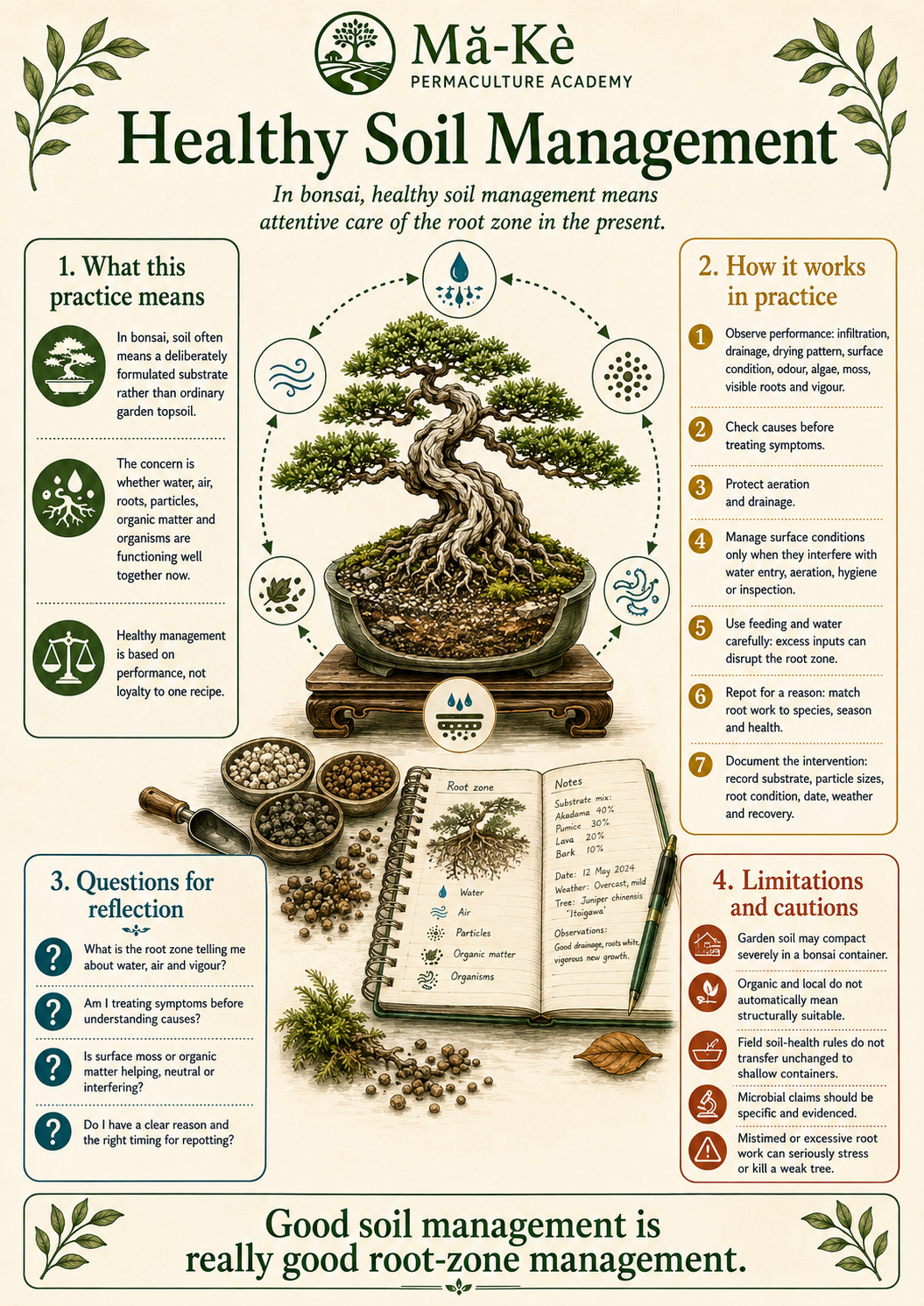
Healthy Soil Management concerns the condition and performance of the root zone now. It asks whether water, air, roots, particles, organic matter and organisms are functioning together well enough to support the tree between repotting interventions.
A necessary definition
In bonsai, 'soil' often means a deliberately formulated substrate rather than ordinary garden topsoil. This page uses root zone when precision is needed. The practice is distinct from Natural and Organic Soil, which examines material selection and formulation, and Regenerative Soil Management, which examines improvement and cycling over time.
Why this matters
Roots require a workable balance of water, oxygen, nutrients, temperature and space. In a small container, particle breakdown, fine-root growth, accumulated salts, blocked drainage or compacted material can change that balance quickly. A visually healthy canopy can also delay recognition of root-zone problems.
Healthy management is therefore based on performance, not on loyalty to one substrate recipe. The right mixture and maintenance regime depend on the species, climate, container, watering practice and development stage.
The practice
- Observe performance. Record infiltration, drainage, drying pattern, surface condition, odour, algae, moss, visible roots and tree vigour.
- Check causes before treating symptoms. Wilting can reflect too little water, damaged roots, excessive heat or saturation. Yellowing can have several causes.
- Protect aeration and drainage. Keep drainage paths functional and avoid creating a permanently saturated lower layer.
- Manage surface conditions. Remove material only when it is interfering with water entry, aeration, hygiene or inspection. Moss is neither universally beneficial nor universally harmful.
- Use feeding and water carefully. Excess inputs can accumulate or disrupt the root zone. Follow product labels and species-appropriate guidance.
- Repot for a reason. Time repotting and root work to species, health and season. Do not disturb roots merely because a fixed anniversary has arrived.
- Document the intervention. Record substrate, particle sizes, root condition, date, weather and subsequent recovery.
From Mark's Diploma
The appendix recommends a mix of organic matter, compost and local materials to support roots, moisture and microbial activity. That proposal records the developing Mă-Kè approach, but it should not be universalised. Some organic materials decompose rapidly, reduce air space or hold excessive moisture in particular climates and containers.
Mark's intention is a living, locally responsive and responsibly managed root zone. Substrate performance must still be tested horticulturally.
Limitations and cautions
- Garden soil may compact severely in a bonsai container.
- 'Organic' and 'local' do not automatically mean structurally suitable.
- General soil-health principles derived from field soils cannot be transferred unchanged to shallow containers.
- Microbial claims should be specific and evidenced. More microbial activity is not always better under every condition.
- Root pruning and repotting can stress or kill a weak tree if mistimed or excessive.
Questions for practice
- How do I know this root zone is functioning well?
- What changed since the last repotting or seasonal review?
- Am I responding to evidence or to a preferred substrate ideology?
- What recovery indicators will I monitor after intervention?
Connections
Read with Natural and Organic Soil, Regenerative Soil Management, Balanced Watering and Efficient Water Use, Organic Fertilisation and Health of the Tree.
Diploma connections
- MKE-APP, PDF p. 2, practice 7.
- MKE-D01, printed pp. 17-19, PDF pp. 21-23.
- MKE-D01, printed p. 32, PDF p. 36, organic soil composition.
References and further reading
- Royal Horticultural Society. 'How to repot a plant'.
- Royal Horticultural Society. 'Growing plants in containers'.
- USDA Natural Resources Conservation Service. 'Soil Health'. Apply field-soil concepts cautiously to containers.
- Warren, Peter. Step-by-Step Bonsai. Dorling Kindersley, 2014.
- D'Cruz, Mark. The Mă-Kè Bonsai Way Appendix and Design 01.