Personal, place and community · Practice 17 of 18
Natural and Organic Soil
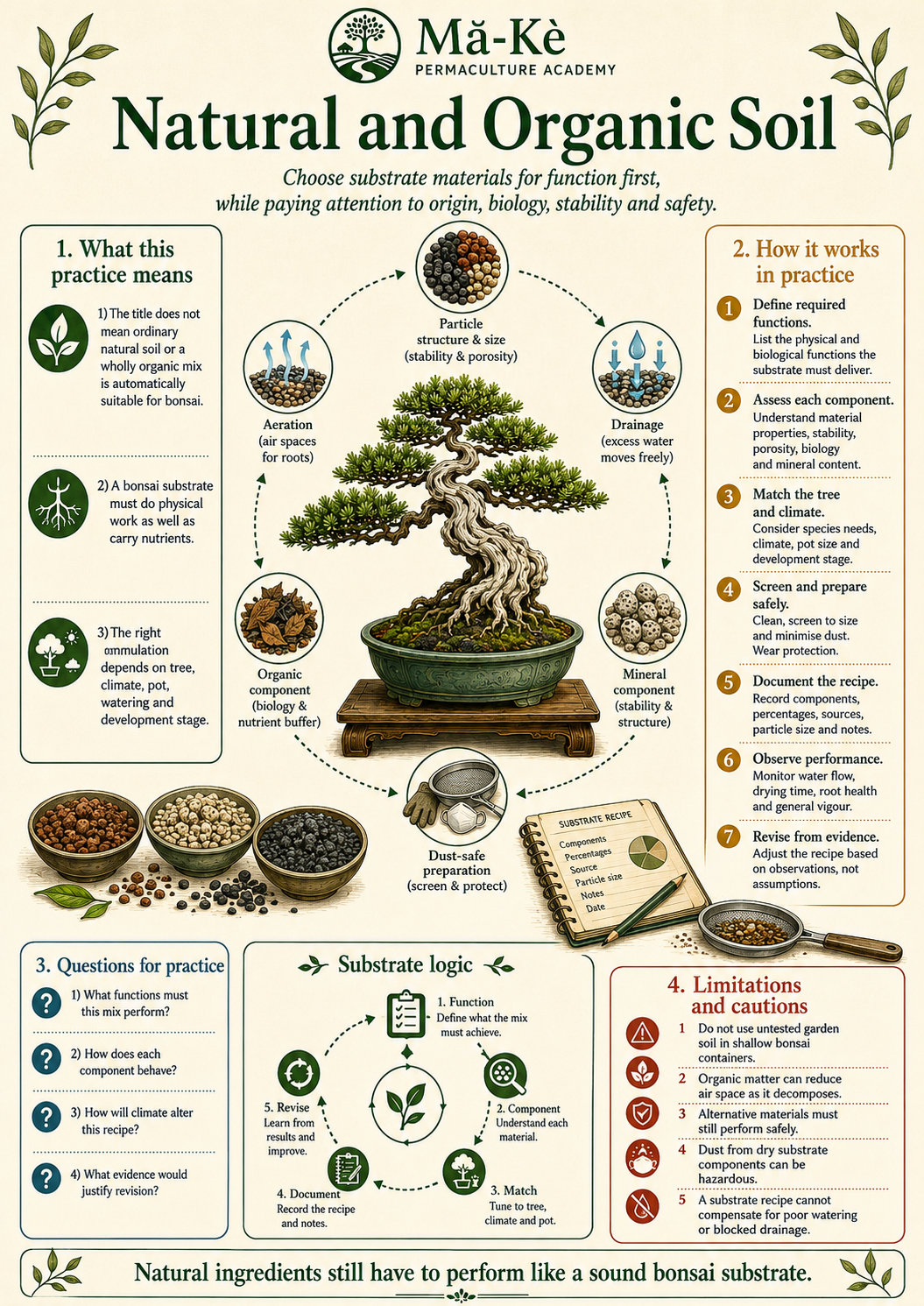
A bonsai substrate must do physical work as well as carry nutrients. Natural and Organic Soil is the Mă-Kè practice of selecting materials with attention to origin and biological potential while preserving the drainage, aeration and stability required by the tree.
A necessary clarification
The title comes from the authored eighteen-practice list. In public explanation, avoid implying that ordinary natural soil or a wholly organic mixture is automatically suitable for bonsai. Many bonsai systems use durable mineral particles alongside organic components. The correct formulation depends on species, climate, pot, watering and development stage.
This page concerns material choice and formulation. Healthy Soil Management concerns the current root zone. Regenerative Soil Management concerns improvement and cycling over time.
The practice
- Define required functions. Establish drainage, aeration, water retention, nutrient behaviour, anchorage and expected service life.
- Assess each component. Record particle size, stability, porosity, water behaviour, pH where relevant, decomposition and provenance.
- Match the tree and climate. A mixture that works in a cool humid setting may behave very differently in hot dry wind.
- Screen and prepare safely. Control dust, contamination and unsuitable fines. Use appropriate respiratory and eye protection.
- Document the recipe. Record components, proportions, particle ranges, tree, pot and date.
- Observe performance. Track watering, drainage, growth, surface change and root condition at repotting.
- Revise from evidence. Avoid treating a preferred recipe as a universal identity or tradition.
From Mark's Diploma
The appendix describes natural and organic soil as a nutrient-rich environment supporting roots, growth and vitality. Design 01 also recommends organic matter, compost and local materials and later names organic soil composition.
Nutrient richness is only one function. Excessively fine, unstable or water-retentive material can undermine oxygen supply and root health. Local material requires testing for performance and contamination.
Limitations and cautions
- Do not use untested garden soil in shallow bonsai containers.
- Organic matter changes as it decomposes and can reduce air space.
- Some mined or imported mineral materials carry significant impacts; alternatives must still perform safely.
- Dust from dry substrate components can be hazardous.
- A substrate recipe cannot compensate for unsuitable watering or a blocked container.
Questions for practice
- Which functions must this substrate provide for this tree here?
- How stable are the components through the intended repotting interval?
- What evidence supports the chosen proportions?
- What did drainage and root condition show at the next review?
Connections
Read with Healthy Soil Management, Regenerative Soil Management, Organic Fertilisation, Balanced Watering and Efficient Water Use and Regenerative Sourcing.
Diploma connections
- MKE-APP, PDF p. 2, practice 16.
- MKE-D01, printed pp. 17-19, PDF pp. 21-23.
- MKE-D01, printed p. 32, PDF p. 36.
References and further reading
- Royal Horticultural Society. 'Growing plants in containers' and 'How to repot a plant'.
- D'Cruz, Mark. The Mă-Kè Bonsai Way Appendix and Design 01.
- Warren, Peter. Step-by-Step Bonsai. Dorling Kindersley, 2014.
- Manufacturer technical data and independent horticultural evidence for the actual substrate components used.