Personal, place and community · Practice 18 of 18
Sharing Knowledge
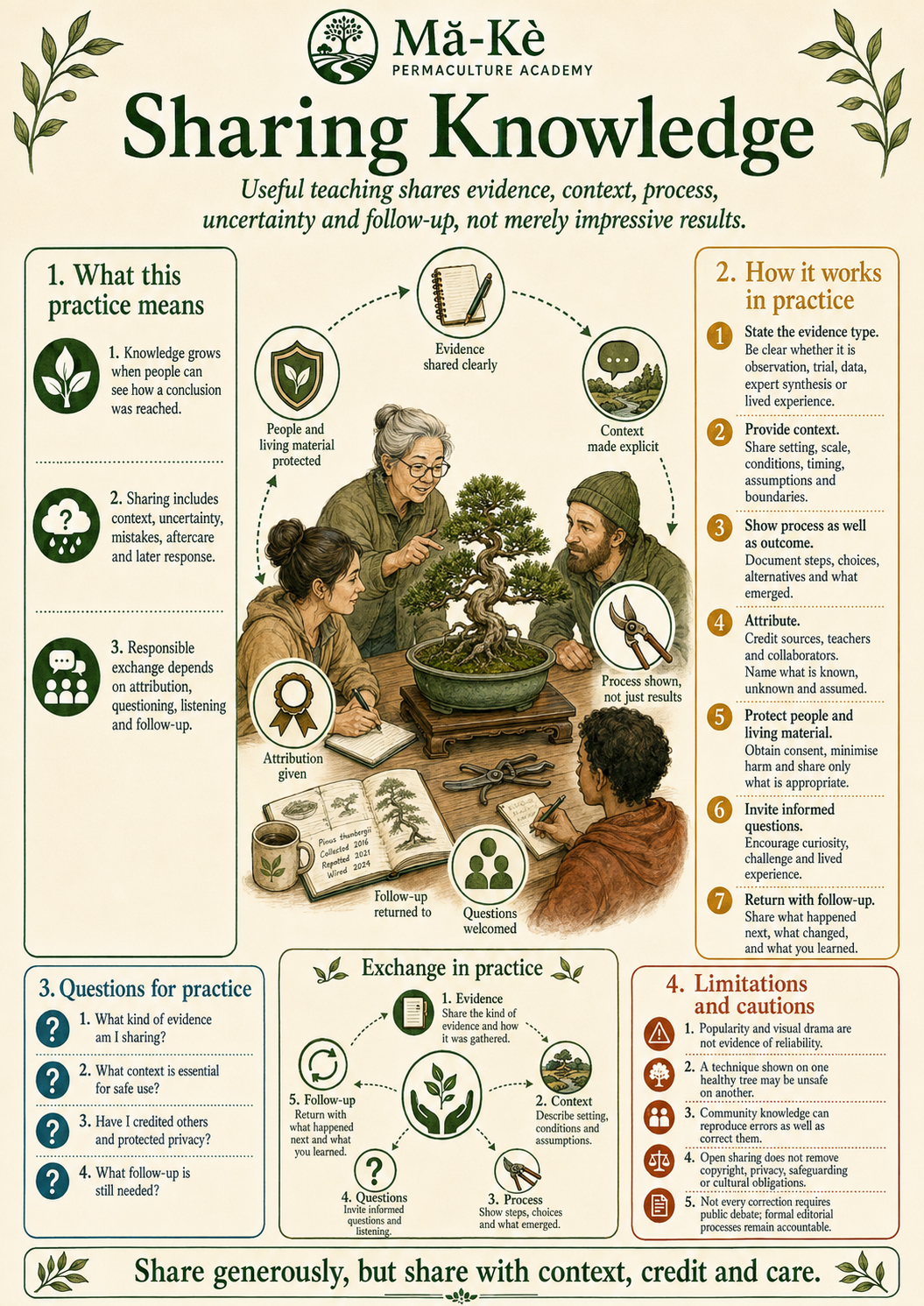
Knowledge grows when people can examine how a conclusion was reached. Sharing Knowledge therefore means more than publishing success: it includes context, uncertainty, mistakes, follow-up and the conditions under which a practice did or did not work.
Defining the boundary
The published tenet Sharing Knowledge and Building Community establishes the wider value: inclusive participation, mutual development and belonging. This practice concerns the acts that make exchange useful and responsible: documenting, demonstrating, attributing, listening, questioning and following up.
The practice
- State the evidence type. Distinguish established horticultural guidance, documented case evidence, personal observation, interpretation and experiment.
- Provide context. Include species, location, climate, season, substrate, tree health, intervention and timescale.
- Show process as well as outcome. Explain preparation, aftercare, failures and later response.
- Attribute. Credit teachers, authors, traditions, images and collaborators accurately.
- Protect people and living material. Obtain consent, avoid exposing private information and do not encourage unsafe imitation.
- Invite informed questions. Treat correction as part of learning rather than a threat to authority.
- Return with follow-up. A dramatic first result is less useful than evidence of recovery and development over time.
From Mark's Diploma
The appendix strongly encourages engagement, mutual learning and exchange of experience. Design 01 connects knowledge sharing to Fair Share and People Care. Design 02 provides a direct teaching context through the Growing Bonsai Sustainably workshop.
Any Diploma example must use an exact locator, distinguish plan from delivered activity, and avoid converting participant response or Mark's reflection into proof of universal effectiveness.
Limitations and cautions
- Popularity, confidence and visual drama are not evidence of reliability.
- A technique shown on a healthy mature tree may be unsafe on another species or weak tree.
- Community knowledge can reproduce errors as well as correct them.
- Open sharing does not remove copyright, privacy, safeguarding or cultural obligations.
- Not every correction requires public debate; the Library's formal editorial process remains private and accountable.
Questions for practice
- What kind of evidence am I sharing?
- Have I included enough context for a reader to judge transferability?
- Who or what should be credited or protected?
- What later outcome will I report?
Connections
Read with Sharing Knowledge and Building Community, Continuous Learning and Experimentation, Mindful Cultivation, Action Learning Pathway and the Mă-Kè workshop material.
Diploma connections
- MKE-APP, PDF p. 2, practice 18.
- MKE-D01, printed pp. 17-19 and 32-33, PDF pp. 21-23 and 36-37.
- MKE-D02, printed pp. 11-12 and 14-18, PDF pp. 16-17 and 19-23, workshop plan, community learning, feedback and future direction.
References and further reading
- D'Cruz, Mark. The Mă-Kè Bonsai Way Appendix and Design 01.
- D'Cruz, Mark. Growing Bonsai Sustainably Workshop. Design 02, 2024/2025.
- Wenger, Etienne. Communities of Practice: Learning, Meaning, and Identity. 1998.
- Schön, Donald A. The Reflective Practitioner. 1983.
- Kolb, David A. Experiential Learning. 1984.