Regenerative craft · Practice 8 of 18
Organic Fertilisation
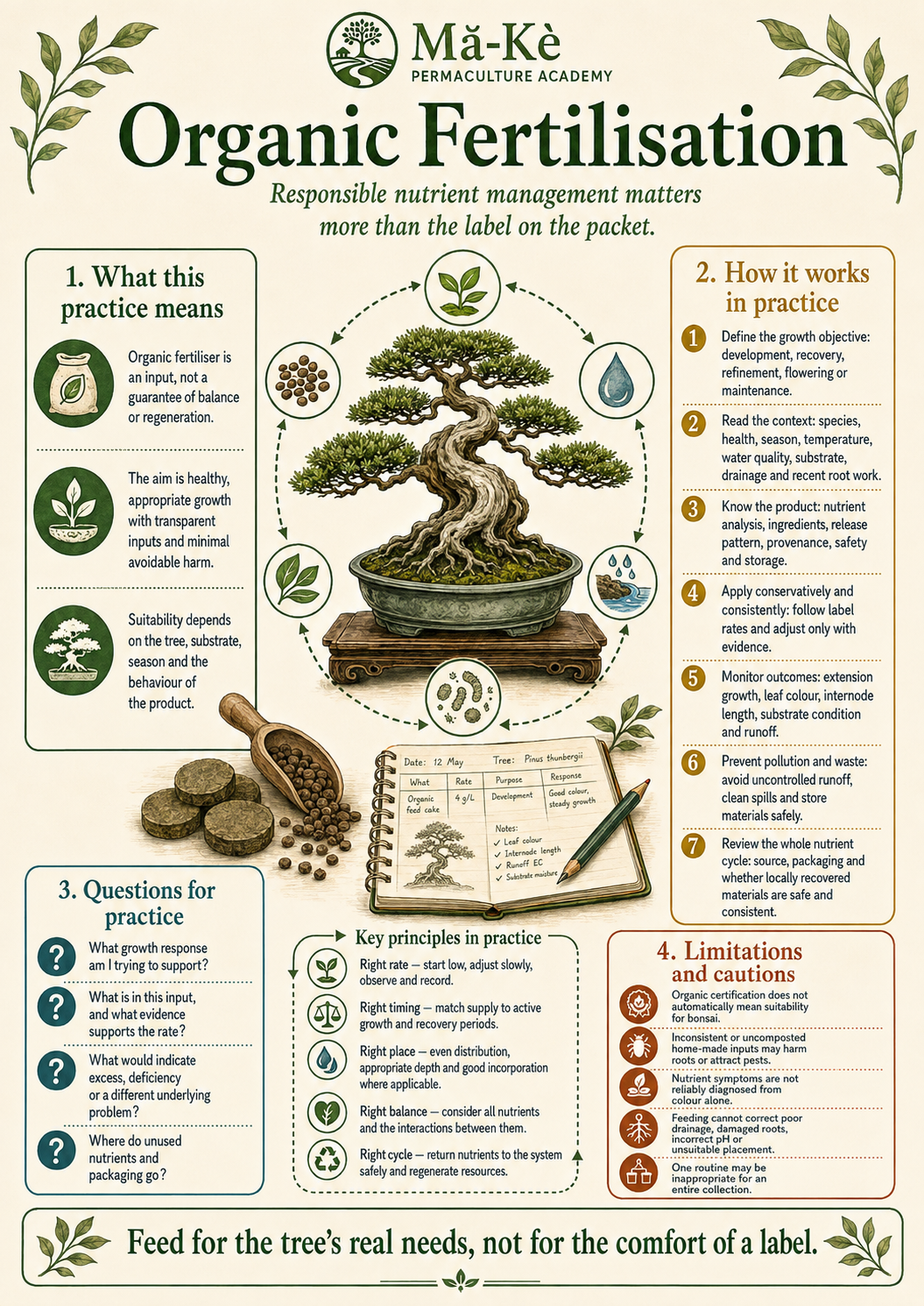
Organic fertiliser is an input, not a guarantee of balance or regeneration. This practice connects the source and use of nutrients to the needs of the tree, the behaviour of the substrate and the wider consequences of production, application and runoff.
Why this matters
Container-grown trees depend on a limited root volume. Nutrients are removed through growth, pruning and leaching, while repeated feeding can also create excesses, salt accumulation or unwanted growth. Product labels such as organic, natural or plant-based do not tell the practitioner whether an input is suitable for a particular tree or system.
The Mă-Kè preference for organic fertilisation is therefore best expressed as responsible nutrient management. The aim is healthy, appropriate growth with transparent inputs and minimal avoidable harm.
The practice
- Define the growth objective. Development, recovery, refinement, flowering and maintenance may require different feeding strategies.
- Read the context. Consider species, health, season, temperature, water quality, substrate, drainage and recent root work.
- Know the product. Record nutrient analysis, ingredients, release pattern, provenance, safety instructions and storage requirements.
- Apply conservatively and consistently. Follow label rates and adjust only with evidence. Feed moist root zones unless species-specific guidance states otherwise.
- Monitor outcomes. Observe extension growth, leaf colour, internode length, substrate condition and runoff.
- Prevent pollution and waste. Avoid application before uncontrolled runoff, clean spills and store materials safely.
- Review the whole nutrient cycle. Ask where inputs originate, how packaging is handled and whether locally recovered materials are safe and consistent enough for use.
From Mark's Diploma
The appendix recommends organic fertilisers as a balanced nutrient source intended to avoid chemical imbalance. Design 01 combines organic fertilisation with soil management, renewable resources and producing no waste.
Organic fertilisers can still be unbalanced, over-applied, contaminated or environmentally costly. Chemical compounds occur in all materials; the meaningful questions concern composition, dose, behaviour, provenance and effect.
Limitations and cautions
- Do not equate organic certification with suitability for bonsai.
- Uncomposted or inconsistent home-made inputs may harm roots or attract pests.
- Nutrient symptoms are not reliably diagnosed from colour alone.
- Feeding cannot correct poor drainage, damaged roots, incorrect pH or unsuitable placement.
- Species and development stages differ; a single routine for an entire collection may be inappropriate.
Questions for practice
- What growth response am I trying to support?
- What is in this input, and what evidence supports the rate?
- What would indicate excess, deficiency or a different underlying problem?
- Where do unused nutrients and packaging go?
Connections
Read with Healthy Soil Management, Regenerative Soil Management, Natural and Organic Soil, Regenerative Sourcing and Health of the Tree.
Diploma connections
- MKE-APP, PDF p. 2, practice 5.
- MKE-D01, printed pp. 17-19, PDF pp. 21-23.
- MKE-D01, printed p. 32, PDF p. 36.
References and further reading
- Royal Horticultural Society. 'Container maintenance'.
- Royal Horticultural Society. Species-specific feeding guidance.
- D'Cruz, Mark. The Mă-Kè Bonsai Way Appendix and Design 01.
- Warren, Peter. Step-by-Step Bonsai. Dorling Kindersley, 2014.