Regenerative craft · Practice 9 of 18
Eco-friendly Practices
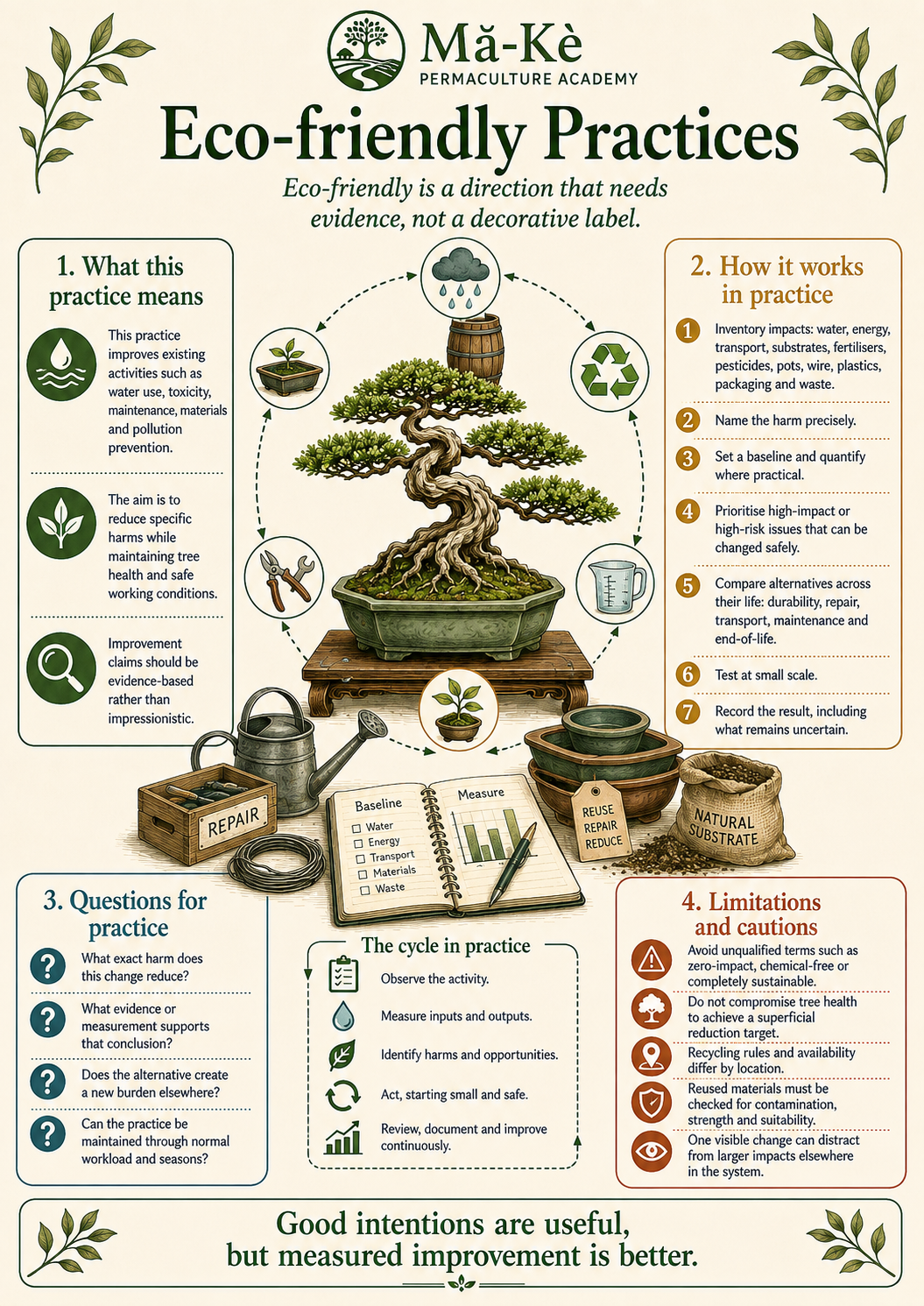
Eco-friendly is a direction that requires evidence, not a decorative label. This Mă-Kè practice examines ordinary nursery operations and chooses feasible alternatives that reduce specific harms while maintaining tree health and safe working conditions.
Defining the boundary
This page concerns improvement within existing activities: using water more carefully, avoiding unnecessary toxicity, maintaining tools, reducing disposable materials and preventing pollution. Regenerative Practices asks the larger question of whether the whole system can improve ecological capacity and close useful cycles over time.
The practice
- Inventory impacts. Review water, energy, transport, substrates, fertilisers, pesticides, pots, wire, plastics, packaging and waste.
- Name the harm precisely. Examples include unnecessary water loss, peat extraction, toxic exposure, contaminated runoff, short product life or non-recyclable waste.
- Set a baseline. Quantify where practical. Without a baseline, an improvement claim may be only an impression.
- Prioritise. Address high-impact or high-risk issues that can be changed safely.
- Compare alternatives across their life. Consider durability, repair, transport, maintenance and end-of-life, not only the purchase label.
- Test at small scale. Confirm that a substitution performs adequately and does not shift harm elsewhere.
- Record the result. Document what changed, what was measured and what remains uncertain.
From Mark's Diploma
The appendix associates eco-friendly practice with local materials, rainwater and natural pest control. Design 01 expands this towards recycling, repurposing, organic waste management and local biodiversity.
These are valid design prompts, not automatic conclusions. Rainwater infrastructure has material and maintenance costs. A local product may be durable and repairable, or it may have poor provenance. A reusable item is beneficial only if it is actually reused enough and handled safely.
Limitations and cautions
- Avoid unqualified terms such as zero-impact, chemical-free or completely sustainable.
- Do not compromise tree health to achieve a superficial reduction target.
- Recycling availability and rules differ by location.
- Reused materials must be checked for contamination, strength and suitability.
- One visible change can distract from larger impacts elsewhere in the system.
Questions for practice
- What exact harm does this change reduce?
- What evidence or measurement supports that conclusion?
- Does the alternative create a new burden elsewhere?
- Can the practice be maintained through normal workload and seasons?
Connections
Read with Regenerative Practices, Regenerative Sourcing, Balanced Watering and Efficient Water Use, Natural Pest Control and Input-Output Analysis.
Diploma connections
- MKE-APP, PDF p. 2, practice 6.
- MKE-D01, printed pp. 17-19, PDF pp. 21-23.
- MKE-D01, printed pp. 17-19, PDF pp. 21-23, eco-friendly and regenerative practice synthesis.
References and further reading
- D'Cruz, Mark. The Mă-Kè Bonsai Way Appendix and Design 01.
- ISO 14040 and ISO 14044. Life-cycle assessment principles and requirements. Use conceptually; do not describe an informal comparison as a certified LCA.
- Royal Horticultural Society. Container watering and maintenance guidance.
- Food and Agriculture Organization of the United Nations. Integrated pest management guidance.