Regenerative craft · Practice 10 of 18
Regenerative Practices
Reducing damage matters, but regeneration asks a harder question: does the practice improve the capacity of the living and social system to function well in the future? In the Mă-Kè Bonsai Way, the answer must be demonstrated through relationships, feedback and time rather than asserted from intention.
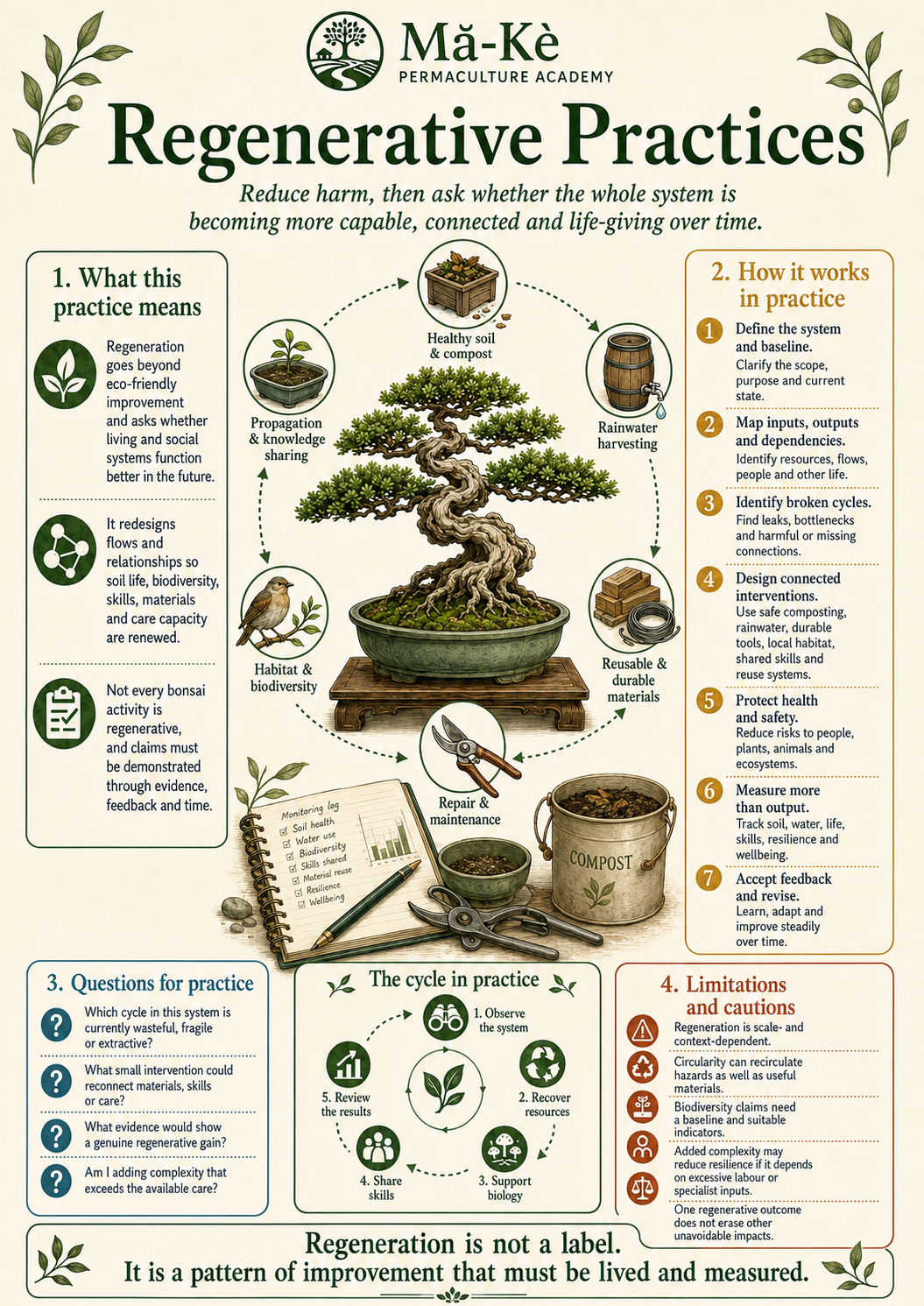
Defining the boundary
Eco-friendly improvement can reduce a known harm. Regenerative practice attempts to redesign flows and relationships so that soil life, biodiversity, skills, materials and care capacity are renewed. Not every bonsai activity can be regenerative, and the term should not become a claim that a small nursery repairs every impact in its supply chain.
The practice
- Define the system and baseline. State what area, activities, people and time period are being considered.
- Map inputs, outputs and dependencies. Include water, organic material, energy, tools, knowledge, labour and external ecological effects.
- Identify broken cycles. Look for waste, contamination, extractive inputs, declining soil function, lost knowledge and fragile dependencies.
- Design connected interventions. Examples may include safe composting, rainwater use, durable repairable tools, local habitat, shared propagation skills or reuse systems.
- Protect health and safety. A closed loop is not beneficial if it recirculates pests, pathogens, salts, contaminants or unreasonable labour.
- Measure more than output. Track tree health, material use, water, soil or substrate performance, biodiversity indicators and human capacity.
- Accept feedback. Stop or revise interventions that transfer harm, fail in practice or exceed available care.
From Mark's Diploma
The appendix names recycling organic waste, repurposing materials and contributing to local biodiversity. Design 01 uses regenerative practice as a central direction for the Mă-Kè system and connects it with Earth Care, People Care, Fair Share and produce no waste.
These are intended pathways, not proven outcomes, unless monitoring data is available. A case example must distinguish what Mark implemented, what he observed and what remains to be measured.
Limitations and cautions
- Regeneration is scale- and context-dependent.
- Circularity can recirculate hazards as well as useful materials.
- Biodiversity claims require an identified baseline and suitable indicators.
- Added complexity may make the system less resilient if it depends on excessive labour or specialist inputs.
- A project can deliver one regenerative outcome while retaining other unavoidable impacts.
Questions for practice
- What capacity is intended to improve, for whom and over what period?
- What baseline makes that improvement visible?
- Which cycle is being repaired, and what could contaminate it?
- Is the design still workable when time, water or labour is constrained?
Connections
Read with Eco-friendly Practices, Regenerative Soil Management, Regenerative Sourcing, Creating a Bonsai Ecosystem and Input-Output Analysis.
Diploma connections
- MKE-APP, PDF p. 2, practice 9.
- MKE-D01, printed pp. 18-20, PDF pp. 22-24.
- MKE-D01, printed pp. 21-23 and 27-28, PDF pp. 25-27 and 31-32, implementation plan and designer reflection.
References and further reading
- D'Cruz, Mark. The Mă-Kè Bonsai Way Appendix and Design 01.
- Holmgren, David. Permaculture: Principles and Pathways Beyond Sustainability. 2002.
- USDA Natural Resources Conservation Service. 'Soil Health' and 'Soil Health Management'.
- ISO 14040 and ISO 14044, used only to inform whole-life questioning.