Ecological care · Practice 2 of 18
Creating a Bonsai Ecosystem
A bonsai does not live alone. Its health is affected by neighbouring plants, shade, wind, water, surfaces, insects, microbes, people and routines. This practice designs those relationships deliberately while avoiding the fiction that a nursery is a self-managing natural ecosystem.
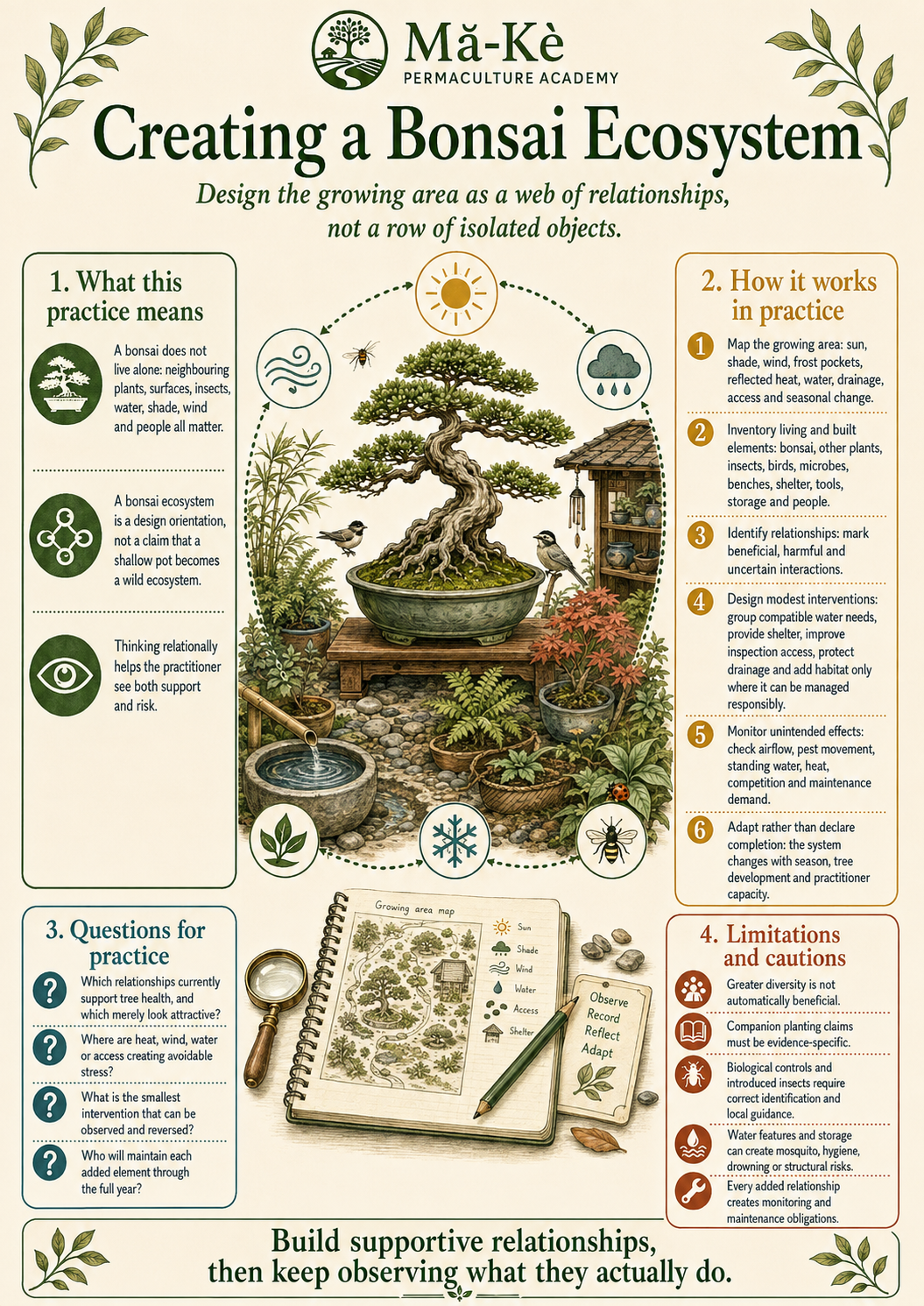
An authored Mă-Kè practice
Creating a Bonsai Ecosystem is Mark D'Cruz's application of ecological and permaculture thinking to the bonsai growing area. The phrase describes a design orientation, not a scientific claim that a shallow pot reproduces all the functions or complexity of a wild ecosystem.
Why this matters
Conventional care advice often treats each tree as a separate object. That is useful for diagnosis, but incomplete for design. The placement of one tree can alter shade and airflow for another. Watering systems affect humidity and runoff. Flowering plants may provide habitat or food for beneficial insects. Benches, walls and paving create temperature differences. Human access determines whether observation and timely care actually happen.
Thinking relationally helps a practitioner see both support and risk. Dense grouping may reduce water loss but also restrict airflow. Companion plants may contribute habitat but can harbour pests. Captured rainwater may reduce demand on mains water but requires safe storage and maintenance.
The practice
- Map the growing area. Record sun, shade, wind, frost pockets, reflected heat, water points, drainage, access and seasonal changes.
- Inventory living and built elements. Include bonsai, other plants, insects, birds, microbes, benches, containers, shelter, tools, storage and people.
- Identify relationships. Mark beneficial, harmful and uncertain interactions. Ask what each element needs and what it contributes.
- Design modest interventions. Group compatible water needs, provide appropriate shelter, improve access for inspection, protect drainage and create habitat only where it can be managed responsibly.
- Monitor unintended effects. Check airflow, pest movement, standing water, heat, competition and maintenance demand.
- Adapt rather than declare completion. The system changes with the season, tree development and practitioner capacity.
From Mark's Diploma
The Mă-Kè appendix defines this practice as designing a miniature ecosystem within the nursery that takes cues from a tree's habitat and encourages supportive relationships. Design 01 links the idea to integration rather than segregation and to Earth Care. The practical achievement is a better-connected growing environment, not ecological equivalence with a native habitat.
Limitations and cautions
- Greater diversity is not automatically beneficial. Species can compete, transmit pests or require incompatible care.
- Claims for companion planting must be evidence-specific. Visual association is not proof of pest control.
- Introducing insects or biological controls requires correct identification and local guidance.
- Water features and storage can create drowning, mosquito, hygiene or structural risks.
- Every added relationship creates monitoring and maintenance obligations.
Questions for practice
- Which relationships currently support tree health, and which merely look attractive?
- Where are heat, wind, water or access creating avoidable stress?
- What is the smallest intervention that can be observed and reversed?
- Who will maintain each added element through the full year?
Connections
Read with Natural Pest Control, Balanced Watering and Efficient Water Use, Working with the Environment, Input-Output Analysis and Needs and Yields Analysis.
Diploma connections
- MKE-APP, PDF p. 1, practice 2.
- MKE-D01, printed pp. 16 and 18, PDF pp. 20 and 22.
- MKE-D01, printed p. 20, PDF p. 24, principle of integration.
References and further reading
- D'Cruz, Mark. The Mă-Kè Bonsai Way: Regenerative Bonsai Development for Everyone. 2025.
- D'Cruz, Mark. The Mă-Kè Bonsai Way: Regenerative Bonsai Culture. 2024/2025.
- Holmgren, David. Permaculture: Principles and Pathways Beyond Sustainability. 2002.
- Food and Agriculture Organization of the United Nations. 'Integrated Pest Management' and 'Principles and practices'.