Ecological care · Practice 1 of 18
Embracing Nature's Cycle and Environment
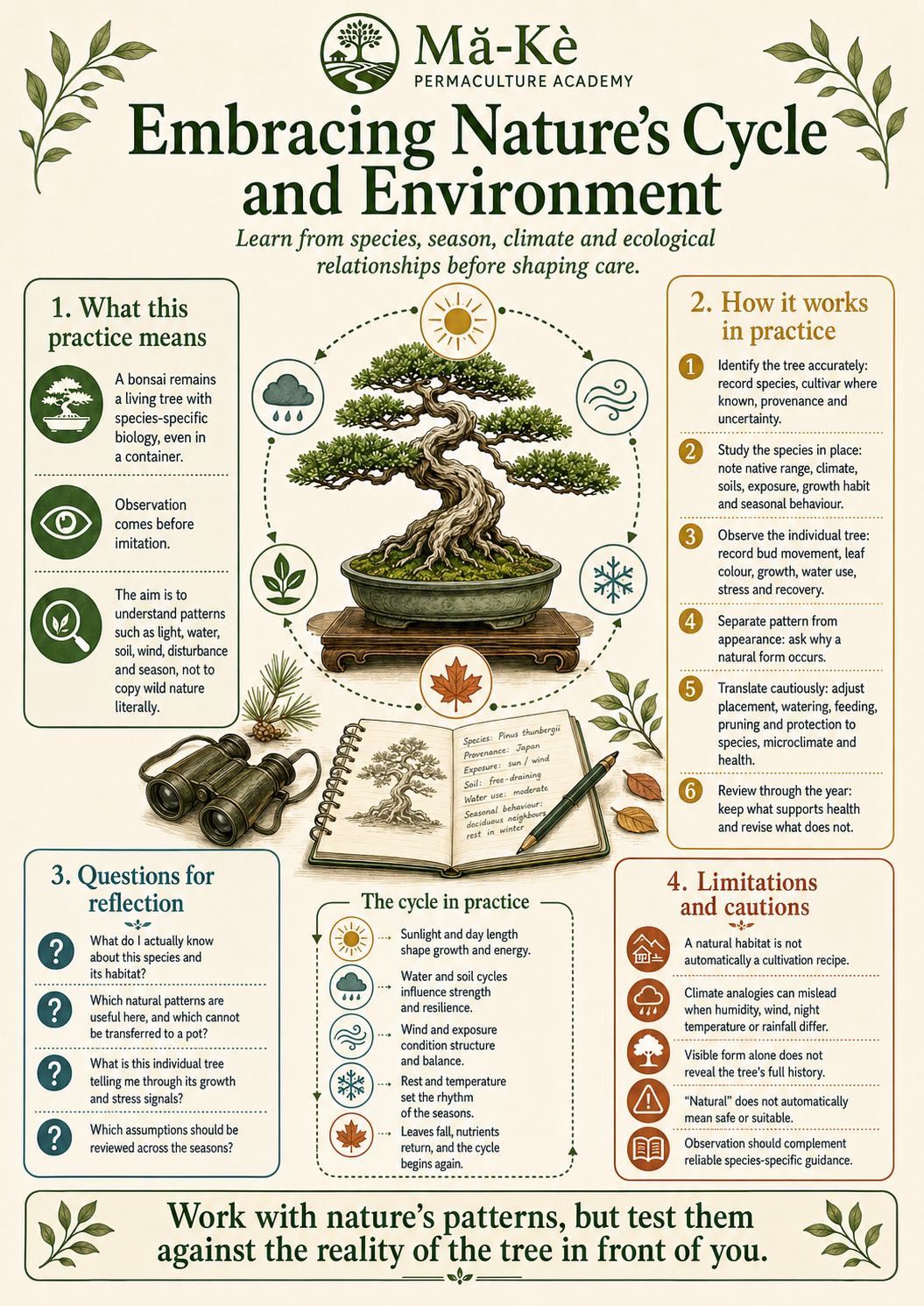
Before shaping or scheduling care, learn how the species lives. This Mă-Kè practice begins with natural form, climate, seasonal rhythm, soil preference and ecological relationships, then asks which of those patterns can responsibly inform life in a bonsai container.
An authored Mă-Kè practice
The Mă-Kè Bonsai Way is Mark D'Cruz's evolving synthesis of bonsai practice, teaching, permaculture ethics, regenerative cultivation and reflective learning. Embracing Nature's Cycle and Environment is part of that authored approach. It is not presented as an ancient Japanese doctrine or a universal rule for every bonsai tradition.
Why this matters
A bonsai is a living tree cultivated under unusually constrained conditions. Its container, reduced root space, exposure and training do not erase its species-specific biology. A juniper, olive, maple and tropical fig do not read the same calendar or respond to the same balance of light, water, temperature and dormancy.
Observation therefore comes before imitation. The aim is not to copy a wild tree literally. It is to understand the forces that produced its form and health: wind, light, competition, water, soil, disturbance and season. Those patterns can then inform care and design without pretending that a pot is a complete natural habitat.
The practice
- Identify the tree accurately. Record species, cultivar where known, provenance and any uncertainty. A care plan built on a mistaken identification can be actively harmful.
- Study the species in place. Examine reputable botanical and horticultural sources alongside direct observation. Note native range, climate, typical soils, exposure, growth habit and seasonal behaviour.
- Observe the individual tree. Record bud movement, leaf colour, extension growth, water use, pest pressure, recovery from work and signs of stress.
- Separate pattern from appearance. Ask why a form occurs in nature. A windswept silhouette is evidence of persistent forces, not permission to impose severe bends on an unsuitable tree.
- Translate cautiously. Adjust placement, watering, feeding, pruning and protection to the species, local microclimate and current health of the individual.
- Review through the year. Compare expectations with actual responses. Keep what supports health, revise what does not and preserve uncertainty where evidence is incomplete.
From Mark's Diploma
The complete eighteen-practice appendix defines this practice through study of natural habitats, seasonal patterns, climate, symbiotic relationships and soil preferences. Design 01 later connects it to observing and interacting, Earth Care and the health of the bonsai. The later twelve-point synthesis again begins by learning from how trees grow in their natural habitats.
This is a documented Mă-Kè synthesis, not a claim that every natural condition can or should be reproduced in a nursery.
Limitations and cautions
- A natural habitat is not automatically a cultivation recipe. Container volume, drainage and root temperature change the system.
- Climate analogies can mislead when humidity, wind, night temperature or seasonal rainfall differ.
- Visible form alone does not reveal the tree's full history.
- The word 'natural' does not guarantee that a technique is safe, low-impact or suitable.
- Direct observation should complement, not replace, reliable species-specific horticultural guidance.
Questions for practice
- Which natural pattern am I responding to, and what evidence supports that reading?
- What has changed because this tree is living in a container?
- Which signals come from the species, and which from this individual tree?
- What would make me revise the current care plan?
Connections
Read with Understanding and Respect for Nature, Seasonal Awareness, Choosing Suitable Tree Species, Working with the Environment and Health of the Tree.
Diploma connections
- MKE-APP, PDF p. 1, practice 1.
- MKE-D01, printed pp. 16 and 18, PDF pp. 20 and 22.
- MKE-D01, printed pp. 31-33, PDF pp. 35-37, later holistic synthesis.
References and further reading
- D'Cruz, Mark. The Mă-Kè Bonsai Way: Regenerative Bonsai Development for Everyone. Design 01 Appendix 01, 2025.
- D'Cruz, Mark. The Mă-Kè Bonsai Way: Regenerative Bonsai Culture. Design 01, 2024/2025.
- Warren, Peter. Step-by-Step Bonsai. Dorling Kindersley, 2014.
- Royal Horticultural Society. Species profiles and guidance for container-grown trees. Use the profile for the actual species under review.