Regenerative craft · Practice 11 of 18
Regenerative Soil Management
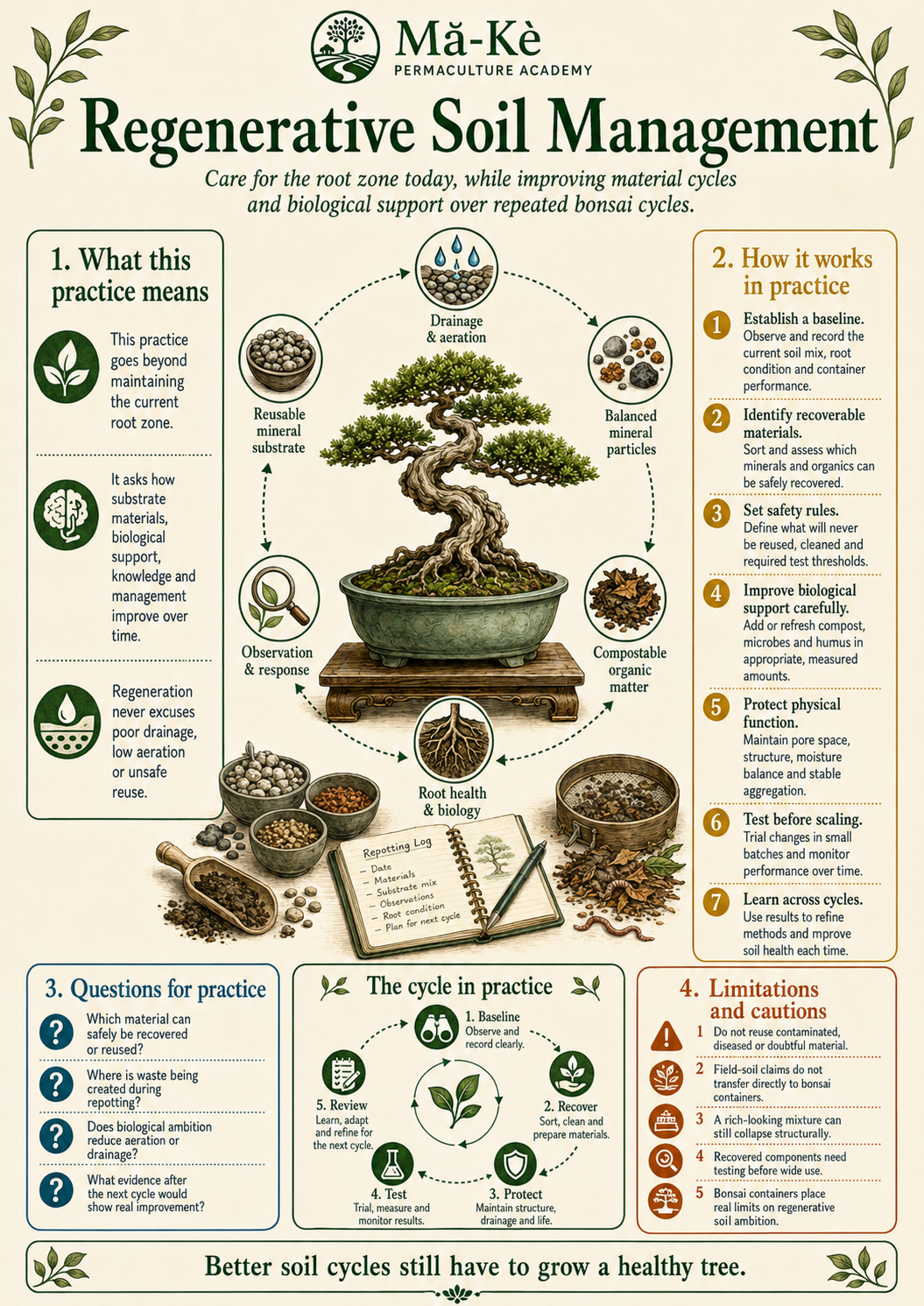
This practice looks beyond maintaining the current root zone. It asks how material cycles, biological function, knowledge and management can be improved over time, while respecting the physical demands of a shallow bonsai container.
Defining the boundary
Healthy Soil Management checks whether the current root zone is functioning. Natural and Organic Soil selects and formulates substrate materials. Regenerative Soil Management evaluates how the wider material and biological system changes across repeated cycles of use, repotting, recovery and reuse.
The practice
- Establish a baseline. Record substrate composition, particle stability, drainage, water retention, root condition, tree response and waste created during repotting.
- Identify recoverable materials. Separate potentially reusable mineral components, compostable organic matter and contaminated or diseased material.
- Set safety rules. Do not circulate material that may carry serious pests, pathogens, salts, herbicides or unknown contaminants.
- Improve biological support carefully. Use mature, suitable organic inputs where the species, climate and substrate design can accommodate them.
- Protect physical function. Aeration and drainage remain essential. A biologically ambitious mixture that collapses rapidly may damage the tree.
- Test before scaling. Trial recovered or reformulated materials on appropriate, non-critical stock with defined monitoring.
- Learn across cycles. Compare root condition, tree health, water use, input demand and discarded material after each repotting cycle.
From Mark's Diploma
The appendix defines this practice as prioritising fertility through organic and regenerative methods to create a thriving soil ecosystem. Design 01 connects fertilisation, composting, renewable resources and producing no waste.
Because general soil-health literature largely concerns field soils, claims about cover crops, tillage or water infiltration do not transfer directly to bonsai containers. The Mă-Kè contribution is the design question: how can root-zone stewardship and material cycles become healthier and less wasteful under bonsai constraints?
Limitations and cautions
- Reused substrate can transmit pests, pathogens or chemical residues.
- Sterilisation or heat treatment changes biological properties and may create other risks.
- Compost quality varies; immature compost can harm roots.
- More organic matter can reduce air-filled porosity as it decomposes.
- Claims of increased soil life or fertility should be measured or carefully qualified.
Questions for practice
- Which root-zone functions should improve, and how will I measure them?
- Which materials can safely circulate, and which must leave the system?
- Does the design preserve drainage and aeration through time?
- What did the roots show at the next repotting?
Connections
Read with Healthy Soil Management, Natural and Organic Soil, Organic Fertilisation, Regenerative Practices and Produce No Waste.
Diploma connections
- MKE-APP, PDF p. 2, practice 11.
- MKE-D01, printed pp. 18-20, PDF pp. 22-24.
- MKE-D01, printed p. 32, PDF p. 36.
References and further reading
- USDA Natural Resources Conservation Service. 'Soil Health' and 'Soil Health Management'. Use with explicit container limitations.
- Royal Horticultural Society. 'How to repot a plant'.
- D'Cruz, Mark. The Mă-Kè Bonsai Way Appendix and Design 01.
- Warren, Peter. Step-by-Step Bonsai. Dorling Kindersley, 2014.