Regenerative craft · Practice 12 of 18
Regenerative Sourcing
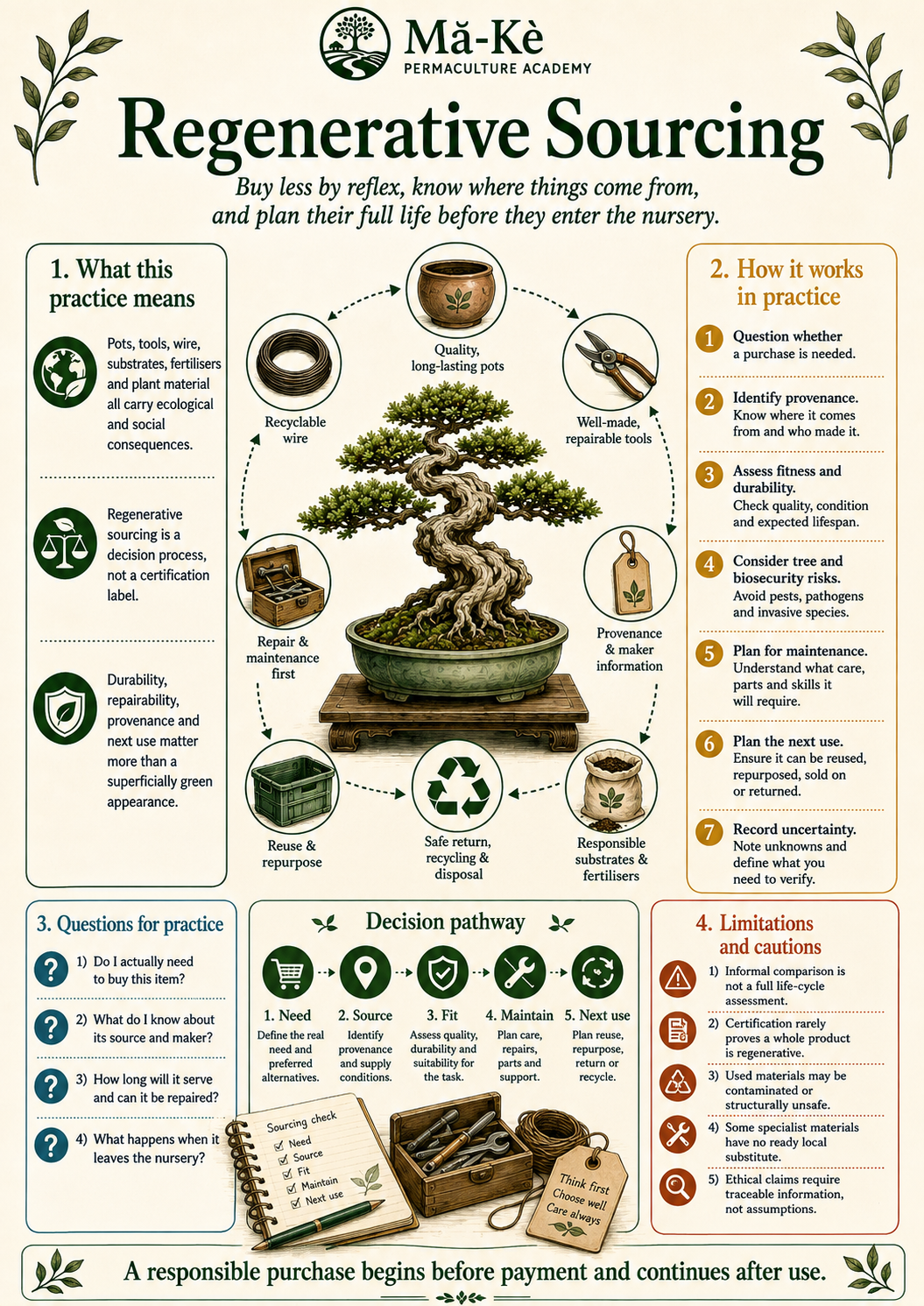
Every bonsai practice depends on materials and supply chains. Regenerative Sourcing asks who and what produced them, how long they will serve, whether they can be repaired or reused, and what happens when they leave the nursery.
Why this matters
Pots, tools, wire, substrates, fertilisers, packaging and plant material carry ecological and social consequences. A low purchase price can conceal short life, difficult repair, extractive production or disposal costs. Equally, a local product is not automatically lower-impact if its materials, process or performance are poor.
The practice is a decision process, not a certification invented by Mă-Kè. The word regenerative should be used as an aspiration supported by transparent criteria and evidence.
The practice
- Question whether a purchase is needed. Maintain, repair, borrow, share or repurpose before replacing where safe and practical.
- Identify provenance. Seek credible information about material, producer, labour, transport and environmental management.
- Assess fitness and durability. A longer-lived, repairable item may outperform a superficially greener disposable alternative.
- Consider tree and biosecurity risks. Plant material and used containers may carry pests or diseases. Follow relevant movement and quarantine rules.
- Plan for maintenance. Sharpening, replacement parts, cleaning and safe storage extend useful life.
- Plan the next use. Define reuse, recycling or safe disposal before purchase where possible.
- Record uncertainty. Do not convert missing supplier information into a positive claim.
From Mark's Diploma
The appendix names pots, tools and wire, together with recycling and repurposing. Design 01 connects sustainable local sourcing with renewable resources and Fair Share.
Proximity must be distinguished from performance. Skilled makers may contribute cultural and craft value, but that does not support general assertions about the total impact of handmade or imported goods.
Limitations and cautions
- A complete life-cycle assessment is usually beyond an individual purchase; an informal comparison must be labelled as such.
- Certification can provide evidence about a defined issue, but rarely proves that a whole product is regenerative.
- Used materials may be contaminated or structurally unsafe.
- Some specialist materials have no readily available local substitute.
- Ethical sourcing claims require traceable information, not assumptions about a country or producer.
Questions for practice
- Do I need this item, and could an existing one be repaired or shared?
- What evidence do I have about origin and production?
- How long should it last, and can it be maintained?
- What will happen at the end of its useful life?
Connections
Read with Eco-friendly Practices, Regenerative Practices, Natural and Organic Soil, Sharing Knowledge and Produce No Waste.
Diploma connections
- MKE-APP, PDF p. 2, practice 12.
- MKE-D01, printed pp. 17-20, PDF pp. 21-24.
- MKE-D01, printed p. 32, PDF p. 36, sustainable sourcing of materials.
References and further reading
- D'Cruz, Mark. The Mă-Kè Bonsai Way Appendix and Design 01.
- ISO 14040 and ISO 14044. Life-cycle assessment principles and requirements.
- Relevant official certification or due-diligence sources for the actual material under review; do not generalise one scheme across all products.
- Local plant-health and biosecurity authority guidance for moving trees and used growing materials.