Mollison and Slay ecological principle · 10 of 10
Edge
Examine boundaries and transition zones for exchange and productivity without assuming that more edge is always better.
Definition and orientation
Edge focuses on the distinctive conditions and exchanges where systems meet: woodland and meadow, water and land, public and private space, or different management regimes. Some edges concentrate resources and niches; others expose organisms to disturbance, predators, pollution or maintenance pressure. The principle guides investigation, not automatic edge multiplication.
Practical meaning: Map the type, width, shape, condition and ownership of an edge. Observe flows in both directions, core habitat needs and seasonal change. Strengthen beneficial exchange where evidence supports it, while preserving refuge, access rights and buffers where exposure creates harm.
Questions it can guide:
- What systems meet here and what crosses the boundary?
- Which benefits and exposures does the edge create?
- Would changing its length, width or management improve the whole system?
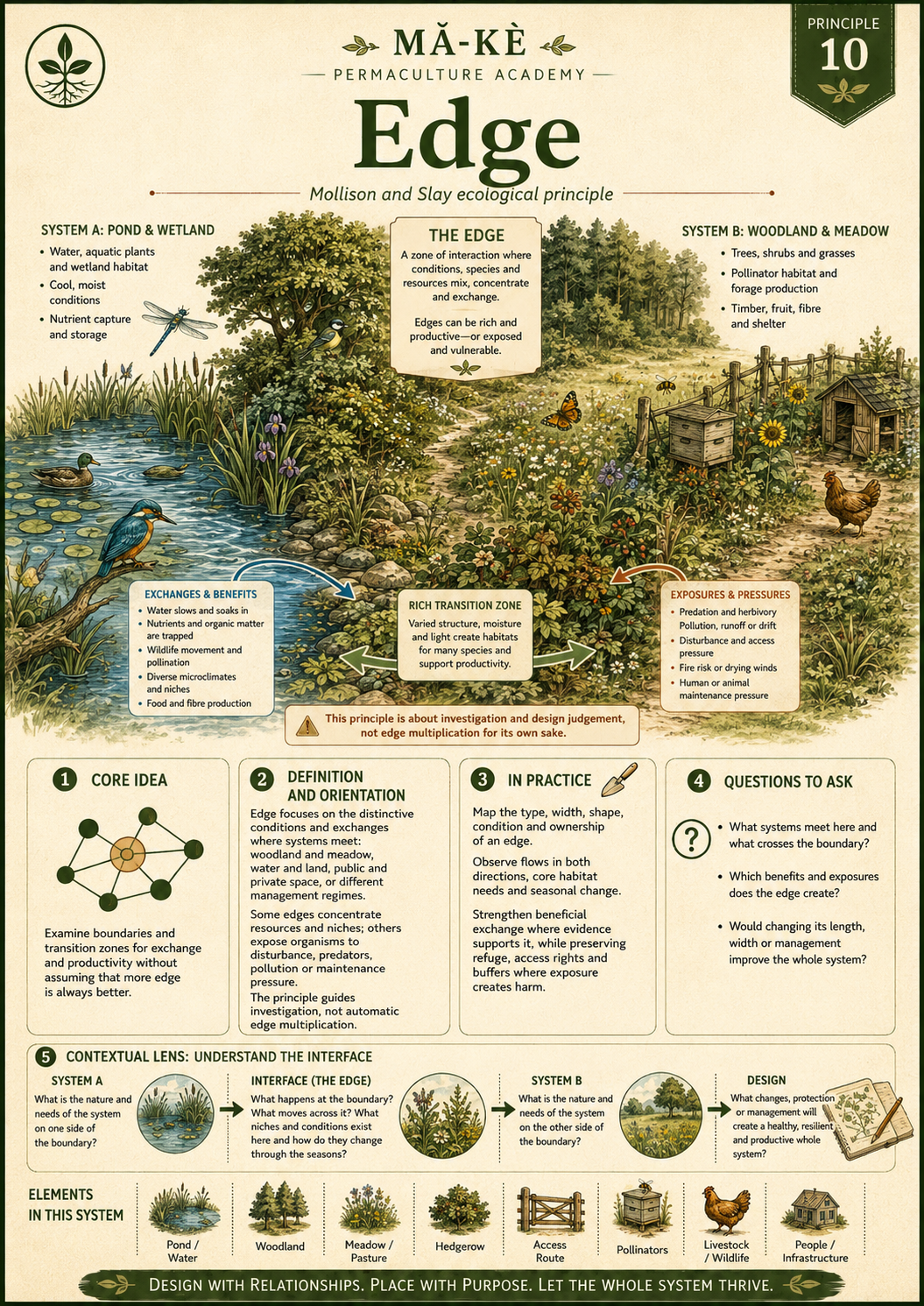
The detailed article and accessible semantic visual below provide the complete HTML text equivalent of the infographic, including its guidance, cautions, connections and evidence boundaries.
Edge: a contextual design lens
- System ADescribe core needs and outgoing flows.
- InterfaceObserve exchange, niches and disturbance.
- System BDescribe different conditions and dependencies.
- DesignSupport benefit while protecting refuge and rights.
Origins, lineage and attribution
This page belongs to the ecological principle tradition published by Bill Mollison and Reny Mia Slay. The displayed title follows the authorised Academy catalogue; the closing acknowledgement records the nearby source wording where it differs.
Similar themes appear in David Holmgren’s twelve principles, but overlap is handled through explicit cross-links. The formulations are not represented as one list, and authorship is not transferred between traditions. The Academy paraphrases the practical meaning rather than reproducing substantial passages from the source books.
Ethical and principle context
Holmgren’s Use Edges and Value the Marginal adds a later and broader emphasis; transects and site observation make edge conditions visible; diversity helps examine the different functions meeting there.
Use Earth Care, People Care and Fair Share to test purpose, consequence and distribution. A provocative principle can widen judgement, but it cannot certify a preferred action. Pair it with evidence, a counter-question and a named review point.
When and how to use it
- Name the decision, scale, affected people and living systems.
- Translate the principle into context-specific questions rather than repeating it as a command.
- Add a counter-question about safety, consent, urgency, maintenance or unequal effects.
- Use a suitable framework or tool to gather evidence and compare alternatives.
- Choose a proportionate action, state uncertainty and distinguish proposal from completion.
- Record what observation or feedback would trigger adaptation or stopping.
Application in Mark’s Diploma and at Vila Pinheiro
Design 08 gives priority to edges and areas beside existing cork-oak cover, with pioneer, support and productive species allocated to the layered strategy. This verifies deliberate use of existing interfaces in a proposal. It does not demonstrate subsequent edge productivity, habitat occupancy or plant survival.
Evidence boundary: the representative connection was checked in Mark D’Cruz, Design 08: Regenerative Silviculture, controlled Diploma PDF, PDF page 21. The master register records broader use across Designs 1–10, but declaration alone is not converted into a public case result.
Limits, critiques and common misuse
- Assuming every edge is productive or healthy.
- Increasing fragmentation and reducing core habitat.
- Treating neglected land as empty or available without checking rights and existing life.
- Using edge as a metaphor while ignoring ecological measurement.
No principle replaces consent, law, competent technical advice, ecological assessment or accountable maintenance. Where principles pull in different directions, make the tension visible rather than selecting only the phrase that supports an existing preference.
Where this material comes from
This ecological design principle comes from Bill Mollison and Reny Mia Slay’s Introduction to Permaculture (1991), where the source wording is “Edge effects”. It belongs to an early practical teaching set focused on placement, function, energy, living resources, scale, succession, diversity and edge. This page uses the authorised catalogue title “Edge”; although teaching summaries use minor wording variants, these do not make the principle part of David Holmgren’s later twelve-principle formulation. Mark D’Cruz used or recorded this principle in his Diploma register; he is not its originator, and the master register records it as LIB-049. Its lineage and wording have been checked against the named publication tradition and Permaculture Association teaching records. The representative Diploma connection is limited to PDF page 21, with proposals kept distinct from measured outcomes.
Related entries
References and provenance
- Bill Mollison and Reny Mia Slay, Introduction to Permaculture, Tagari, 1991.
- Permaculture Association, “Principles from Introduction to Permaculture by Bill Mollison and Reny Mia Slay”.
- Mark D’Cruz, Design 08: Regenerative Silviculture, controlled Diploma PDF, PDF page 21.
- Mă-Kè Diploma Library Master Register, Page Register LIB-049; source-matrix declarations retained separately from verified page evidence.
- Mă-Kè Permaculture Academy, “Comparing Permaculture Principle Traditions”.