Monitoring and evaluation · Tool 6 of 12
Field Journalling for Permaculture Design
Turn repeated field observations into cumulative design evidence by separating what was seen, what it might mean and what should happen next.
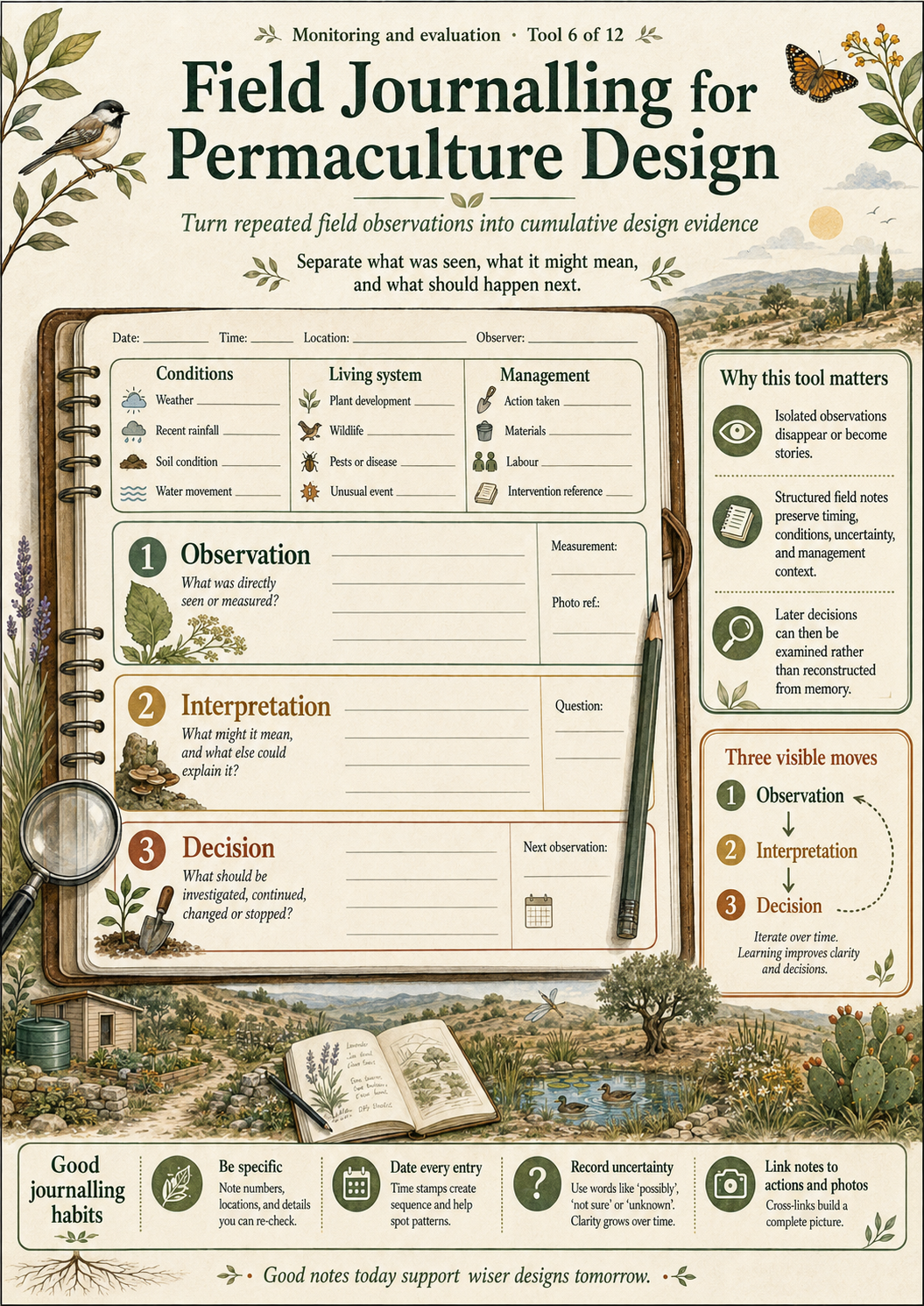
The detailed article and accessible semantic visual below provide the complete HTML text equivalent of the infographic, including its method, cautions and interpretation.
Why this tool matters
Isolated observations disappear or become stories. Structured field notes preserve timing, conditions, uncertainty and management context so later decisions can be examined rather than reconstructed from memory.
What the tool is
Field journalling is a repeatable record of observations, measurements, actions, interpretations and questions. Its central discipline is to keep three moves visible: observation (what was seen or measured), interpretation (what it might mean) and decision (what should be investigated or changed).
Origins and disciplinary context
Field notebooks are established across ecology, agriculture, geography and reflective practice. A permaculture journal can integrate biophysical and management evidence, but it remains useful only when entries are specific enough to compare and revisit.
The tool at a glance
One-page permaculture field journal template with context, observation, measurement, interpretation, decision, question, photo reference and next-observation fields.
Conditions
Weather · recent rainfall · soil condition · water movement
Living system
Plant development · wildlife · pests or disease · unusual event
Management
Action taken · materials · labour · intervention reference
Observation
What was directly seen or measured?
Interpretation
What might it mean, and what else could explain it?
Decision
What should be investigated, continued, changed or stopped?
When to use it
Use during survey, implementation, monitoring, experiments, maintenance and evaluation. Keep the structure stable enough to compare entries while allowing sketches, maps and unexpected observations.
How to use it
- Record context before interpretation.
- Describe direct observations in precise language.
- Add measurements with units and method.
- Record management actions and unusual events.
- Write possible interpretations as hypotheses, not facts.
- State the next question, decision or observation date.
- Review entries periodically for patterns and contradictions.
What to record
Include date and time, weather, rainfall, location, soil condition, water movement, plant development, wildlife, pests or disease, management action, unusual event, photo reference, measurement, question and next observation.
Worked example
Observation: soil under mulch remained visibly damp after adjacent bare soil had dried. Interpretation: mulch may be reducing moisture loss. Decision: compare equivalent areas with a defined moisture measure at the same depth and time. The wording preserves the difference between appearance, explanation and test.
Connection with Mark’s Diploma practice
Design 08 explicitly proposes field journals and shared observation logs for soil, growth and water flow, integrated with photo monitoring, drone flyovers and indicators.
Diploma source locators
- Design 08, PDF page 23: field journals and shared observation logs for soil, growth and water flow.
- Design 08, PDF page 30: field journals, photo monitoring and drone flyovers.
- Design 08, Appendix 03, PDF page 75: field journals for soil, growth and water flows.
Interpreting the results
Review sequences rather than isolated entries. Look for repeated conditions, delayed responses and contradictions. A journal supports memory and reasoning; it does not turn subjective descriptions into measurements.
Limitations
- Records reflect the observer’s attention and skill.
- Inconsistent vocabulary and units reduce comparability.
- Detailed forms can become burdensome and stop being used.
- Private or sensitive information needs appropriate handling.
Common mistakes and misuse
- Mixing observation and explanation in one statement.
- Recording only successes or unusual days.
- Omitting units, location or recent management.
- Collecting notes without scheduling review.
Relationship to other Library tools
Reflection and application questions
- Can another reader distinguish what happened from what you think it means?
- Which fields must remain consistent?
- When will the journal be reviewed for decisions?
References and further reading
- US Forest Service, Photo Point Monitoring Handbook, documentation and repeatability principles.
- Defra, “30by30 on land”, recording and retaining monitoring information for transparency and learning.