Experimentation and adaptive design · Tool 9 of 12
Safe-to-Fail Experiments
Use small, bounded and observable interventions to learn under uncertainty before scaling, with consequences genuinely safe enough to tolerate.
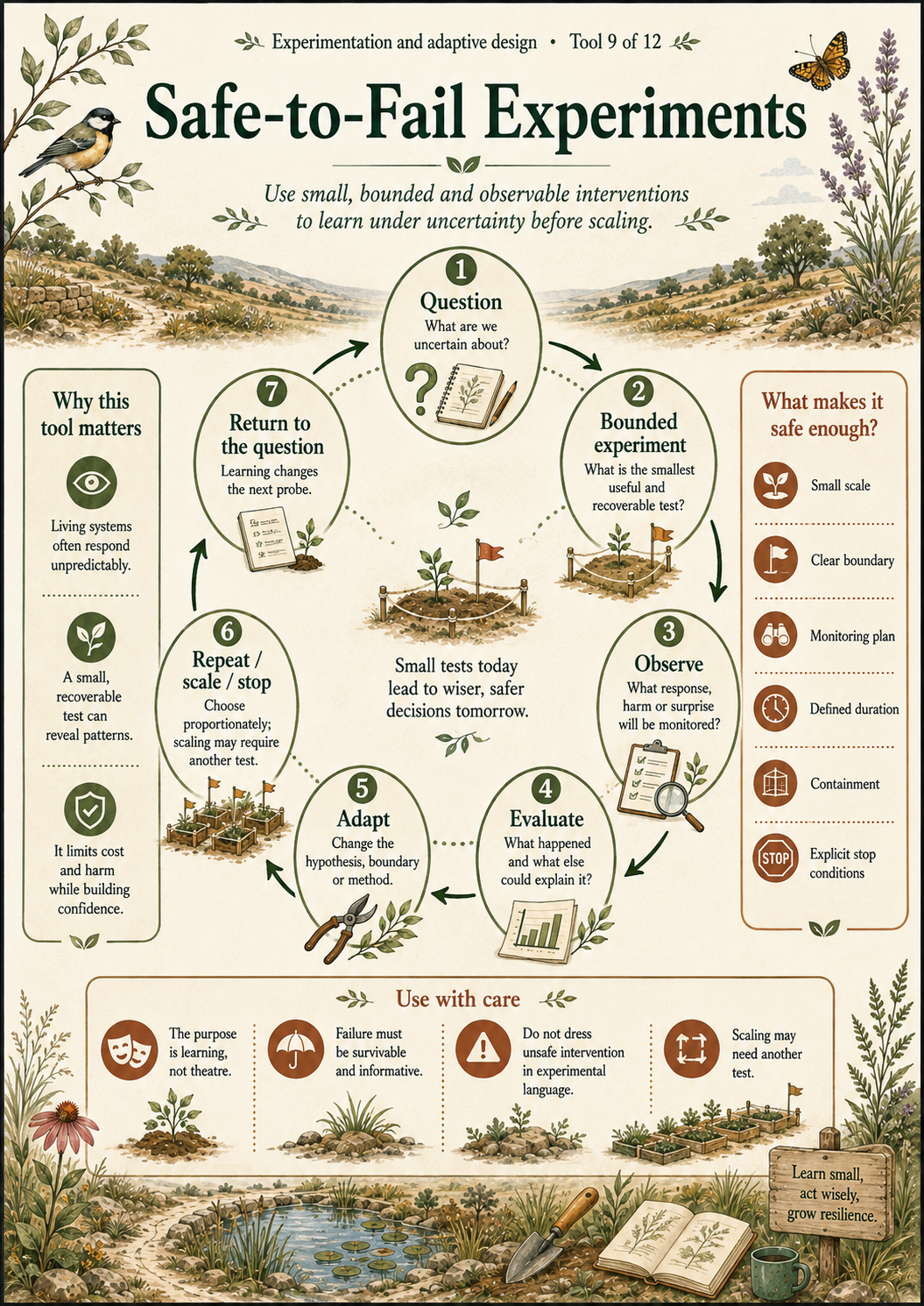
The detailed article and accessible semantic visual below provide the complete HTML text equivalent of the infographic, including its method, cautions and interpretation.
Why this tool matters
Living systems often respond in ways that cannot be predicted confidently. A small recoverable test can reveal patterns while limiting cost and harm. The purpose is learning, not dressing an unsafe intervention in experimental language.
What the tool is
A safe-to-fail experiment is a small, bounded probe with an explicit question, expected response, monitoring plan, duration and containment. Failure must be survivable and informative. The response may be to stop, dampen, modify, repeat or scale cautiously.
Origins and disciplinary context
Safe-to-fail probes are associated with complexity and sense-making practice, including Cynefin. Permaculture’s emphasis on observation, small and slow solutions and feedback makes the approach compatible, but the term is not an original permaculture method.
The tool at a glance
Circular safe-to-fail experiment from question to experiment, observation, evaluation and adaptation, then branching to repeat, scale or stop and returning to the question.
- QuestionWhat are we uncertain about?
- Bounded experimentWhat is the smallest useful and recoverable test?
- ObserveWhat response, harm or surprise will be monitored?
- EvaluateWhat happened and what else could explain it?
- AdaptChange the hypothesis, boundary or method.
- Repeat / scale / stopChoose proportionately; scaling may require another test.
- Return to the questionLearning changes the next probe.
When to use it
Use where uncertainty is material, impacts can be bounded and learning can influence a later choice. Do not use experimental framing for major earthworks, unstable slopes, contaminated water, structural systems, fire safety, animal welfare or regulated activity where failure is not tolerable.
How to use it
- Question: state the uncertainty.
- Hypothesis: state the expected response and alternatives.
- Small intervention: choose the smallest useful test.
- Boundary: contain harmful consequences and set stop conditions.
- Observation: define indicators and context records.
- Duration: allow enough time for the process.
- Review: compare outcomes with the question and notice surprises.
- Decision: stop, modify, repeat or scale cautiously.
What to record
Record question, hypothesis, alternatives, site and scale, intervention, control or comparison where possible, boundary, stop condition, indicators, duration, weather and management context, observations, adverse effects, review and decision.
Worked example
Illustrative bounded trial: compare a small contour-aligned bed using chipped pine prunings with a nearby bed without woody material. Define equivalent planting, moisture observations, fungal response, settlement, duration and a stop condition for unwanted water movement. This reconstructs a testable design; it is not a reported result from the Diploma.
Connection with Mark’s Diploma practice
Design 08 explicitly presents small safe-to-fail experiments and documents pine material reserved for hügelkultur, swale and hügelkultur integration, a zero-waste patch with ash and charcoal, goat-assisted green manuring, and reshaped swales or contour paths. The record contains proposals and trials at different stages; this page does not convert them into proven outcomes.
Diploma source locators
- Design 08, PDF page 17: purpose and guiding principles for small safe-to-fail experiments, with ash and charcoal pictured for soil fertility.
- Design 08, PDF pages 18 to 19: pine culling, hügelkultur and biochar material, swale and hügelkultur integration, and a zero-waste resource test patch.
- Design 08, PDF page 20: reshaped swales, contour paths and goat trampling within implementation.
- Design 08, Appendix 03, PDF page 75: hügelkultur from pine prunings, goat-assisted green manuring, ash and charcoal soil trials, swale reshaping and contour path testing.
Interpreting the results
Look for observable response, adverse effects, context and repeatability. A promising pattern does not prove general validity. Scaling changes the system, exposure and consequences, so it can invalidate the safety assumptions of the small trial.
Limitations
- Some ecological responses take longer than the trial.
- Small scale can hide effects that appear when scaled.
- Controls are difficult in heterogeneous landscapes.
- “Failure” can still shift costs to people or living systems outside the boundary.
Common mistakes and misuse
- Testing something whose failure is not tolerable.
- Running one preferred probe rather than considering alternatives.
- Changing multiple variables without recording them.
- Scaling from an attractive early response without review.
Relationship to other Library tools
Reflection and application questions
- Is the failure genuinely tolerable for everyone and everything affected?
- What stop condition will be used?
- What would justify repeating, scaling or stopping?
References and further reading
- Cynefin, “Safe to fail probes”, bounded probe-sense-respond practice.
- Cynefin, “Tests for coherence”, testing assumptions against natural science and context.