Experimentation and adaptive design · Tool 10 of 12
Sprint Planning for Adaptive Implementation
Adapt short-cycle project planning to land implementation so weather, dependencies, observations and learning can reshape the next commitment.
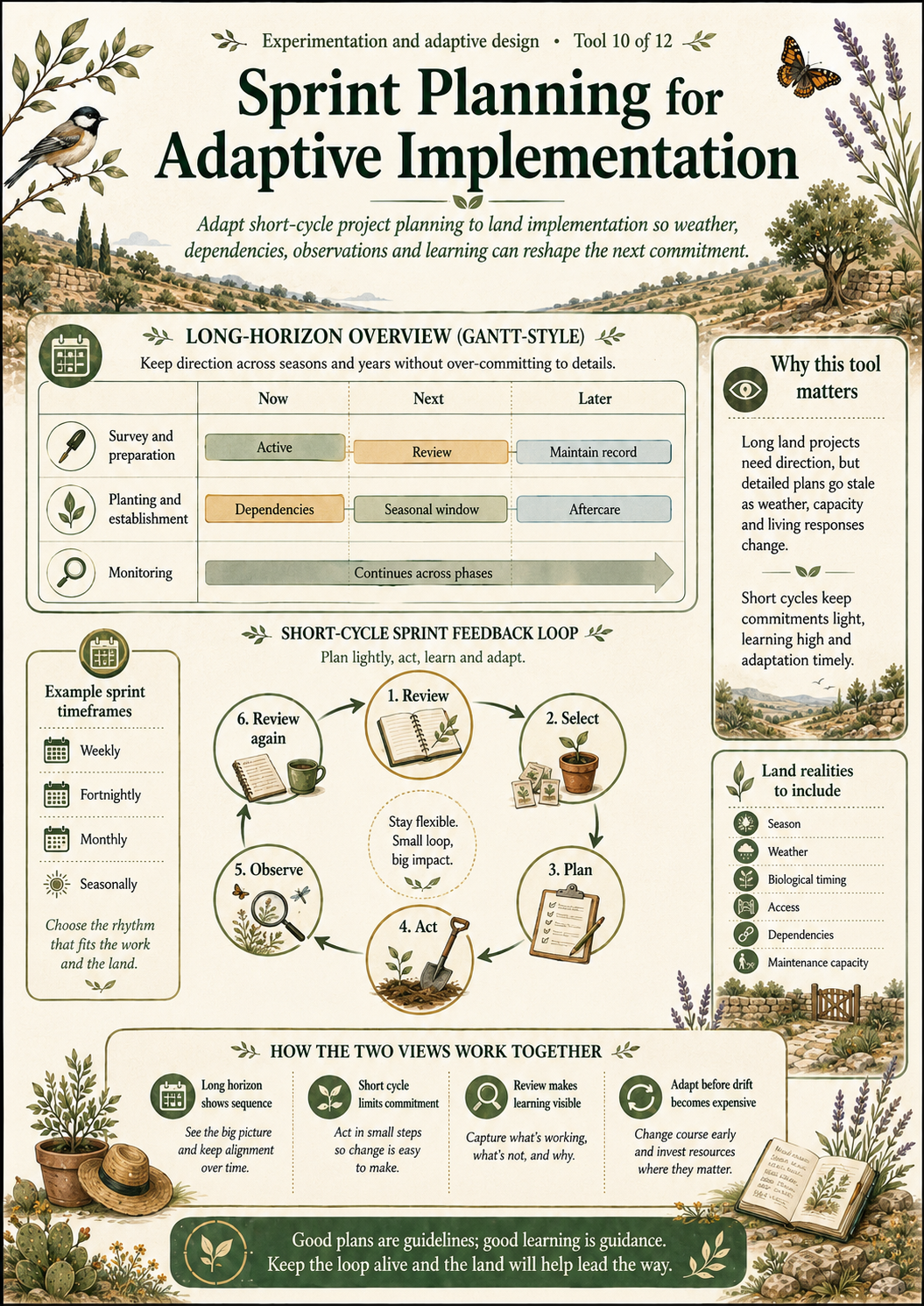
The detailed article and accessible semantic visual below provide the complete HTML text equivalent of the infographic, including its method, cautions and interpretation.
Why this tool matters
Long land projects need direction, but detailed plans become stale as weather, capacity and living responses change. A short cycle can preserve a longer purpose while limiting commitment to work that can be reviewed soon.
What the tool is
A sprint is a fixed short period with a clear objective, selected work and review. This page adapts contemporary iterative project-management practice to regenerative implementation; it does not present sprint planning as a traditional or original permaculture technique.
Origins and disciplinary context
The language comes from Agile and Scrum in software and project work. The Academy adaptation retains transparency, inspection and adaptation while replacing software assumptions with land-based realities such as season, weather, biological timing, access and maintenance.
The tool at a glance
Two related planning views: a long-horizon Gantt-style overview for phases and dependencies, and a short sprint cycle from review through selection, planning, action and observation back to review.
Long horizon: Gantt-style overview
| Workstream | Now | Next | Later |
|---|---|---|---|
| Survey and preparation | Active | Review | Maintain record |
| Planting and establishment | Dependencies | Seasonal window | Aftercare |
| Monitoring | Continues across phases | ||
Short cycle: sprint feedback loop
- Review
- Select
- Plan
- Act
- Observe
- Review again
When to use it
Use when work can be divided into coherent short objectives and reviewed before the next commitment. Match sprint length to ecological and practical feedback; two weeks is a Diploma example, not a universal rule.
How to use it
- Review the longer purpose, current evidence and unfinished work.
- Select one short-cycle objective.
- Identify tasks, owners, materials, dependencies, weather limits and stop conditions.
- Act without expanding the scope invisibly.
- Observe completion, response and unexpected change.
- Review what finished, what blocked, what changed and what was learned.
- Carry forward, change or abandon work explicitly.
What to record
Record objective, sprint dates, tasks, owner, materials, predecessor, weather or seasonal dependency, safety condition, completion evidence, observation, blocker, learning, carry-forward and abandoned work.
Worked example
Two-week objective: establish a small woodland guild trial. Tasks: mark the area, inspect soil, prepare the planting zone, install plants, mulch, establish a photo point, take a baseline measurement and inspect after the first week. At review, ask what completed, what blocked, what changed, what was learned and what should stop.
Connection with Mark’s Diploma practice
Design 08 explicitly breaks implementation into bi-weekly sprints with tasks, leads, materials and weather-related dependencies. This is Mark’s adaptation of iterative planning to silviculture, not evidence that sprint planning originated in permaculture.
Diploma source locators
- Design 08, PDF page 23: bi-weekly sprints with tasks, leads, materials and weather-related dependencies.
- Design 08, PDF page 30: bi-weekly sprint plans with assigned leads, tasks and weather dependencies.
- Design 08, Appendix 03, PDF page 75: bi-weekly sprint planning with task and weather dependencies.
Interpreting the results
Review flow and learning, not just task count. Repeated carry-forward may indicate excessive scope, missing capacity, a dependency or a task that should be abandoned. Weather delay can be responsible adaptation rather than failure.
Limitations
- Short cycles can fragment long ecological processes.
- Activity measures can displace outcomes and care.
- Frequent planning has an administrative cost.
- Rigid sprint boundaries can conflict with weather and biological timing.
Common mistakes and misuse
- Importing software terminology without land-based adaptation.
- Treating unfinished work as automatic failure.
- Adding work mid-cycle without recording the trade-off.
- Using sprints instead of longer seasonal and dependency planning.
Relationship to other Library tools
Reflection and application questions
- What is the smallest coherent objective for the next cycle?
- Which weather or biological dependency can invalidate the plan?
- What work should be abandoned rather than carried forever?
References and further reading
- Beck et al., Manifesto for Agile Software Development, 2001.
- Ken Schwaber and Jeff Sutherland, The Scrum Guide, 2020, inspection, adaptation and Sprint Planning.