Monitoring and evaluation · Tool 8 of 12
Community Feedback Loops
Use feedback from people affected by a design to expose experience, difficulty and missing knowledge, then show how it informed accountable decisions.
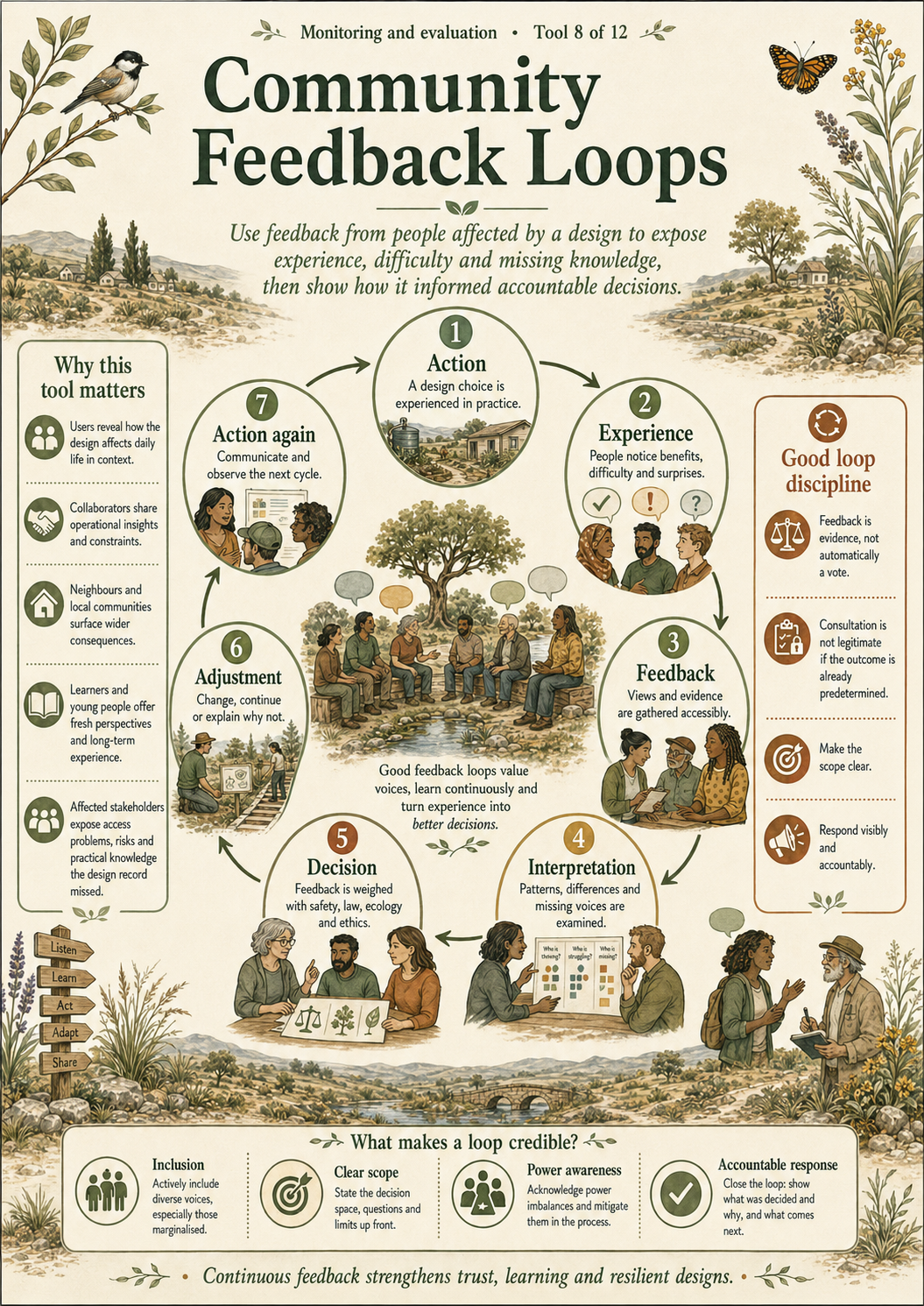
The detailed article and accessible semantic visual below provide the complete HTML text equivalent of the infographic, including its method, cautions and interpretation.
Why this tool matters
Designers do not experience a system from every position. Users, collaborators, neighbours, learners and affected stakeholders can reveal consequences, access problems and practical knowledge that the design record missed.
What the tool is
A community feedback loop is a repeated process in which experience is gathered, interpreted alongside other evidence, connected to a decision and followed by a visible adjustment or explanation. Feedback is evidence. It is not automatically a vote, and consultation is not legitimate when the outcome is already predetermined.
Origins and disciplinary context
Feedback loops are central to systems practice, evaluation, participatory design and public engagement. The quality of the loop depends on inclusion, clear scope, power awareness and an accountable response.
The tool at a glance
Circular community feedback loop from action through experience, feedback, interpretation, decision and adjustment, returning to action.
- ActionA design choice is experienced in practice.
- ExperiencePeople notice benefits, difficulty and surprises.
- FeedbackViews and evidence are gathered accessibly.
- InterpretationPatterns, differences and missing voices are examined.
- DecisionFeedback is weighed with safety, law, ecology and ethics.
- AdjustmentChange, continue or explain why not.
- Action againCommunicate and observe the next cycle.
When to use it
Use while options are still open, after a trial, during implementation reviews and when ongoing users or affected people hold knowledge the design team lacks. State what can and cannot be influenced.
How to use it
- Define the decision and whose experience matters.
- Identify affected, under-represented and non-participating interests.
- Provide enough information for informed feedback.
- Ask what works, what creates difficulty, what changed, who benefits, who bears cost and what knowledge is missing.
- Analyse agreements, differences and uncertainty without counting volume as representativeness.
- Make an accountable decision with other duties and evidence.
- Report what was heard, what changed and why.
What to record
Record purpose, participants and missing groups, method, questions, access arrangements, feedback themes, disagreements, safety or ethical concerns, evidence considered, decision, rationale, adjustment, responsible person and next review.
Worked example
After a woodland path trial, learners report easier access while a neighbour reports increased visibility and a land carer notes compaction after wet weather. The team does not take a majority vote. It inspects the path, considers access, privacy and soil evidence, then narrows use during wet conditions and records the next review.
Connection with Mark’s Diploma practice
Design 08 embeds community feedback loops in decision-making and describes management decisions as flowing from data, intuition and community reflection. The source supports an adaptive input, not a claim of automatic consensus.
Diploma source locators
- Design 08, PDF page 4: community reflection and feedback loops within adaptive management.
- Design 08, Appendix 03, PDF page 75: community feedback loops embedded in decision-making.
Interpreting the results
Distinguish frequency, intensity, affected interest and evidential support. One well-founded safety concern may matter more than many preferences. Equally, expertise should not be used to dismiss lived experience without explanation.
Limitations
- Participation can reproduce power and access inequalities.
- Feedback may conflict or be strategically framed.
- Consultation fatigue reduces quality.
- Non-human and future interests require explicit representation.
Common mistakes and misuse
- Consulting after the decision is fixed.
- Treating the loudest or largest group as representative.
- Promising consensus where duties constrain the decision.
- Collecting feedback without reporting its influence.
Relationship to other Library tools
Reflection and application questions
- Can participants still influence the decision?
- Whose costs or knowledge are missing?
- How will people see what their feedback changed?
References and further reading
- UK Cabinet Office, Consultation Principles, 2018.
- Local Government Association, “Good practice guidance on principles of effective decision-making”, consultation and engagement section.