Land and Living Systems · 4 of 7
Composting Systems for Homesteads
Compare cold compost, hot compost, wormeries, leaf mould, manure systems and direct soil-building methods by inputs, labour, water, risks and intended use.
The short answer
The best homestead composting system is the one that safely matches your materials, climate, space, labour and intended use. A slow leaf pile, managed hot heap and wormery solve different problems. Choose the process before mixing the inputs.
Carbon-to-nitrogen ratios are useful guidance, not domestic alchemy. Texture, moisture, oxygen, particle size, volume, temperature and turning matter just as much as a theoretical number.
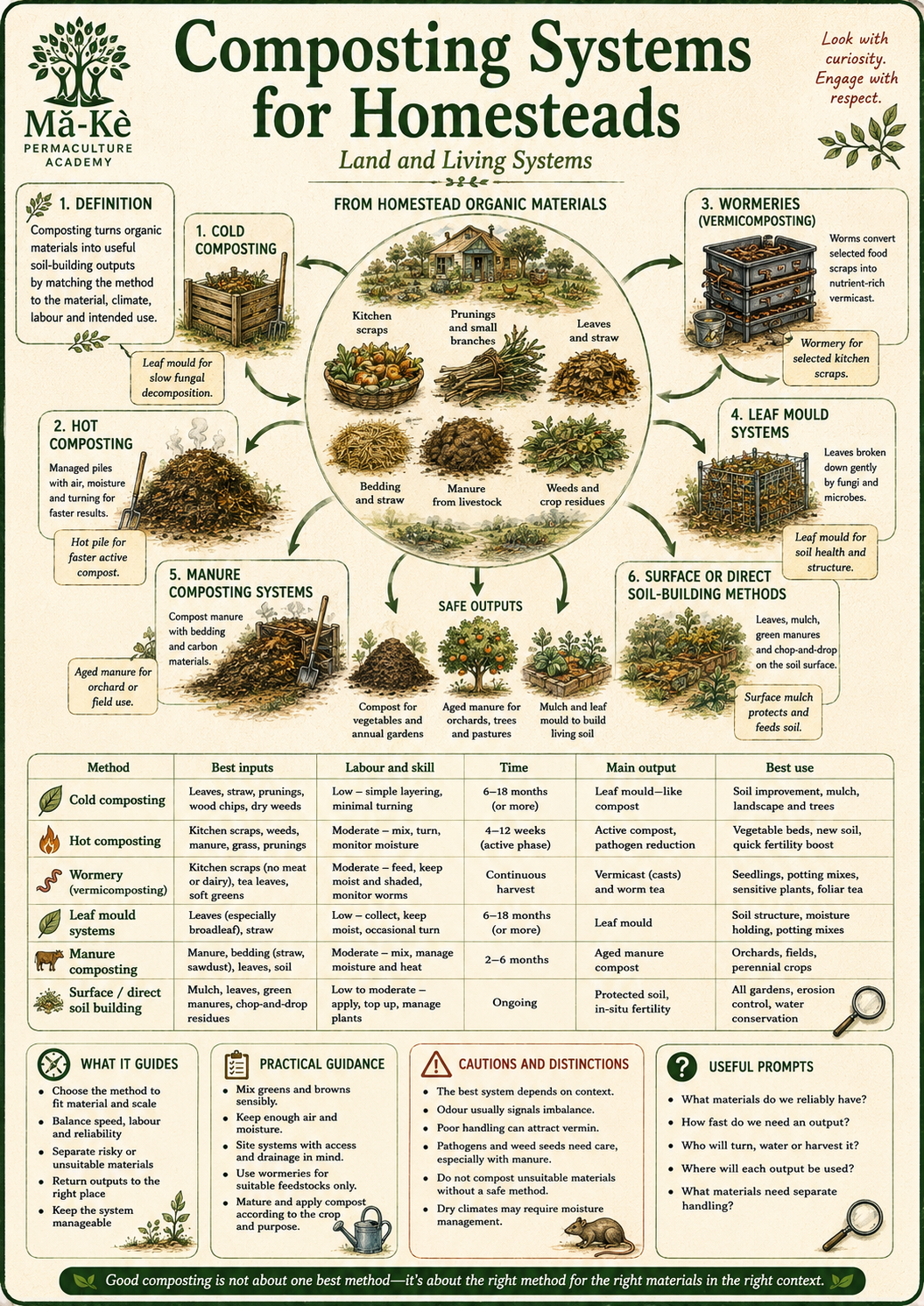
The teaching sections that follow provide the substantive HTML text equivalent of this infographic.
Compare the main systems
| System | Best inputs and conditions | Labour and time | Output and main cautions |
|---|---|---|---|
| Cold compost | Mixed garden residues and covered food scraps; modest space and water | Low routine labour; often many months to a year | General soil conditioner; may not destroy weed seeds or pathogens |
| Hot compost | A sufficiently large, balanced batch of moist greens and browns | Higher skill, monitoring and turning; weeks plus curing | Quicker, more uniform compost when managed well; overheating, drying and incomplete treatment remain possible |
| Wormery | Small regular amounts of suitable kitchen waste in a shaded, temperature-stable bin | Frequent light care; several months | Fine vermicast and liquid requiring careful use; vulnerable to heat, flooding, acidity and overfeeding |
| Leaf mould | Mostly autumn leaves held moist with air | Very low labour; commonly one to two years | Excellent moisture-retentive conditioner; low nutrient concentration and slow processing |
| Managed manure compost | Known livestock manure, bedding and carbon material | High hygiene and process control; time depends on treatment | Fertility and organic matter; pathogen, medicine residue, weed-seed and nutrient-loss risks |
| Surface or direct methods | Clean residues, cut plants or mulch placed where soil is protected | Low processing but careful placement | Slow in-place cycling; may attract pests, spread weeds or increase fire fuel |
Match inputs to the process
“Greens” tend to be moist and nitrogen-rich: fresh plant material, vegetable scraps and some manures. “Browns” tend to be drier and carbon-rich: leaves, straw, shredded card and woody prunings. Mix structure as well as chemistry so air can move through the heap. Add water only to reach an evenly damp condition; a saturated heap loses air and can smell.
Keep meat, fish, dairy, fats, pet waste, diseased plants, persistent herbicide residues, treated timber and invasive weeds out of an ordinary backyard system unless a competent, permitted process explicitly handles them. Local waste rules and animal-disease controls govern what may be accepted.
Cold and hot composting
Cold composting suits households that accumulate material gradually and accept slower, less predictable decomposition. Cover fresh scraps, maintain air and separate finished material from new additions. Do not assume a cold pile has treated pathogens or weed seeds.
Hot composting requires enough compatible material to build a batch, consistent moisture and temperature monitoring across the pile. Turning can expose cooler material to the active centre. Temperature alone is not proof of treatment unless time, coverage and process are recorded. Allow a finished heap to cure before use.
Wormeries and leaf mould
Wormeries concentrate a controlled food-waste stream in little space. Protect them from direct summer sun, waterlogging, drying and sudden large feeds. Add bedding and stop feeding when conditions turn sour. Drainage liquid is not automatically a safe fertiliser; dilute or use it only according to a sound system-specific method.
Leaf mould needs little nitrogen and should not be forced into hot-compost expectations. Gather leaves into a ventilated enclosure, keep them moist and let fungi dominate. The result is usually more useful for structure and moisture retention than as a rich fertiliser.
Animal manure needs a higher safety bar
Animal manure can return nutrients and organic matter, but raw material may contain human pathogens, viable weed seeds, veterinary residues and excess nutrients. Keep collection areas away from clean water, prevent runoff and use protective hygiene. Compost intended for food-growing requires a controlled treatment and application plan appropriate to local food-safety guidance.
Design 09 proposes manure cycling through grazing, bedding and compost. It is a systems intention, not evidence that every manure stream at Vila Pinheiro has been treated or tested. Animal welfare, stocking pressure, pasture recovery and veterinary care remain prior responsibilities.
Diagnose smells and pests
- Rotten or sour odour: often too wet, compacted or overfed; add structure and air.
- Ammonia smell: often too much nitrogen or poor capture; add carbon and prevent loss.
- Rodents or flies: exclude unsuitable foods, bury scraps and secure the container.
- No decomposition: check moisture, particle size, temperature and the balance of fresh and dry material.
- Persistent heat after turning: the material is not ready to cure or use.
Where this material comes from
Design 06 records composting, vermiculture, mulching and woody-bed proposals within the food system. Design 09 connects animal movement and manure with soil fertility. This comparison adds household safety and management distinctions from institutional compost guidance and does not treat those Diploma proposals as validated processing standards.
Related Library resources
Sources and evidence notes
- Mark D’Cruz, Design 06 - Food Self-sufficiency, controlled Diploma source.
- Mark D’Cruz, Design 09 - Regenerative Animal Ecosystem Design, controlled Diploma source.
- United States Environmental Protection Agency, “Composting at Home”, household inputs, management and pest precautions.
Diploma source locators
- Design 06, PDF pages 21-22, 30, 34-39 and 43: organic inputs, composting, vermiculture, mulching and woody materials.
- Design 06, PDF pages 50-55: evaluation and maintenance context.
- Design 09, PDF pages 9-18 and 27-36: proposed grazing, manure cycling, welfare, soil and monitoring relationships.
Planning proposals, completed activity and measured outcomes are identified separately throughout this article.