Land and Living Systems · 5 of 7
Permaculture for Smallholders
Use permaculture to connect household aims, land capability, water, food, trees, animals, infrastructure, labour, finance and risk on a smallholding.
The short answer
Permaculture helps a smallholder design relationships and priorities; it does not require every possible feature. Co-originated by Bill Mollison and David Holmgren, permaculture brings ethics, observation and systems thinking to how people meet needs within ecological limits.
On a smallholding, the work begins with household quality of life and land capability. A productive plan that exceeds available money, skill, time or physical capacity is not resilient.
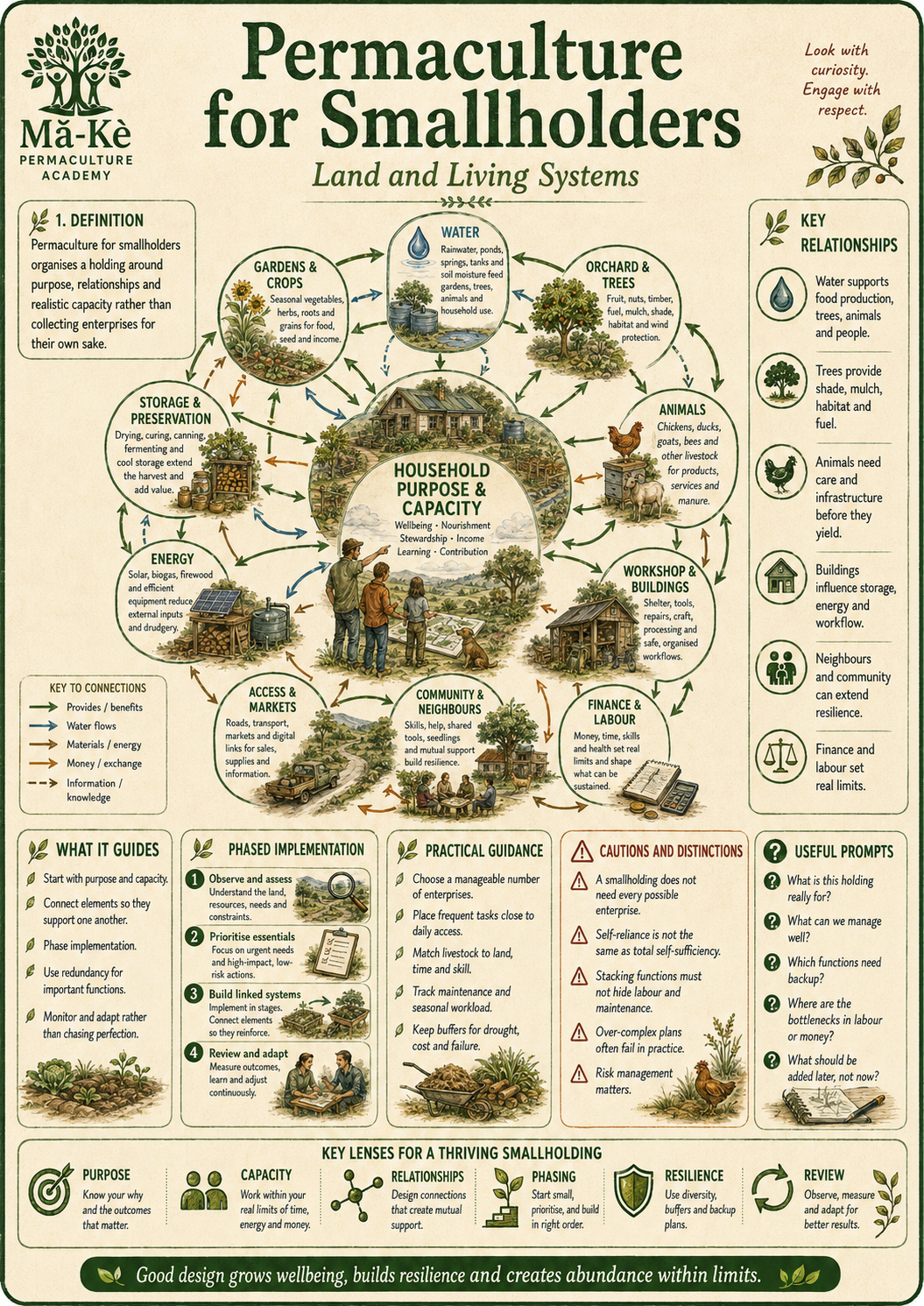
The teaching sections that follow provide the substantive HTML text equivalent of this infographic.
Start with people, purpose and limits
Describe who lives and works on the holding, what they need from it and what they do not want it to become. Include rest, privacy, income, care responsibilities, accessibility and seasonal absences. Record decision criteria such as safety, affordability, ecological repair, food supply, learning and manageable maintenance.
Be candid about constraints. A household may prefer a smaller reliable garden and well-managed trees to a complex farm enterprise. Specialist knowledge, neighbour agreements or paid labour may be essential parts of the design rather than signs of failure.
Read land capability
Survey soils, slope, water, vegetation, wildlife, access, buildings, utilities, tenure and regulation. Map sun, wind, fire, frost, flood, noise and views. Separate observed conditions from assumptions, and distinguish a one-season snapshot from a durable pattern.
Zones organise attention and travel frequency; sectors describe energies or influences crossing the site. Neither tool decides land use automatically. A frequently visited animal system may still be unsuitable near a dwelling because of welfare, hygiene, odour or water risks.
Connect the physical systems
Water
Budget demand, harvest seasonal flows, protect quality and design overflow.
Food
Choose production types that fit diet, climate, skills, access and processing capacity.
Trees and woodland
Plan mature size, succession, fire, shade, habitat, timber and harvest.
Animals
Meet welfare, feed, water, shelter, veterinary and pasture-recovery needs before claiming system benefits.
Buildings and energy
Repair efficiency and safety first; compare generation, storage, embodied cost and maintenance.
Access and infrastructure
Protect emergency routes, daily movement, deliveries, drainage and safe work areas.
Design labour and seasonal workload
Map weekly and annual work: irrigation checks, animal care, harvest peaks, pruning, processing, maintenance, fire preparation and administration. Identify tasks that cannot be postponed and who can perform them. Design for illness, holidays, ageing and extreme weather rather than an ideal week.
Reduce handling and travel by placing frequent tasks together, providing suitable storage and simplifying systems. Automation can help, but sensors, pumps and controllers introduce power, connectivity and repair dependencies.
Include finance and enterprise honestly
Estimate capital costs, operating costs, replacement cycles and the value of household labour. Separate household savings from business revenue. Test markets, licences, insurance, processing requirements and reliable demand before building an enterprise around surplus.
Multiple yields can improve resilience, but too many enterprises divide attention. Preserve a cash reserve for water, access, animal welfare and building safety. Stage investments so later phases depend on evidence from earlier ones.
Work with neighbours and community
Water, smoke, noise, animals, access, pests and fire do not stop at a boundary. Discuss shared risks and responsibilities early. Community relationships may provide knowledge, tools and mutual aid, but should not be treated as guaranteed free labour. Record agreements and keep routes for concerns open.
Phase, monitor and adapt
- Stabilise safety, water, access and essential maintenance.
- Run small trials close to everyday observation.
- Measure labour, cost, failures and useful yields.
- Expand only what the household can maintain.
- Review goals and retire systems that no longer serve them.
Designs 03 to 10 show an evolving whole-site ambition at Vila Pinheiro. Some elements were underway; others remained proposed. The sequence is useful precisely because it records learning and revision rather than a finished model to copy.
Where this material comes from
This whole-system introduction draws selectively on Mark’s Designs 03 to 10: homestead, energy, water, food, Ayurvedic food forest, silviculture, animal systems and action learning. It retains the Diploma’s connected vision while removing unsupported universality and keeping proposed, implemented and measured states distinct.
Related Library resources
Sources and evidence notes
- Mark D’Cruz, Design 03 - Vila Pinheiro: A Sustainable Homestead, whole-site survey, analysis, zoning, implementation planning and review.
- Mark D’Cruz, Designs 04-10, controlled Diploma sources covering energy, water, food, trees, animals and action learning.
- Mark D’Cruz, Diploma Journey, public overview of the ten-design learning pathway.
- Food and Agriculture Organization of the United Nations, “Overview: Agroforestry”, context-led integration of woody plants, crops and animals.
Diploma source locators
- Design 03, PDF pages 9-32: vision, goals, survey, sectors, zones, priorities, finance, maintenance and evaluation.
- Designs 04-09: system-specific design summaries, implementation plans and evaluation sections.
- Design 10, PDF pages 4-12 and 41-50: action learning, personal capacity, momentum and planned next action.
Planning proposals, completed activity and measured outcomes are identified separately throughout this article.