Land and Living Systems · 3 of 7
Soil Building in Dry Climates
Protect and observe dry-climate soil through cover, roots, reduced disturbance, infiltration and measured organic inputs while managing fire and salinity risks.
The short answer
In a dry climate, protect soil before trying to improve it. Bare, compacted or repeatedly disturbed soil loses water, organic matter and biological activity quickly under sun and wind. The first design task is to reduce avoidable damage, keep suitable cover and living roots, and help rainfall infiltrate without creating new erosion or fire hazards.
There is no universal amendment recipe. Soil texture, depth, pH, salinity, drainage, contamination, crop needs and available materials must guide the response.
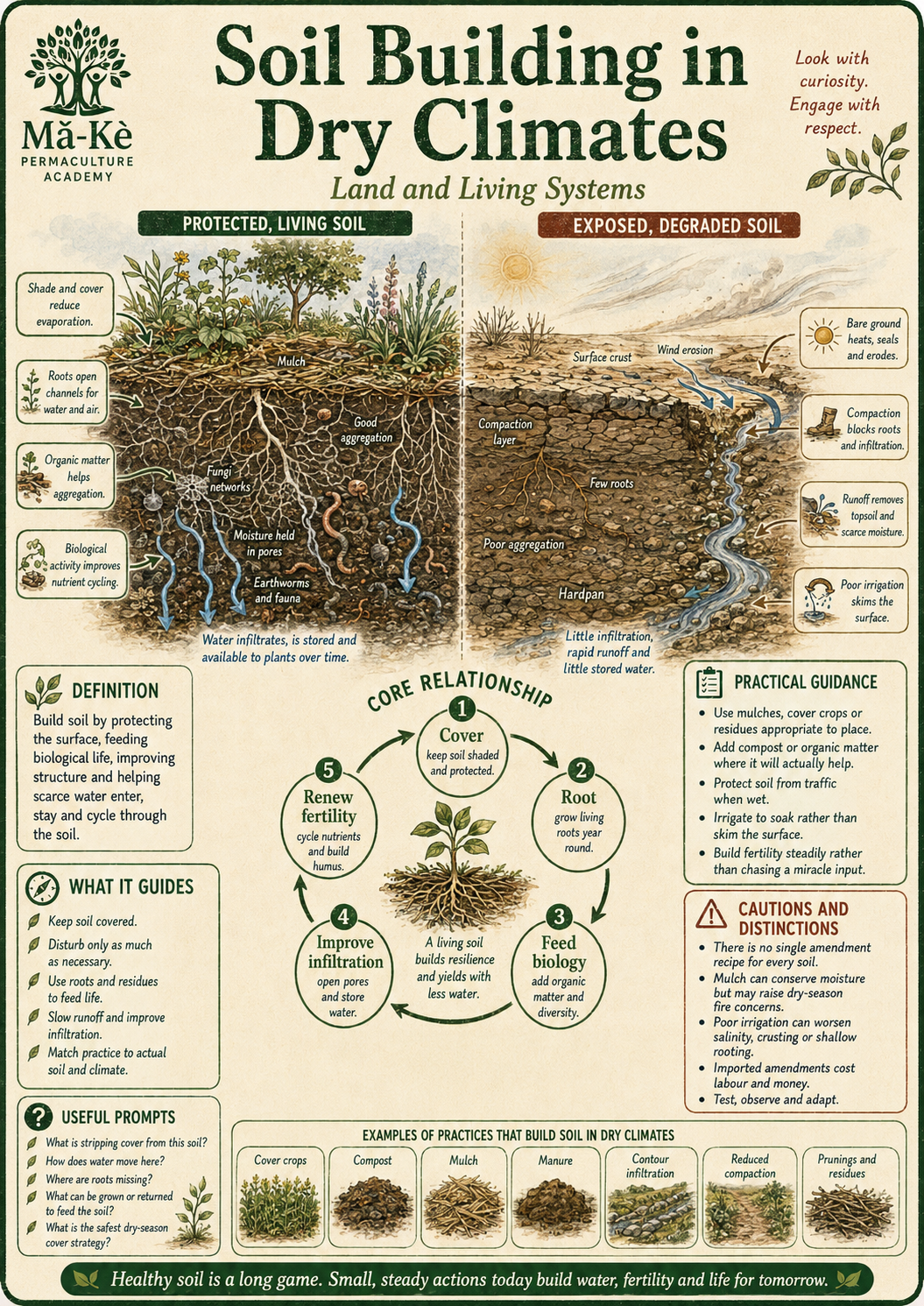
The teaching sections that follow provide the substantive HTML text equivalent of this infographic.
Begin with condition, not product
Observe where water ponds, runs off or disappears; where crusting, cracking, erosion, compaction or poor rooting occurs; and how these patterns change between wet winter and dry summer. Dig simple inspection pits where safe. Compare smell, aggregation, roots, earthworm or arthropod activity and infiltration at repeatable points. Laboratory tests are appropriate where nutrient, salinity, sodicity, contamination or pH decisions carry significant cost.
A baseline turns “better soil” into testable indicators: ground cover, infiltration time, aggregate stability, rooting depth, organic matter where measured, crop response and erosion after storms.
Keep suitable cover and living roots
Living roots feed soil organisms and create channels, while vegetation and residues reduce raindrop impact and summer heating. Choose cover that can survive the water regime and can be managed before it competes with crops or becomes hazardous fuel. In orchards and perennial systems, seasonal ground covers may be more realistic than insisting on green cover through the driest months.
Mulch can conserve moisture and moderate temperature, but material, depth and placement matter. Keep combustible mulch away from buildings and critical access in wildfire-prone landscapes. Avoid deep wet layers against trunks, importing contaminated material or allowing plastic and persistent weed propagules into the site.
Build organic matter through manageable cycles
Compost, leaf litter, chipped prunings, crop residues, manures and cover crops can return carbon and nutrients. Use materials whose origin and risks are known. Apply modest amounts, observe response and account for the labour and water required to process and distribute them. Importing tonnes of material may move depletion, weeds, contaminants or transport impacts elsewhere.
Organic matter is not a one-off ingredient. It is maintained through photosynthesis, roots, residues, careful grazing or cutting, decomposition and restrained harvest. Woody materials often serve best as surface mulch or in managed compost rather than being buried indiscriminately.
Improve infiltration without moving the problem
Reduce compaction by defining paths, limiting machinery when soil is vulnerable and concentrating access. Slow runoff with vegetation, surface roughness or carefully designed contour measures, while retaining a safe overflow. Infiltration is beneficial only where the soil and slope can accept it without waterlogging, landslip, building damage or contaminated flow.
Disturbance may be justified to relieve a verified compaction layer or establish plants, but repeated cultivation breaks aggregates and exposes organic matter. Use the least disruptive method that addresses the diagnosed constraint.
Check irrigation water and salts
In dry climates, irrigation salts can accumulate because limited rainfall does not always leach them below the root zone. Water that appears clear may still carry salts or bicarbonates. Plant symptoms are not enough to diagnose the cause: test irrigation water and soil where salinity, sodicity or hard-water effects are plausible.
More irrigation can worsen drainage and salt problems. Match application to rooting depth, infiltration rate and weather; repair leaks; and avoid generic flushing advice where drainage or downstream water quality is uncertain.
Monitor a small set of indicators
- Percentage and type of ground cover at fixed points.
- Time for a standard volume of water to infiltrate.
- Presence and depth of living roots.
- Visible erosion, crusting and compaction after rain.
- Crop vigour and water use, recorded by zone.
- Soil and water test results where a material decision depends on them.
Compare the same place and season. A single wet-year photograph or one unusually productive bed does not establish regeneration.
Where this material comes from
Designs 03, 05, 06 and 08 describe Vila Pinheiro’s sandy-loam conditions, seasonal water, erosion and compaction risks, proposed soil-building practices and monitoring ambitions. Some numerical improvement targets in those designs were goals, not verified outcomes; this article does not repeat them as results.
Related Library resources
Sources and evidence notes
- Mark D’Cruz, Design 03 - Vila Pinheiro: A Sustainable Homestead, whole-site survey, analysis, zoning, implementation planning and review.
- Mark D’Cruz, Design 05 - Water Self-sufficiency, water-system design and supporting analysis.
- Mark D’Cruz, Design 06 - Food Self-sufficiency, controlled Diploma source.
- Mark D’Cruz, Design 08 - Regenerative Silviculture, controlled Diploma source.
- USDA Natural Resources Conservation Service, “Soil Health”, principles of cover, living roots, diversity and reduced disturbance.
Diploma source locators
- Design 03, PDF pages 14-18: water, erosion, access and land-resource observations.
- Design 05, PDF pages 13-24: runoff, infiltration and proposed water-soil relationships.
- Design 06, PDF pages 21-24, 30 and 34-39: existing land resources, soil management, composting, mulching and phased work.
- Design 08, PDF pages 15-20 and 31-39: soil constraints, woodland cover, fire and adaptive management.
Planning proposals, completed activity and measured outcomes are identified separately throughout this article.