Land and Living Systems · 2 of 7
Food Forest Design for Beginners
Design a beginner food forest around household goals, mature plant size, water, access, succession and realistic maintenance rather than a compulsory layer checklist.
The short answer
A food forest is a deliberately managed, tree-led growing system that combines perennial and sometimes annual plants in useful relationships. It borrows the idea of layered vegetation and succession from woodland, but it is not an unmanaged forest, a promise of effortless abundance or a requirement to fill every possible layer.
Begin with household needs and the site. If regular annual vegetables, straightforward mechanised access or predictable commercial volumes are the priority, an orchard, market garden or simpler mixed system may be more appropriate.
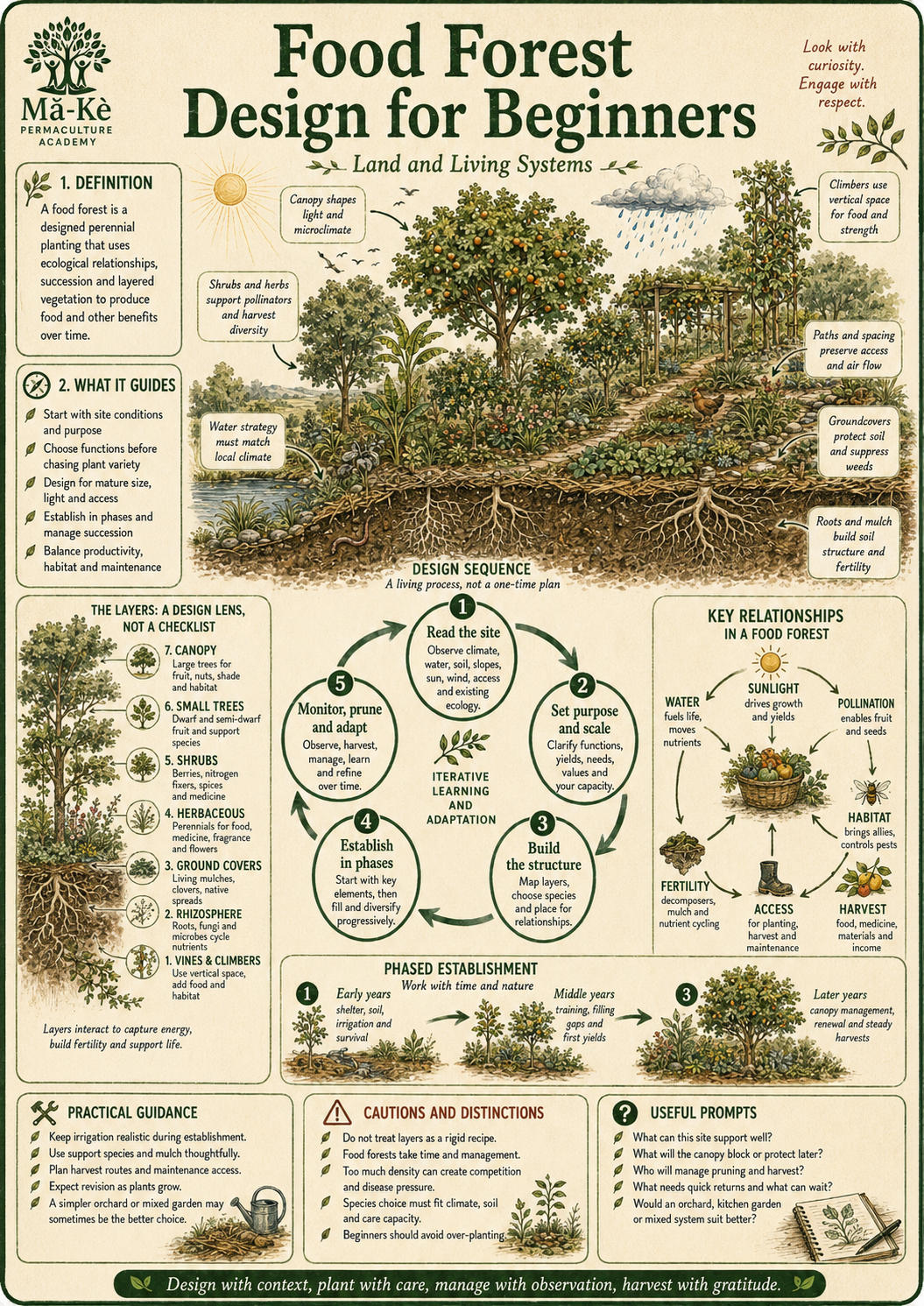
The teaching sections that follow provide the substantive HTML text equivalent of this infographic.
Decide what the system is for
Write a short purpose statement: household fruit, shade, habitat, teaching, herbs, wind protection, seasonal surplus or another bounded combination. Estimate who will harvest, prune, irrigate, process and use the yields. A species list without a use and maintenance plan can create waste and inaccessible abundance.
Set realistic expectations. Perennial systems take years to establish, yields vary and some functions compete. Decide what success would look like after one, three and ten years, and what evidence would trigger redesign.
Read the place before selecting plants
Map sun through the year, cold pockets, wind, wildfire exposure, water sources, drainage, soil depth, compaction, existing vegetation, wildlife pressure and movement. Mark paths, gates, harvest routes, irrigation lines and places where ladders or machinery must operate safely. The mature dimensions of trees matter more than their nursery size.
At Vila Pinheiro, Designs 03, 06, 07 and 08 connect a proposed food forest with water, orchard, woodland, fire and access decisions. They do not provide a transferable planting recipe. The useful lesson is the relationship map.
Use layers as a lens
Canopy, smaller trees, shrubs, herbs, ground covers, climbers, roots and fungi can help a designer notice vertical and below-ground opportunities. They are analytical prompts, not boxes that must all be filled. Too many layers can reduce light, obstruct access, intensify root competition and increase dry-season fuel.
Draw mature crowns and root zones. Place climbers only where their host and maintenance can carry them. Keep vigorous ground covers away from young plants they could overwhelm. Retain open sunny spaces for seasonal crops when these meet household needs better than another perennial layer.
Establish succession in phases
- Protect soil and secure access, water and fire-safety routes.
- Test a small number of locally suitable trees and support plants.
- Use temporary annuals, nurse plants or short-lived shrubs where they serve a defined establishment function.
- Thin, prune or replace as crowns close and evidence accumulates.
- Add complexity only when the earlier phase can be maintained.
Succession means planned change. A pioneer that helps in year one may shade a crop or become a fire risk later. Record removal and replacement decisions at planting time.
Design functions, pollination and fertility
Choose plants for compatible functions: food, habitat, shade, wind moderation, organic matter, pollinator resources or nutrient capture. “Nitrogen fixer” does not mean nitrogen automatically transfers to neighbours in useful quantities. Pollination depends on compatible cultivars, flowering overlap, pollinator activity and weather. Check each crop rather than relying on the general language of diversity.
Fertility also comes from protected soil, careful harvest of biomass, compost, animal integration where appropriate and the return of safe organic materials. Avoid importing more fertility or mulch than can be sourced, stored and used responsibly.
Make harvesting and maintenance ordinary
Paths should reach every plant without compressing its root zone. Group frequent harvests near daily routes. Provide working space for pruning, mulching and carrying produce. Plan irrigation isolation points and label plants whose fruits, leaves or roots may be unsafe or easily confused.
Common beginner mistakes include planting too densely, choosing novelty before suitability, neglecting mature size, mixing incompatible water needs, hiding maintenance behind “self-sustaining” language and expanding before the household can use the harvest.
Where this material comes from
This guide synthesises established agroforestry relationships with Mark’s Diploma designs for food self-sufficiency, an Ayurvedic food forest and regenerative silviculture. The Diploma records contain both practical observations and ambitious proposed outcomes. This page uses the former to frame questions and labels the latter as design intentions rather than proof.
Related Library resources
Sources and evidence notes
- Mark D’Cruz, Design 06 - Food Self-sufficiency, controlled Diploma source.
- Mark D’Cruz, Design 07 - Ayurvedic Food Forest, controlled Diploma source.
- Mark D’Cruz, Design 03 - Vila Pinheiro: A Sustainable Homestead, whole-site survey, analysis, zoning, implementation planning and review.
- Mark D’Cruz, Design 08 - Regenerative Silviculture, controlled Diploma source.
- Food and Agriculture Organization of the United Nations, “Overview: Agroforestry”, context-led integration of woody plants, crops and animals.
Diploma source locators
- Design 06, PDF pages 25-31 and 39-47: stakeholder needs, food-system design, zoning and phased establishment.
- Design 07, PDF pages 12-19 and 25-34: site inventory, evolving food-forest concept, functions and proposed planting.
- Design 08, PDF pages 11-20 and 31-39: woodland condition, succession, fire relationships and adaptive management.
- Design 03, PDF pages 14-24: whole-site sectors, zones, access and implementation priorities.
Planning proposals, completed activity and measured outcomes are identified separately throughout this article.