Mollison and Slay ecological principle · 8 of 10
Accelerating Succession
Guide ecosystem development by supporting suitable stages while retaining feedback, diversity and future options.
Definition and orientation
Accelerating Succession works with the way communities and conditions change over time. Designers may protect existing regeneration, introduce pioneer or support species, build soil and shelter, and establish later productive layers sooner. Acceleration is not a race towards a fixed climax: trajectories differ, disturbance continues and intervention can misread local ecology.
Practical meaning: Read present vegetation, soil, seed sources, disturbance and likely future conditions. Identify which processes already move towards the purpose, then remove constraints or add nurse functions proportionately. Stage planting, retain monitoring and allow natural recruitment or changed evidence to alter the planned sequence.
Questions it can guide:
- What stage and trajectory are evident now?
- Which constraint slows a desirable transition?
- What intervention supports the next stage without closing alternatives?
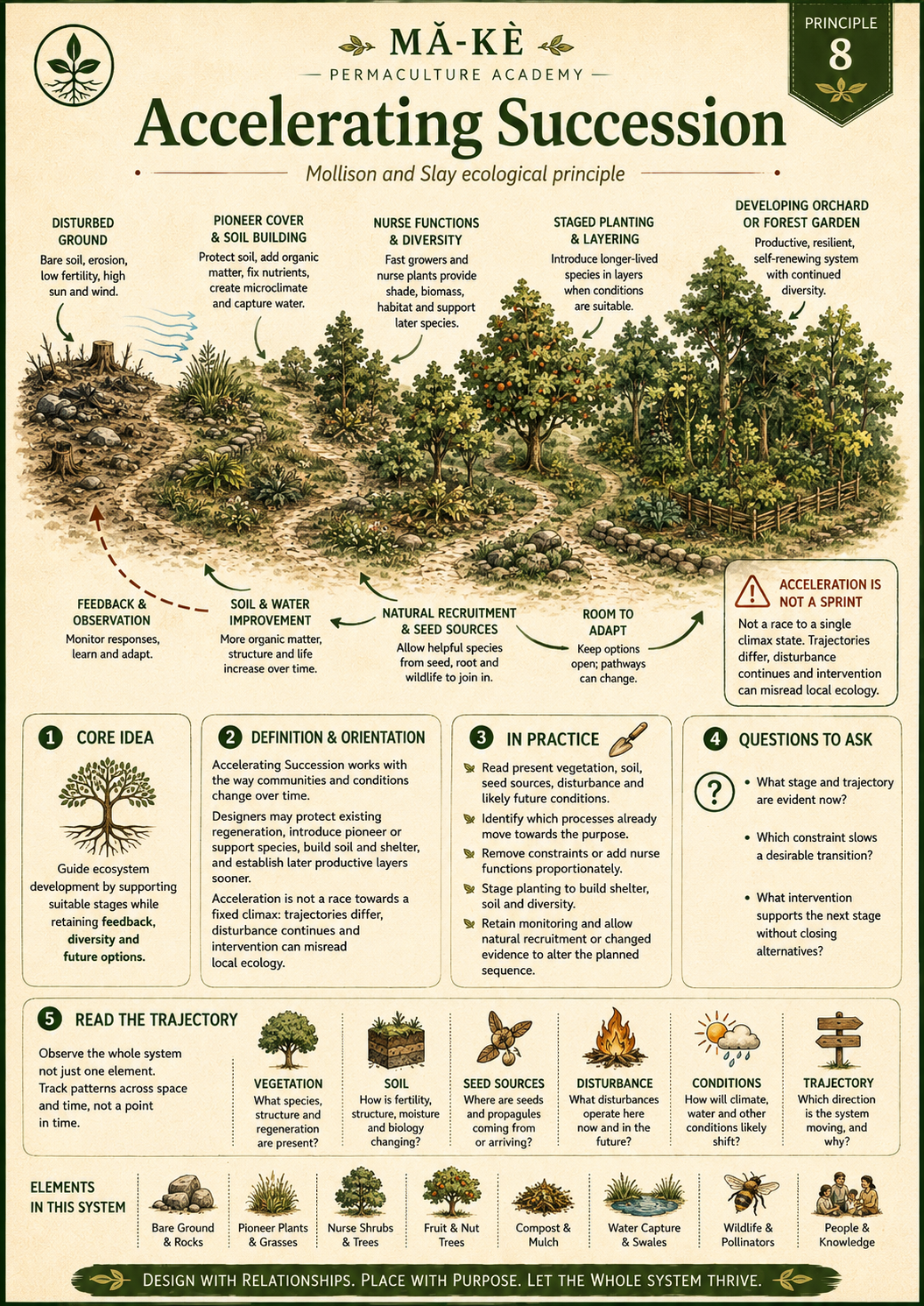
The detailed article and accessible semantic visual below provide the complete HTML text equivalent of the infographic, including its guidance, cautions, connections and evidence boundaries.
Accelerating Succession: a contextual design lens
- Present stageObserve vegetation, soil and disturbance.
- Desired directionState functions rather than an idealised endpoint.
- SupportAdd protection, pioneers or missing conditions.
- SuccessionMonitor recruitment, mortality and changed pathways.
Origins, lineage and attribution
This page belongs to the ecological principle tradition published by Bill Mollison and Reny Mia Slay. The displayed title follows the authorised Academy catalogue; the closing acknowledgement records the nearby source wording where it differs.
Similar themes appear in David Holmgren’s twelve principles, but overlap is handled through explicit cross-links. The formulations are not represented as one list, and authorship is not transferred between traditions. The Academy paraphrases the practical meaning rather than reproducing substantial passages from the source books.
Ethical and principle context
Holmgren’s Respond to Change addresses succession within a wider change principle; SADIMET supplies implementation and review stages; observation and biodiversity monitoring test whether the intended pathway is emerging.
Use Earth Care, People Care and Fair Share to test purpose, consequence and distribution. A provocative principle can widen judgement, but it cannot certify a preferred action. Pair it with evidence, a counter-question and a named review point.
When and how to use it
- Name the decision, scale, affected people and living systems.
- Translate the principle into context-specific questions rather than repeating it as a command.
- Add a counter-question about safety, consent, urgency, maintenance or unequal effects.
- Use a suitable framework or tool to gather evidence and compare alternatives.
- Choose a proportionate action, state uncertainty and distinguish proposal from completion.
- Record what observation or feedback would trigger adaptation or stopping.
Application in Mark’s Diploma and at Vila Pinheiro
Design 08 sets out a first planting round of pioneer and support species for canopy scaffolding and windbreaks, followed by Ayurvedic productive and understorey trees. This is a verified staged succession proposal. The source does not prove establishment, survival or that the proposed tropical and subtropical species were suitable through later winters.
Evidence boundary: the representative connection was checked in Mark D’Cruz, Design 08: Regenerative Silviculture, controlled Diploma PDF, PDF page 21. The master register records broader use across Designs 1–10, but declaration alone is not converted into a public case result.
Limits, critiques and common misuse
- Assuming every site moves towards one stable climax community.
- Removing existing vegetation before understanding its functions.
- Using fast growth as the only measure of progress.
- Locking a long-lived planting plan despite mortality, climate or invasive behaviour.
No principle replaces consent, law, competent technical advice, ecological assessment or accountable maintenance. Where principles pull in different directions, make the tension visible rather than selecting only the phrase that supports an existing preference.
Where this material comes from
This ecological design principle comes from Bill Mollison and Reny Mia Slay’s Introduction to Permaculture (1991), where the source wording is “Accelerating succession and evolution”. It belongs to an early practical teaching set focused on placement, function, energy, living resources, scale, succession, diversity and edge. This page uses the authorised catalogue title “Accelerating Succession”; although teaching summaries use minor wording variants, these do not make the principle part of David Holmgren’s later twelve-principle formulation. Mark D’Cruz used or recorded this principle in his Diploma register; he is not its originator, and the master register records it as LIB-047. Its lineage and wording have been checked against the named publication tradition and Permaculture Association teaching records. The representative Diploma connection is limited to PDF page 21, with proposals kept distinct from measured outcomes.
Related entries
References and provenance
- Bill Mollison and Reny Mia Slay, Introduction to Permaculture, Tagari, 1991.
- Permaculture Association, “Principles from Introduction to Permaculture by Bill Mollison and Reny Mia Slay”.
- Mark D’Cruz, Design 08: Regenerative Silviculture, controlled Diploma PDF, PDF page 21.
- Mă-Kè Diploma Library Master Register, Page Register LIB-047; source-matrix declarations retained separately from verified page evidence.
- Mă-Kè Permaculture Academy, “Comparing Permaculture Principle Traditions”.